Recombinant Human Tumor necrosis factor receptor superfamily member 18 (TNFRSF18), partial (Active)

In Stock
Code: CSB-MP896537HU
Size:
20ug
20ug100ug1mg
US$116
Quantity:
Express system: Mammalian cell
Species: Homo sapiens (Human)
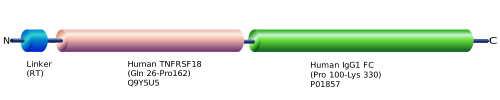
Tag Info: C-terminal hFc1-tagged
For inquiries on large quantities or another requirements
Send an Inquiry
Start an on-line Chat
Online ordering is currently available for U.S. customers only. For orders outside the U.S., please kindly submit an inquiry or start a chat with us.

Product Details

Abbreviation
Recombinant Human TNFRSF18 protein, partial (Active)
Purity
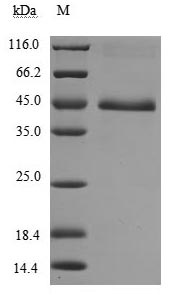
Greater than 90% as determined by SDS-PAGE.
Endotoxin
Less than 1.0 EU/ug as determined by LAL method.
Activity
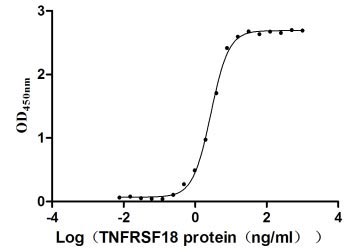
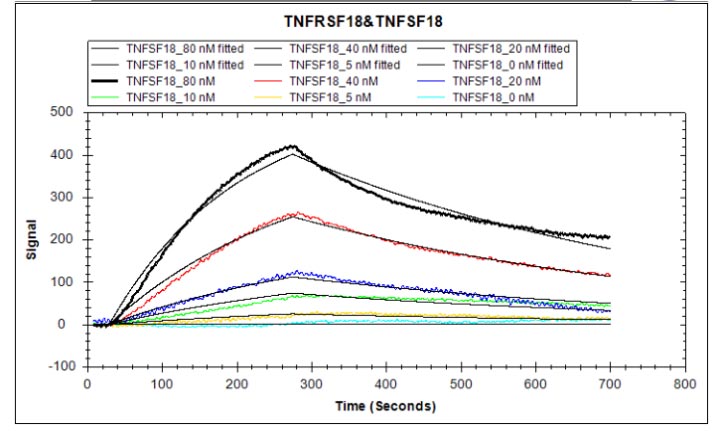
①Measured by its binding ability in a functional ELISA. Immobilized TNFRSF18 at 2 μg/ml can bind TNFSF18 (CSB-MP891791HU), the EC50 is 2.565 to 2.940 ng/ml.②Human TNFRSF18 protein hFc tag (CSB-MP896537HU) captured on COOH chip can bind Human TNFSF18 protein hFc and Flag tag (CSB-MP891791HU) with an affinity constant of 38.5 nM as detected by LSPR Assay.
Target Names
TNFRSF18
Uniprot NO.
Alternative Names
(CD357)(AITR)(GITR)
Molecular Characterization
Species
Homo sapiens (Human)
Source
Mammalian cell
Expression Region
26-162aa
Target Protein Sequence
QRPTGGPGCGPGRLLLGTGTDARCCRVHTTRCCRDYPGEECCSEWDCMCVQPEFHCGDPCCTTCRHHPCPPGQGVQSQGKFSFGFQCIDCASGTFSGGHEGHCKPWTDCTQFGFLTVFPGNKTHNAVCVPGSPPAEP
Note: The complete sequence may include tag sequence, target protein sequence, linker sequence and extra sequence that is translated with the protein sequence for the purpose(s) of secretion, stability, solubility, etc.
If the exact amino acid sequence of this recombinant protein is critical to your application, please explicitly request the full and complete sequence of this protein before ordering.
Mol. Weight
40.8 kDa
Protein Length
Partial
Tag Info
C-terminal hFc1-tagged
The tag type will be determined during production process. If you have specified tag type, please tell us and we will develop the specified tag preferentially.
Buffer
Lyophilized from a 0.2 μm filtered PBS, 6% Trehalose, pH 7.4
Storage
Store at -20°C/-80°C upon receipt, aliquoting is necessary for mutiple use. Avoid repeated freeze-thaw cycles.
Lead Time
3-7 business days
Note: All of our proteins are default shipped with normal blue ice packs, if you request to ship with dry ice, please communicate with us in advance and extra fees will be charged.
Notes
Repeated freezing and thawing is not recommended. Store working aliquots at 4°C for up to one week.
Shelf Life
The shelf life is related to many factors, storage state, storage temperature and the stability of the product itself. Generally, the shelf life of lyophilized form is 6 months at -20°C/-80°C from the date of receipt.
Troubleshooting and FAQs
Datasheet & COA
Please contact us to get it.
Images
  • (Tris-Glycine gel) Discontinuous SDS-PAGE (reduced) with 5% enrichment gel and 15% separation gel.
  • Activity
    Measured by its binding ability in a functional ELISA. Immobilized TNFRSF18 at 2 μg/ml can bind TNFSF18 (CSB-MP891791HU), the EC50 is 2.565 to 2.940 ng/ml.
  • Activity
    Human TNFRSF18 protein hFc tag (CSB-MP896537HU) captured on COOH chip can bind Human TNFSF18 protein hFc and Flag tag (CSB-MP891791HU) with an affinity constant of 38.5 nM as detected by LSPR Assay.
Description

TNFRSF18 (GITR) plays a critical role in T-cell co-stimulation and immune regulation, making precise characterization of its interaction with GITRL essential for immunotherapy research. This recombinant human TNFRSF18 encompasses the extracellular ligand-binding domain (aa 26–162) produced in mammalian cells to preserve native glycosylation and disulfide-mediated folding, with a C-terminal hFc1 tag facilitating oriented capture in binding assays. Validated activity demonstrates an EC50 of 2.565–2.940 ng/ml for TNFSF18 binding by functional ELISA and a KD of 38.5 nM by LSPR, providing a suitable basis for receptor-ligand interaction studies, competitive blocking antibody screening, therapeutic antibody epitope mapping, and affinity characterization by SPR or BLI. Purity exceeding 90% by SDS-PAGE combined with endotoxin levels below 1.0 EU/μg satisfies the criteria typical for use as a positive control in quantitative binding assays and small-molecule inhibitor screening campaigns.


Customer Reviews and Q&A

 Customer Reviews

Target Background

Function(From Uniprot)
Receptor for TNFSF18. Seems to be involved in interactions between activated T-lymphocytes and endothelial cells and in the regulation of T-cell receptor-mediated cell death. Mediated NF-kappa-B activation via the TRAF2/NIK pathway.
Gene References into Functions
  1. HTLV-1 infection can modify the expression of main functional transcription factors, FOXP3 and GITR PMID:28101786
  2. a novel molecular mechanism by which MBD4 inhibits GITR expression in a DNMT1-dependent manner PMID:28542810
  3. Aberrant expression of GITR may contribute to systemic lupus erithematosus pathogenesis. Glucocorticoid may achieve its therapeutic effect partly by inducing GITR expression on Tresps rather than Tregs, which initiates the apoptosis of Tresp cells in SLE patients. PMID:25293713
  4. GITR expression can enhance the sensitivity to Bortezomib by inhibiting Bortezomib-induced NF-kappaB activation. PMID:25973846
  5. GITR is a crucial player in differentiation of thymic regulatory T cells and expansion of regulatory T cells, including both thymic regulatory T cells and peripheral regulatory T cells. PMID:25961057
  6. Data may suggest a key role of regulatory GITR+CD25 low/-CD4+ T cells subset in the modulation of the abnormal immune response in lupus erythematosus (SLE) patients. PMID:25256257
  7. results suggest that the GITR rs3753348 polymorphism may be involved in the development and susceptibility of CWP. PMID:25445616
  8. these results show a higher susceptibility to apoptosis in patients' versus controls' T(reg) cells, suggesting that GITR is a T(reg)-cell marker that would be primarily involved in T(reg)-cell survival rather than in their suppressor function. PMID:23929911
  9. Our findings indicate the possible involvement of GITR-GITRL pathway in the pathogenesis of pSS. PMID:23935647
  10. GITR acts as a potential tumor suppressor in MM. PMID:23785514
  11. Data indicate that the mRNAs of CTLA-4 and GITR genes were expressed at lower levels in CVID patients compared to control group. PMID:23432692
  12. GITR is pathologically expressed on Treg cells in systemic lupus erythematosus. PMID:22516990
  13. Liver tumor Tregs up-regulate the expression of glucocorticoid-induced tumor necrosis factor receptor compared with Tregs in tumor-free liver tissue and blood. PMID:22911397
  14. Results suggest that GITR expression might indicate a molecular link between steroid use and complicated acute sigmoid diverticulitis. Increased MMP-9 expression by GITR signalling might explain morphological changes in the colonic wall in diverticulitis. PMID:22309286
  15. The regulatory SNPs identified in this study will provide useful information for understanding the relevance of sequence polymorphisms in populations of different background and may serve as a basis to study parasite susceptibility in association studies PMID:21445534
  16. GITRL may contribute to disease pathophysiology and resistance to direct and Rituximab-induced NK reactivity in CLL PMID:22064350
  17. GITR, which transmits a signal that abrogates regulatory T cell functions, was elevated in early rheumatoid arthritis. PMID:21670968
  18. DCs transfected with mRNA encoding a humanized anti-CTLA-4 mAb and mRNA encoding a soluble human GITR fusion protein enhance the induction of anti-tumor CTLs in response to DCs. PMID:22028176
  19. Findings suggest that GITR-expression of TILs is associated with cancer progression. PMID:21694467
  20. Although GITR transgene costimulation can therapeutically enhance T helper (Th) type 2 cell responses, GITR-GITR ligand interactions are not required for development of Th2-mediated resistance or pathology. PMID:21705620
  21. Data indicate that CD4(+) CD25(low) GITR(+) cells represent a low percentage of the CD4(+) T-cell population (0.32-1.74%) and are mostly memory cells. PMID:21557210
  22. study concludes, the rs3753348 C/G SNP in the GITR is associated with Hashimoto's disease prognosis and expression on T(reg) and T(eff) cells PMID:21592113
  23. GITR rapidly recruits TNF receptor-associated factor 2 (TRAF2) in a ligand-dependent manner; data indicate that the cytoplasmic domain of GITR contains a single TRAF binding site where acidic residues 202/203 and 211-213 are critical for this interaction. PMID:15944293
  24. Since regulatory T-cells are localized in the vicinity of GITRL-expressing cells in atopic dermatitis skin, the GITR/GITRL interaction may serve to perpetuate the inflammation locally. PMID:16955181
  25. This protein has been shown to stimulate T cell-mediated antitumor immunity in mice, and now in a human tumor cell line. PMID:17360848
  26. These data suggest that, despite abnormal GITR expression during HIV infection, GITR triggering enhances HIV-specific CD4(+) T cell cytokine expression and protects HIV-specific CD4(+) T cells from apoptosis. PMID:17538882
  27. although GITR is an activation marker for NK cells similar to that for T cells, GITR serves as a negative regulator for NK cell activation PMID:18230609
  28. CD4(+)CD25(+) effector memory T-cells expressing CD134 and GITR seem to play a role in disease mechanisms, as suggested by their close association with disease activity and their participation in the inflammatory process in Wegener's granulomatosis. PMID:18723571
  29. mechanism of IgG4 induction by regulatory cells involves GITR-GITR-L interactions, IL-10 and TGF-beta. PMID:18924213
  30. Data show that in humans GITRL expression subverts NK cell immunosurveillance of AML. PMID:19155305
  31. mRNA level for CTLA-4, ICOS1, IL-23, IL-27, SMAD3 and GITR were lower in T regulatory cells of children with diabetes compared to the control patients PMID:19547759

Show More

Hide All

Subcellular Location
[Isoform 1]: Cell membrane; Single-pass type I membrane protein.; [Isoform 2]: Secreted.
Tissue Specificity
Expressed in lymph node, peripheral blood leukocytes and weakly in spleen.
Database Links

HGNC: 11914

UNIGENE: Hs.212680

KEGG: hsa:8784

STRING: 9606.ENSP00000328207

OMIM: 603905

icon of phone
Call us
301-363-4651 (Available 9 a.m. to 5 p.m. CST from Monday to Friday)
icon of address
Address
No. 269, Shendun 5th Road, Donghu Hi-Tech Development Area, Hubei Province, 430206, P.R.China
icon of social media
Join us with

Subscribe newsletter

Leave a message

* To protect against spam, please pass the CAPTCHA test below.
CAPTCHA verification
© 2007-2025 CUSABIO TECHNOLOGY LLC All rights reserved. 鄂ICP备15011166号-1
Select 0 Products