Recombinant Human T-cell antigen CD7 (CD7), partial (Active)

In Stock
Code: CSB-MP004953HU
Size:
20ug
20ug100ug1mg
US$138
Quantity:
Express system: Mammalian cell
Species: Homo sapiens (Human)
Tag Info: C-terminal hFc1-Myc-tagged
For inquiries on large quantities or another requirements
Send an Inquiry
Start an on-line Chat
Online ordering is currently available for U.S. customers only. For orders outside the U.S., please kindly submit an inquiry or start a chat with us.

Product Details

Abbreviation
Recombinant Human CD7 protein, partial (Active)
Purity
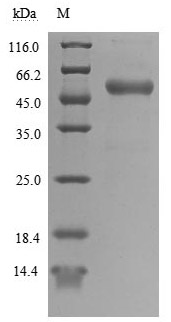
Greater than 90% as determined by SDS-PAGE.
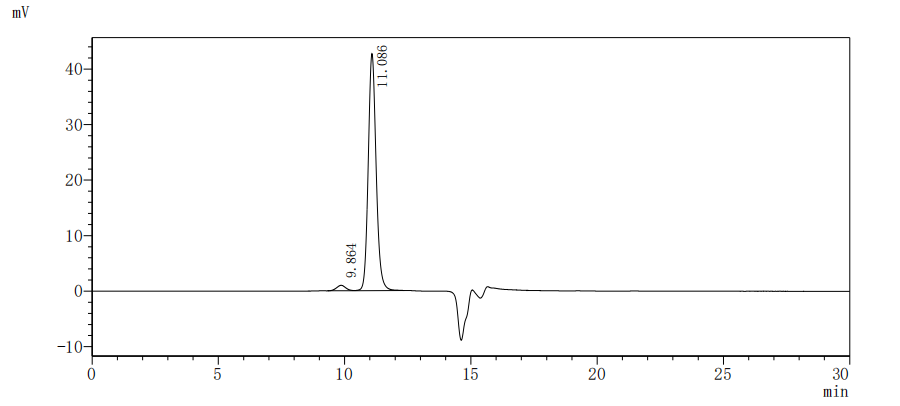
Greater than 95% as determined by SEC-HPLC.
Endotoxin

Less than 1.0 EU/ug as determined by LAL method.

Activity
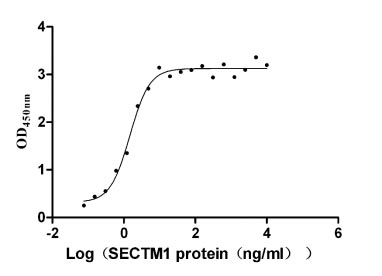
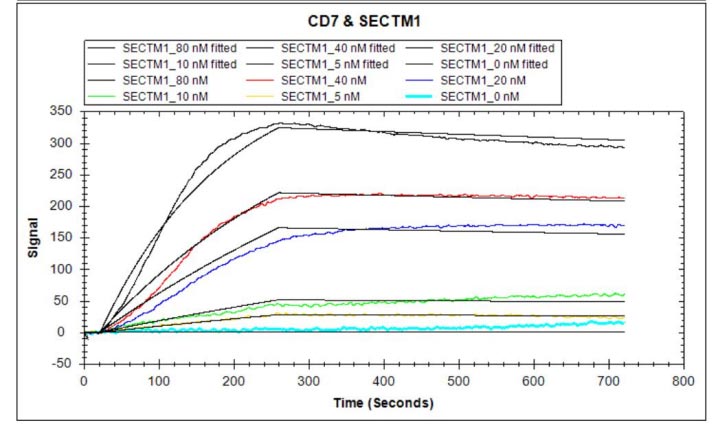
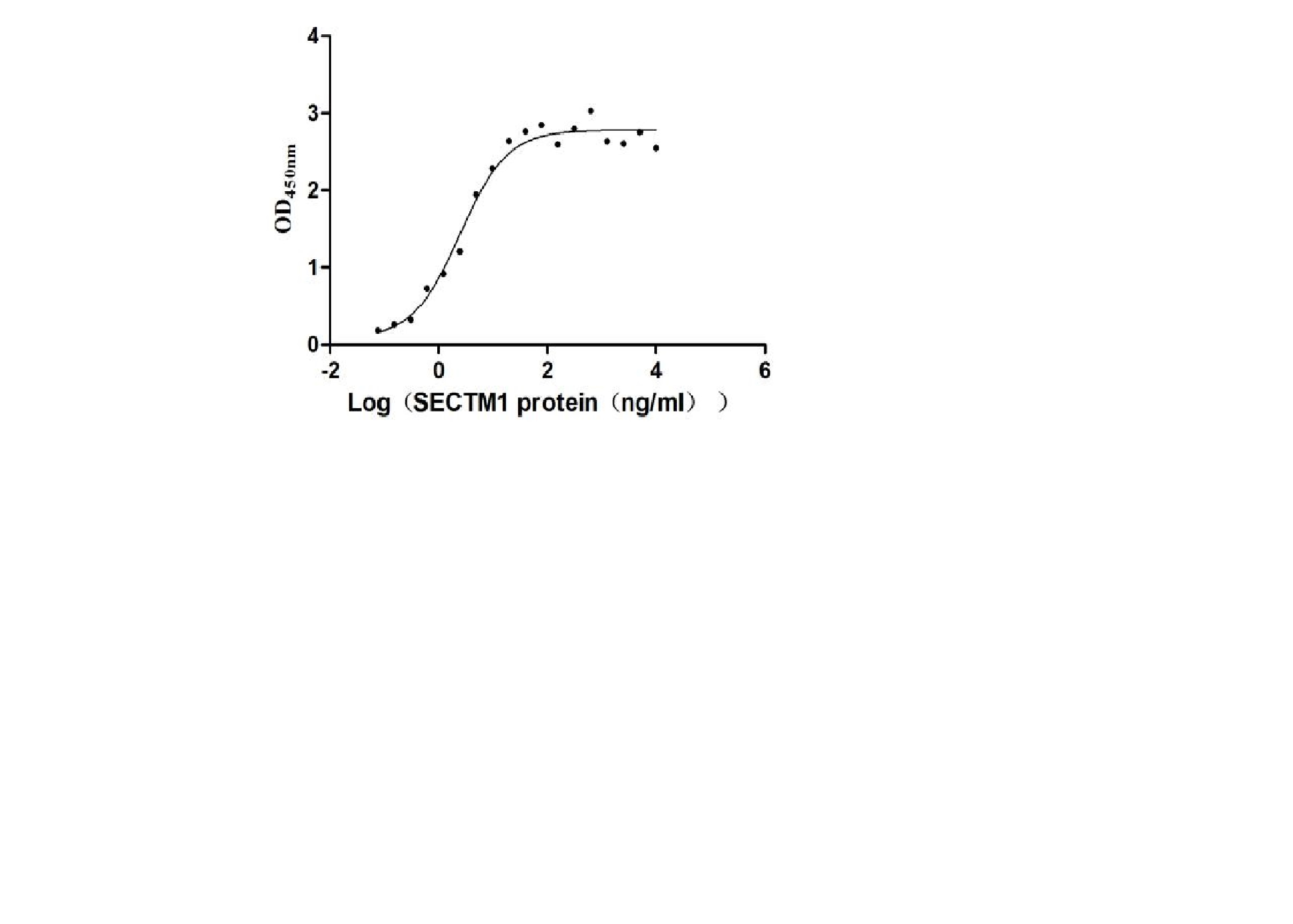
Measured by its binding ability in a functional ELISA. Immobilized CD7 at 5 μg/ml can bind SECTM1 (CSB-MP819898HU), the EC50 is 1.236-1.773 ng/ml.②Human CD7 protein hFc and Myc tag (CSB-MP004953HU) captured on COOH chip can bind Human SECTM1 protein hFc tag (CSB-MP819898HU) with an affinity constant of 1.84 nM as detected by LSPR Assay.
Target Names
CD7
Uniprot NO.
Alternative Names
(GP40)(T-cell leukemia antigen)(T-cell surface antigen Leu-9)(TP41)
Molecular Characterization
Species
Homo sapiens (Human)
Source
Mammalian cell
Expression Region
26-180aa
Target Protein Sequence
AQEVQQSPHCTTVPVGASVNITCSTSGGLRGIYLRQLGPQPQDIIYYEDGVVPTTDRRFRGRIDFSGSQDNLTITMHRLQLSDTGTYTCQAITEVNVYGSGTLVLVTEEQSQGWHRCSDAPPRASALPAPPTGSALPDPQTASALPDPPAASALP
Note: The complete sequence may include tag sequence, target protein sequence, linker sequence and extra sequence that is translated with the protein sequence for the purpose(s) of secretion, stability, solubility, etc.
If the exact amino acid sequence of this recombinant protein is critical to your application, please explicitly request the full and complete sequence of this protein before ordering.
Mol. Weight
46.5 kDa
Protein Length
Partial
Tag Info
C-terminal hFc1-Myc-tagged
The tag type will be determined during production process. If you have specified tag type, please tell us and we will develop the specified tag preferentially.
Buffer
Lyophilized from a 0.2 μm filtered PBS, 6% Trehalose, pH 7.4
Storage
Store at -20°C/-80°C upon receipt, aliquoting is necessary for mutiple use. Avoid repeated freeze-thaw cycles.
Lead Time
3-7 business days
Note: All of our proteins are default shipped with normal blue ice packs, if you request to ship with dry ice, please communicate with us in advance and extra fees will be charged.
Notes
Repeated freezing and thawing is not recommended. Store working aliquots at 4°C for up to one week.
Shelf Life
The shelf life is related to many factors, storage state, storage temperature and the stability of the product itself. Generally, the shelf life of lyophilized form is 6 months at -20°C/-80°C from the date of receipt.
Troubleshooting and FAQs
Datasheet & COA
Please contact us to get it.
Images
  • (Tris-Glycine gel) Discontinuous SDS-PAGE (reduced) with 5% enrichment gel and 15% separation gel.
  • Activity
    Measured by its binding ability in a functional ELISA. Immobilized CD7 at 5 μg/ml can bind SECTM1 (CSB-MP819898HU), the EC50 is 1.236-1.773 ng/ml.
  • Activity
    Human CD7 protein hFc and Myc tag (CSB-MP004953HU) captured on COOH chip can bind Human SECTM1 protein hFc tag (CSB-MP819898HU) with an affinity constant of 1.84 nM as detected by LSPR Assay.
  • The purity of CD7 was greater than 95% as determined by SEC-HPLC
Description

CD7 is a transmembrane glycoprotein expressed on T cells and NK cells that engages SECTM1 to modulate immune costimulatory signaling, making precise characterization of this interaction critical for immunotherapy research. This recombinant human CD7 construct covers the extracellular domain (aa 26–180) and is produced in mammalian cells with a C-terminal hFc1-Myc tag, preserving native glycosylation and conformational integrity essential for ligand recognition. LSPR analysis confirms high-affinity binding to SECTM1 with a KD of 1.84 nM, while functional ELISA demonstrates dose-dependent interaction with an EC50 of 1.236–1.773 ng/ml—data that supports use in receptor-ligand interaction assays, competitive inhibition studies, blocking antibody screening, and affinity characterization by SPR or BLI. Purity exceeding 90% by SDS-PAGE combined with endotoxin levels below 1.0 EU/μg satisfies the criteria typical for cell-based functional assays and therapeutic antibody epitope mapping workflows.

Customer Reviews and Q&A

 Customer Reviews
Average Rating:
4.0 - 1 reviews

Submit a Review here

Applications : Binding assay/Protein-protein interaction

Review: I used the CSB-MP004953HU product for an ELISA experiment, and CD7 was detected at 5 μg/ml can bind to human SECTM1, with an EC50 of 1.811-3.372ng/ml. The protein has good binding activity and can be used for my future research and application. It has excellent repeatability, and is convenient to purchase at a favorable price. I plan to purchase in large quantities in the future!

By Anonymous

Target Background

Function(From Uniprot)
Not yet known.
Gene References into Functions
  1. in acute myeloid leukemia patients the association of CD7 positivity and FLT3 positivity was found to be significant PMID:25679063
  2. Data show that CD7 promotes extramedullary involvement of the B-ALL line Tanoue in an integrin beta2-dependent manner. PMID:24920488
  3. We showed that the CADM1 versus CD7 plot is capable of discriminating clonally expanding HTLV-I-infected cells in indolent and acute-type T-cell leukemia-lymphomas and in asymptomatic carriers PMID:24727323
  4. CD7 is present on monocytes and tumor macrophages and its ligand, SECTM1, is frequently expressed in corresponding melanoma tissues PMID:24157461
  5. SECTM1 secreted from bone marrow stromal cells may interact with CD7 to influence GM-CSF expression in leukemic cells. PMID:24211252
  6. epigenetic down-regulation of CD7 is associated with acute myeloid leukemia. PMID:20398252
  7. CD7 loss in aggressive natural killer-cell leukemia; a useful diagnostic marker PMID:20046078
  8. low expression in T-cell lymphomas due to Twist2-mediated suppression of promoter activity; enhanced by histone deacetylase inhibitors PMID:19937140
  9. These findings indicate a link between epigenetic modifications and CD7 expression in primitive chronic myeloid leukemia cells. PMID:20175919
  10. CD7 expression in hematopoitic cells denotes commitment to B-cell and natural killer cells lineages. PMID:12393702
  11. Association of T cell antigen CD7 with type II phosphatidylinositol-4 kinase, a key component in pathways of inositol phosphate turnover. PMID:12594831
  12. a novel fusion protein, designated scFvCD7:sFasL is designed to have leukemia-restricted activity. PMID:16332967
  13. Patients expressing CD7 had significant shorter disease free (DFS) and post-remission survivals (PRS) than patients without CD7 (DFS of 12 months versus 42 months, P=0.005; PRS of 15 months versus 33 months, P=0.013). PMID:16837044
  14. CD7 antigen notably expresses in lung microvascular endothelial cells (LME) and that it acts as an Fc receptor for IgM in LME cells. PMID:16990185
  15. HTLV-IInfected cells acquired a profound decrease of intracellular calcium levels in response to ionomycin, timely correlated with decreased CD7 expression PMID:17287851
  16. differential levels of CD7 identify the progressive stages of lineage commitment in human thymus, initiated from a primitive CD7(-) lympho-myeloid thymic progenitor PMID:17959857
  17. close association of aberrant CD7 expression and FLT3/ITD mutation in the myeloblasts of FLT3/ITD+ acute myeloid leukemia suggests that FLT3/ITD- mediated leukemic transformation occurs in the more early stage of myeloid progenitor cells PMID:18343790
  18. The CD7 expression in CD4(+) T cells discriminates between HL and reactive LAD, suggesting that this could be a useful and practical adjunctive tool in the diagnosis of Hodgkin lymphoma. PMID:18956470
  19. by down-regulating CD7, ATLL cells could have escaped Gal-3-induced apoptosis to run a more aggressive clinical course PMID:19207946
  20. the galectin-1 glycoprotein receptor CD7 maybe a novel target for GdA on T cells. PMID:19683346

Show More

Hide All

Subcellular Location
Membrane; Single-pass type I membrane protein.
Database Links

HGNC: 1695

UNIGENE: Hs.36972

KEGG: hsa:924

STRING: 9606.ENSP00000312027

OMIM: 186820

  Email: support@cusabio.com
  Distributors Worldwide

CUSABIO guaranteed quality
icon of phone
Call us
301-363-4651 (Available 9 a.m. to 5 p.m. CST from Monday to Friday)

icon of address
Address
No. 269, Shendun 5th Road, Donghu Hi-Tech Development Area, Hubei Province, 430206, P.R.China
icon of social media
Join us with

Subscribe newsletter

Leave a message

* To protect against spam, please pass the CAPTCHA test below.
CAPTCHA verification
© 2007-2025 CUSABIO TECHNOLOGY LLC All rights reserved. 鄂ICP备15011166号-1
Select 0 Products