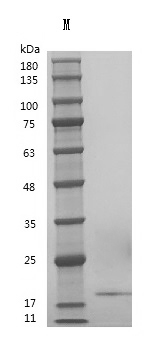
Lyophilized from a 0.2 μm filtered solution containing PBS, 5% mannitoland 0.01% Tween 80, pH 7.4
Storage
Store at -20°C/-81°C upon receipt, aliquoting is necessary for mutiple use. Avoid repeated freeze-thaw cycles.
Lead Time
3-7 business days
Notes
Repeated freezing and thawing is not recommended. Store working aliquots at 4°C for up to one week.
Shelf Life
The shelf life is related to many factors, storage state, storage temperature and the stability of the product itself. Generally, the shelf life of lyophilized form is 6 months at -20°C/-80°C from the date of receipt.
Plays an important role in the regulation of embryonic development, cell proliferation and cell differentiation. Required for normal branching morphogenesis. May play a role in wound healing.
Gene References into Functions
We report the ophthalmological and genetic study of a 19-year-old woman and her relatives suffering from this syndrome. A new probably pathogenic variant is described in the FGF10 gene.PMID:29053399
We have revealed significant association of FGFR2 and MAP3K1 polymorphisms with breast cancer.PMID:29372690
data suggest that the strongest signal of association at 5p12 is mediated through coordinated activation of FGF10 and MRPS30, two candidate genes for breast cancer pathogenesisPMID:27640304
Fgf10 signaling has an essential role in the formation of lipofibroblasts during late lung developmentPMID:26511927
Expression of Fibroblast Growth Factor 10 is correlated with poor prognosis in gastric adenocarcinoma.PMID:26268776
FGF10 has a role in protecting neuron against oxygen-glucose deprivation injury through inducing heme oxygenase-1PMID:25446127
Data identify autocrine activation of FGF signaling as an essential mechanism in promoting Pten-deficient skin tumors.PMID:24582960
The therapeutic potential of the FGF10 treatment.PMID:24865969
FGF10 plays an important role for tumor growth by both paracrine and autocrine manner.PMID:24320134
The findings show that immunohistochemistry with FGF10, FGFR2b, or SHH could be useful in differentiating CCAM from type I PPB, when a child presents with a focal cystic lung lesion.PMID:24004862
Paracrine FGF10 signaling stimulates the differentiation of human stem cell into urothelial cells.PMID:23949743
High FGF10 expression is associated with ameloblastoma.PMID:24002438
Three FGF10 single nucleotide polymorphisms in complete linkage disequilibrium--rs339501, rs12517396, and rs10462070--were associated with extreme myopia in the Japanese population.PMID:24265547
FGF-10 expression during the development of the human hindgut and anorectum suggests that it may play a role in hindgut and anorectal morphogenesis.PMID:23774963
The sclera of myopic eyes had higher FGF10 levels. The risk G allele of SNP rs339501 was associated with extreme myopia in human and caused a higher gene expression in the luciferase assay.PMID:23599340
the posttranslational and transcriptional mechanisms underlying stimulation of P-glycoprotein function and expression by keratinocyte growth factor-2 (KGF2) that may contribute to the beneficial effects of KGF2 in intestinal inflammatory disordersPMID:23328208
tooth agenesis had increased risk of a family history of cancer. tooth agenesis was associated with positive self-reported family history of cancer and variants in FGF10.PMID:23169889
Identification of FGF-10 at both protein and mRNA levels in ovaries from fetuses, girls, and women suggests that FGF-10 contributes to preantral follicle development; FGF-10 is expressed in both granulosa cells and oocytes.PMID:22877940
Our data suggest that common variants in FGF10 increase the risk for a wide range of non-syndromic limb deficiencies.PMID:22965740
[review] FGF10 mediates biological responses by activating FGF receptor 2b (FGFR2b) in a paracrine manner.PMID:21696361
The relationship between human ISL1 and FGF10 within the embryonic time window during which the linear heart tube remodels into four chambers, was examined.PMID:22303449
Investigation of the pulmonary functions of COPD patients heterozygous for loss of function mutations in the FGF10 gene was performed. The patients show a significant decrease in lung function parameters when compared to control values.PMID:21742743
Gremlin-mediated BMP inhibition results in activation of epithelial cells and transient fibrosis, but also induction of epithelium-protective FGF10PMID:20705941
FGF2 and FGF10 regulate migratory activity of ovine trophoblast cells through MAPK-dependent pathways.PMID:21310815
FGF10 can promote the adipogenesis effect in situ.PMID:19915940
There was no association among gene FGFR1 rs13317, p. E467K, p. M369I, p. S393S and gene FGF10 rs1448037 and nonsyndromic cleft lip with or without palate in Chinese population.PMID:19727229
These results suggested that Thr-114 is a crucial functional residue for FGF10, and mutating Thr-114 to Ala or Arg would lead to great decrease in receptor-binding affinity and biological activity of FGF10.PMID:20036575
FGF10 upregulates Na(+)-K(+)-exchanging ATPase via the MAPK pathway.PMID:12804770
FGF-10 attenuates H2O2-induced alveolar epithelium DNA damage by mechanisms that involve activation of Grb2-SOS/Ras/RAF-1/ERK1/2 pathway and DNA repair.PMID:14975937
Fgf10 mRNA is overexpressed in a subset of human breast carcinomas.PMID:15208658
Data validate the symmetric two-end model of fibroblast growth factor (FGF) receptor (FGFR) dimerization and FGF binding and argue against the asymmetric model of FGFR dimerization.PMID:15632068
We suggest that haploinsufficiency for FGF10 during a crucial stage of development results in ALSG.PMID:15654336
Human embryonic pancreatic mesenchyme expresses FGF10, which might be used used to expand human embryonic pancreatic epithelial cells.PMID:15690149
Human recombinant FGF10 maintains murine Notch activation and induces the expansion of murine pancreatic precursors while blocking their differentiation.PMID:16323074
Localization of the FGF-10 receptor to the urothelial layer is clinically significant because intravesical administration of FGF-10 may provide a means to control the turnover of transitional epithelium in bladder disorders such as interstitial cystitis.PMID:16597614
Activation of Toll-like receptor 2 (TLR2) or Toll-like receptor 4 (TLR4) inhibited FGF-10 expression, leading to abnormal saccular airway morphogenesis.PMID:17071719
R80S and G138E mutations are associated with aplasia of the lacrimal and salivary glands.PMID:17213838
a nuclear localization signal-like motif of FGF-10 is a partial determinant of its intracellular distribution and is necessary for its mitogenic activityPMID:17471512
Trophoblast outgrowth and invasion (part of placental villi sprouting) at the fetal maternal interface is in part under delicate control of FGF 10 and Sprouty 2.PMID:17496316
Results suggest that Lacrimo-auriculo-dento-digital syndrome is caused by reduced activity of the fibroblast growth factor 10 (FGF10)-FGF receptor 2 signaling pathway.PMID:17682060
Expression in diverse niches of adult brain of Fgf10-lacZ reporter mice implicates Fgf10 in control of neurogenesis and/or conservation of neurogenic potential.PMID:18329286
It cannot be ruled out that other genes involved in the signalling pathway of FGF10 may contribute to the formation of these congenital malformations.PMID:18587586
Stromal FGF10 induces migration and invasion in pancreatic cancer cells through interaction with FGFR2, resulting in a poor prognosis.PMID:18594526
family-based approach revealed an intronic variation of the FGF10 gene causing aplasia of lacrimal and salivary glands-syndromePMID:19102732
Disruption of localized pattern of mesenchymal fibroblast growth factor 10 expression results in impairment of lung branching morphogenesis, which progresses to emphysematous airspaces in adults.PMID:19115389
Fgf10 is a strong causative candidate for defects observed in Apert syndrome since its genetic knockdown in a mouse model of Apert syndrome results in the rescue of the skeletal and visceral defects associated with this congenital disease.PMID:18773495
An analysis of the distribution and fate of Fgf10-expressing cells in the adult mouse brain suggests that Fgf10 may have critical regulatory roles in stem cell function and generation of new neurons in diverse areas of the adult brain.PMID:18773495
TGFbeta1 caused a rapid and transient decrease in Fgf10 mRNA levels in primary prostatic cells. Deletion analysis of the Fgf10 promoter identified a region that mediated a proportion of promoter activity as well as promoter down-regulation by TGFbeta1.PMID:14726452