
Call us
301-363-4651 (Available 9 a.m. to 5 p.m. CST from Monday to Friday)

| Application | Recommended Dilution |
|---|---|
| WB | 1:500-1:2000 |
| ICC | 1:50-1:500 |
| IF | 1:50-1:200 |
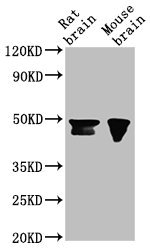
Western Blot
Positive WB detected in: Rat brain tissue, Mouse brain tissue
All lanes: NANOG antibody at 1:500
Secondary
Goat polyclonal to Mouse IgG at 1/10000 dilution
Predicted band size: 35, 33 kDa
Observed band size: 46, 42 kDa
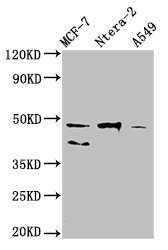
Western Blot
Positive WB detected in: MCF-7 whole cell lysate, Ntera-2 whole cell lysate, A549 whole cell lysate
All lanes: NANOG antibody at 1:500
Secondary
Goat polyclonal to Mouse IgG at 1/10000 dilution
Predicted band size: 35, 33 kDa
Observed band size: 46, 40 kDa
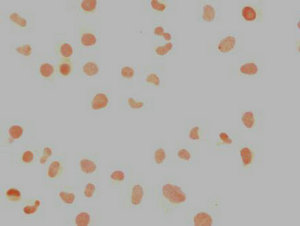
Immunocytochemistry analysis of CSB-MA888008A0m diluted at 1:100 and staining in Hela cells performed on a Leica BondTM system. The cells were fixed in 4% formaldehyde, permeabilized using 0.2% Triton X-100 and blocked with 10% normal goat serum 30min at RT. Then primary antibody (1% BSA) was incubated at 4°C overnight. The primary is detected by a biotinylated secondary antibody and visualized using an HRP conjugated SP system.
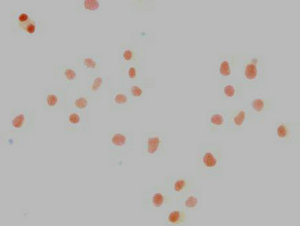
Immunocytochemistry analysis of CSB-MA888008A0m diluted at 1:100 and staining in Ntera-2 cells performed on a Leica BondTM system. The cells were fixed in 4% formaldehyde, permeabilized using 0.2% Triton X-100 and blocked with 10% normal goat serum 30min at RT. Then primary antibody (1% BSA) was incubated at 4°C overnight. The primary is detected by a biotinylated secondary antibody and visualized using an HRP conjugated SP system.
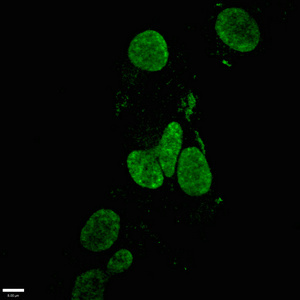
Immunofluorescence staining of Hela cells with CSB-MA888008A0m at 1:100, counter-stained with DAPI. The cells were blocked in 10% normal Goat Serum and then incubated with the primary antibody overnight at 4°C. The secondary antibody was Alexa Fluor 488-congugated AffiniPure Goat Anti-Mouse IgG(H+L).
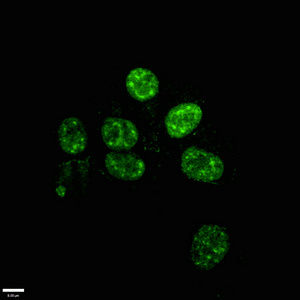
Immunofluorescence staining of Ntera-2 cells with CSB-MA888008A0m at 1:100, counter-stained with DAPI. The cells were blocked in 10% normal Goat Serum and then incubated with the primary antibody overnight at 4°C. The secondary antibody was Alexa Fluor 488-congugated AffiniPure Goat Anti-Mouse IgG(H+L).
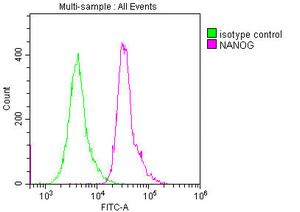
Overlay histogram showing Hela cells stained with CSB-MA888008A0m (red line) at 1:250. The cells were incubated in 1x PBS /10% normal goat serum to block non-specific protein-protein interactions followed by primary antibody for 1 h at 4°C. The secondary antibody used was FITC goat anti-mouse IgG(H+L) at 1/200 dilution for 1 h at 4°C. Isotype control antibody (green line) was used under the same conditions. Acquisition of >10,000 events was performed.
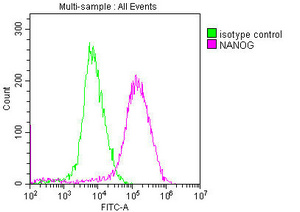
Overlay histogram showing MCF-7 cells stained with CSB-MA888008A0m (red line) at 1:250. The cells were incubated in 1x PBS /10% normal goat serum to block non-specific protein-protein interactions followed by primary antibody for 1 h at 4°C. The secondary antibody used was FITC goat anti-mouse IgG(H+L) at 1/200 dilution for 1 h at 4°C. Isotype control antibody (green line) was used under the same conditions. Acquisition of >10,000 events was performed.
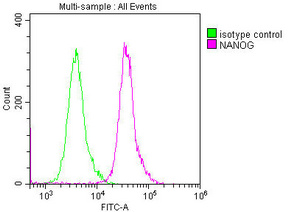
Overlay histogram showing Ntera-2 cells stained with CSB-MA888008A0m (red line) at 1:250. The cells were incubated in 1x PBS /10% normal goat serum to block non-specific protein-protein interactions followed by primary antibody for 1 h at 4°C. The secondary antibody used was FITC goat anti-mouse IgG(H+L) at 1/200 dilution for 1 h at 4°C. Isotype control antibody (green line) was used under the same conditions. Acquisition of >10,000 events was performed.
The monoclonal NANOG antibody is secreted from the hybridoma formed by the fusion of mouse myeloma cells and splenocytes from mice immunized with the recombinant human NANOG protein. It is purified from mouse ascites through protein G, and its purity reaches over 95%. This unconjugated NANOG monoclonal antibody is matched with the mouse IgG1 isotype. It is suitable for ELISA, WB, ICC, IF, and FC applications and can detect the NANOG protein from human, mouse, and rat.
NANOG is a transcription factor that is involved in the self-renewal of embryonic stem cells (ES). It is a critical factor in maintaining pluripotency. Studies have shown that NANOG is strictly involved in the process of carcinogenesis and is a potential prognostic marker of malignant tumors.


Email: support@cusabio.com
Distributors Worldwide



