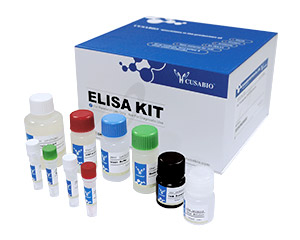
Mouse protein C (PC) ELISA kit

Promotion
Code: CSB-E13585m
Size:
96T,5×96T,10×96T
96T,5×96T,10×96T
Pls inquire
Quantity:
Sample Types: serum, plasma, tissue homogenates
Detect Range: 1.25 ng/ml-80 ng/ml
Sensitivity: 0.625 ng/ml
Trial Size:
24T ELISA Kit Trial Size (Only USD$150/ kit)
* Sample kit cost can be deducted as a $30 credit for each 96-assay kit of the same analyte and brand you subsequently purchase within six months until depleted. More details >>
Interested in a trial size? Please leave a message below.

For inquiries on large quantities or another requirements
Send an Inquiry
Start an on-line Chat
Online ordering is currently available for U.S. customers only. For orders outside the U.S., please kindly submit an inquiry or start a chat with us.
Promotion

Product Details

Alternative Names
Proc ELISA Kit; Vitamin K-dependent protein C ELISA Kit; EC 3.4.21.69 ELISA Kit; Anticoagulant protein C ELISA Kit; Autoprothrombin IIA ELISA Kit; Blood coagulation factor XIV) [Cleaved into: Vitamin K-dependent protein C light chain; Vitamin K-dependent protein C heavy chain; Activation peptide] ELISA Kit
Abbreviation
PROC
Uniprot NO.
Species
Mus musculus (Mouse)
Sample Type
serum, plasma, tissue homogenates
Detection Range
1.25 ng/ml-80 ng/ml
Sensitivity
0.625 ng/ml
Assay Time
1-5h
Sample Loading Volume
50-100ul
Detection Wavelength
450 nm
Research Area
Cardiovascular
Assay Principle
quantitative
The tag type will be determined during production process. If you have specified tag type, please tell us and we will develop the specified tag preferentially.
Measurement
Competitive
Storage
Store at 2-8°C. Please refer to protocol.
Shelf Life
6 months
Lead Time
3-5 working days after you place the order, and it takes another 3-5 days for delivery via DHL or FedEx.
Note: All of our proteins are default shipped with normal blue ice packs, if you request to ship with dry ice, please communicate with us in advance and extra fees will be charged.
Troubleshooting and FAQs
Description

This Mouse PROC ELISA Kit was designed for the quantitative measurement of Mouse PROC protein in serum, plasma, tissue homogenates. It is a Competitive ELISA kit, its detection range is 1.25 ng/mL-80 ng/mL and the sensitivity is 0.625 ng/mL.


Customer Reviews and Q&A

 Customer Reviews

Target Background

Function(From Uniprot)
Protein C is a vitamin K-dependent serine protease that regulates blood coagulation by inactivating factors Va and VIIIa in the presence of calcium ions and phospholipids. Exerts a protective effect on the endothelial cell barrier function.
Gene References into Functions
  1. Data show that activated protein C signals via protease activated receptors PAR2/PAR3 to expand Treg cells, mitigating the disease in mice. PMID:28827518
  2. APC modifies pulmonary fibrosis by limiting thrombin-dependent macrophage recruitment. PMID:27295971
  3. Small interfering RNA-mediated silencing of protein C in apolipoprotein E-deficient mice creates a condition that allows the occurrence of spontaneous atherothrombosis. PMID:28302625
  4. These findings reveal a novel biological function and mechanism of the protein C pathway in which protein S and the aPC-cleaved form of fV are cofactors for anti-inflammatory cell signaling by aPC in the context of endotoxemia and infection PMID:26341257
  5. activated PC-EPCR-PAR1 signaling promotes hematopoietic stem cell retention in bone marrow. PMID:26457757
  6. impaired EPCR/protein C-binding interactions not only result in procoagulant and proinflammatory effects, but also impact hematopoiesis PMID:26045607
  7. SOD prevents thrombomodulin methionine oxidation, promotes protein C activation, and protects against arterial and venous thrombosis in mice. PMID:26069236
  8. sPLA2-V plays a thrombogenic role by impairing the ability of EPCR to promote protein C activation. PMID:25069533
  9. Data identify anticoagulant activated protein C as a "metaplastic molecule", capable of shifting the threshold of LTP towards further potentiation PMID:24753100
  10. Histones regulate activated protein C formation in a manner similar to PF4 and suggest heparinoids may be benificial in sepsis. PMID:24177324
  11. EPCR and APC play a limited role in the host response during pulmonary tuberculosis. PMID:23348224
  12. Inhibition of the anticoagulant function of activated protein C does not interfere with its protective role during Gram-negative pneumosepsis, suggesting a more prominent role for cytoprotective effects of APC . PMID:23216621
  13. RNA interference of Serpinc1 and/or Proc allows for evaluation of the function of these genes in vivo and provides a novel, controlled mouse model for spontaneous venous thrombosis. PMID:23550037
  14. Activated protein C ameliorates diabetic nephropathy by epigenetically inhibiting the redox enzyme p66Shc. PMID:23267072
  15. Polyphosphate can elicit potent pro-inflammatory responses through the activation of NF-kappaB, which are counteracted by activated protein C. PMID:22372856
  16. The aPC mechanism of action is complex, involving induction of Treg differentiation, inhibition of inflammation, and possibly direct cyto-protective effects on beta cells. PMID:22447930
  17. We conclude that activated protein C generation and function can be modulated by changes in phospholipid occupancy of its endothelial cell receptor. PMID:22167755
  18. Findings show that the protein C (PC) pathway is a unique system involved in controlling intestinal homeostasis and inflammation by regulating epithelial barrier function. PMID:22109555
  19. Endogenous PC has strong effects on the host response to lethal influenza A infection, inhibiting pulmonary coagulopathy and inflammation on the one hand, but facilitating neutrophil influx and protein leak and accelerating mortality on the other hand. PMID:21330465
  20. Endogenous protein C inhibits activation of coagulation and transiently lowers bacterial outgrowth in murine Escherichia coli peritonitis PMID:21251201
  21. endogenous APC is essential for immune-mediated cancer cell elimination PMID:21420234
  22. Age-dependent vulnerability to endotoxemia is associated with reduction of anticoagulant factors activated protein C and thrombomodulin. PMID:20348393
  23. endogenous acute coagulopathy is mediated by the activation of the protein C pathway PMID:19333141
  24. These findings show a new function for the thrombomodulin-protein C system in controlling the growth and survival of trophoblast cells in the placenta, which is essential for the maintenance of pregnancy. PMID:12579195
  25. surviving Thrombomodulin pro/pro mice displayed increased lung inflammation accompanied by higher mycobacterial loads in liver and spleen PMID:16014564
  26. directly links host endogenous levels of PC with various coagulation, inflammation, and hemodynamic end points following a severe acute inflammatory challenge PMID:17047151
  27. in the presence of a limited level of the anticoagulant, PC, placental homeostasis can be restored by reducing TF expression, thus facilitating proper embryonic implantation PMID:18647222
  28. species specificity in the effects of pregnancy on the major determinants of the protein C system; Pregnancy causes a decrease in APC resistance in mice, which can be explained by the elevation of protein S levels and increased TFPI activity in plasma. PMID:19036061
  29. An important role for the aPC/EPCR pathway in reducing metastasis via inhibition of tumor cell adhesion and transmigration. PMID:19188668
  30. Protection of vascular barrier integrity by activated protein C in murine models depends on protease-activated receptor-1. PMID:19350118
  31. activated PC is barrier-protective in ventilator lung injury and endothelial PC receptor is a critical participant in APC-mediated protection PMID:19363121

Show More

Hide All

Subcellular Location
Secreted. Golgi apparatus. Endoplasmic reticulum.
Protein Families
Peptidase S1 family
Tissue Specificity
Plasma; synthesized in the liver.
Database Links

UNIGENE: Mm.2786

KEGG: mmu:19123

STRING: 10090.ENSMUSP00000132226

icon of phone
Call us
301-363-4651 (Available 9 a.m. to 5 p.m. CST from Monday to Friday)
icon of address
Address
No. 269, Shendun 5th Road, Donghu Hi-Tech Development Area, Hubei Province, 430206, P.R.China
icon of social media
Join us with

Subscribe newsletter

Leave a message

* To protect against spam, please pass the CAPTCHA test below.
CAPTCHA verification
© 2007-2025 CUSABIO TECHNOLOGY LLC All rights reserved. 鄂ICP备15011166号-1
Select 0 Products