* Sample kit cost can be deducted as a $30 credit for each 96-assay kit of the same analyte and brand you subsequently purchase within six months until depleted. More details >>
Interested in a trial size? Please leave a message below.


| Intra-assay Precision (Precision within an assay): CV%<8% | ||||||
| Three samples of known concentration were tested twenty times on one plate to assess. | ||||||
| Inter-assay Precision (Precision between assays): CV%<10% | ||||||
| Three samples of known concentration were tested in twenty assays to assess. | ||||||
| To assess the linearity of the assay, samples were spiked with high concentrations of mouse NF-κB in various matrices and diluted with the Sample Diluent to produce samples with values within the dynamic range of the assay. | ||||||
| Sample | Serum(n=4) | |||||
| 1:1 | Average % | 92 | ||||
| Range % | 86-99 | |||||
| 1:2 | Average % | 97 | ||||
| Range % | 92-103 | |||||
| 1:4 | Average % | 86 | ||||
| Range % | 80-89 | |||||
| 1:8 | Average % | 90 | ||||
| Range % | 83-99 | |||||
| The recovery of mouse NF-κB spiked to levels throughout the range of the assay in various matrices was evaluated. Samples were diluted prior to assay as directed in the Sample Preparation section. | ||||||
| Sample Type | Average % Recovery | Range | ||||
| Serum (n=5) | 95 | 89-99 | ||||
| EDTA plasma (n=4) | 92 | 87-96 | ||||
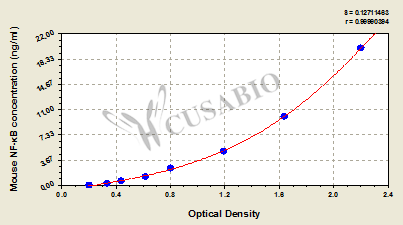
| These standard curves are provided for demonstration only. A standard curve should be generated for each set of samples assayed. | |||||||||||||||||||||||||||||||||||||||||||||||||||||||||||||||
| |||||||||||||||||||||||||||||||||||||||||||||||||||||||||||||||
Nuclear factor-kappa B (NF-κB) represents a family of transcription factors that play important roles in regulating immune responses, inflammation, and cell survival. The NFKB1 gene encodes the p105/p50 subunit, which forms homo- and heterodimeric complexes that control the expression of numerous genes involved in innate and adaptive immunity. NF-κB signaling pathways are necessary for proper immune cell development and function. Dysregulation of these pathways has been linked to various inflammatory diseases, autoimmune disorders, and cancer.
The Mouse Nuclear factor-kappa B,NF-κB ELISA Kit (CSB-E12108m) is designed for quantitative measurement of nuclear factor of kappa light polypeptide gene enhancer in B-cells 1 (NFKB1) in Mus musculus samples. This sandwich ELISA works with serum, plasma, and cell culture supernatants with a detection range of 0.312 ng/mL to 20 ng/mL and sensitivity of 0.078 ng/mL. The assay requires 50-100 μL sample volume, measures absorbance at 450 nm wavelength, and can be completed within 1-5 hours.
Application Examples
Note: The following application examples are drawn from a selection of publications citing this product. For additional applications, please refer to the full list of references in the "Citations" section.
This ELISA kit has been used in research examining inflammatory processes and tissue-specific biomarker analysis. Studies have applied the kit to quantify nuclear factor-kappa B levels in various biological samples as part of broader inflammatory pathway evaluations.
• Hepatic inflammation research - Analysis of nuclear factor-kappa B levels in liver tissue homogenates alongside other inflammatory mediators to evaluate hepatic inflammatory responses
• Gastrointestinal inflammation studies - Measurement of nuclear factor-kappa B in intestinal tissue samples to determine inflammatory factor levels in digestive system research
• Multi-target inflammatory profiling - Integration with other inflammatory biomarker measurements to provide comprehensive evaluation of inflammatory pathway activation in tissue samples
I want to ask about sample processing of CSB-E12108m, Mouse Nuclear factor-kappa B, NF-κB ELISA Kit. I have a serum sample but before using it for the ELISA test I will treat it at a temperature of 56℃ for 30min for heat deactivation, would it affect the cytokine which I want to detect? What will be the sensitivity if my samples are preheated?
Generally speaking, the high temperature would denature the protein and affect the detection result. The mentioned treatment with a temperature of 56℃ for 30min is usually used in the inactivation. There should be not much effect to do so. However, our ELISA kit does not require extra special steps or operations. As to the serum preparation, we suggest you follow the manual.


Email: support@cusabio.com
Distributors Worldwide



