Mouse C-Reactive Protein,CRP ELISA Kit

CSB-E07923m
Size:
96T,5×96T,10×96T
96T,5×96T,10×96T
Pls inquire
Quantity:
Sample Types: serum, plasma, cell culture supernates, tissue homogenates
Detect Range: 15.6 ng/mL-1000 ng/mL
Sensitivity: 3.9 ng/mL
For inquiries on large quantities or another requirements
Send an Inquiry
Start an on-line Chat
Orders can only be placed from within the U.S.

Product Details

Alternative Names
Crp ELISA Kit; Ptx1C-reactive protein ELISA Kit
Abbreviation
CRP
Uniprot NO.
Species
Mus musculus (Mouse)
Sample Type
serum, plasma, cell culture supernates, tissue homogenates
Detection Range
15.6 ng/mL-1000 ng/mL
Sensitivity
3.9 ng/mL
Assay Time
1-5h
Sample Volume
50-100ul
Detection Wavelength
450 nm
Research Area
Immunology
Assay Principle
quantitative
Measurement
Sandwich
Shelf Life
6 months
Lead Time
3-5 working days after you place the order, and it takes another 3-5 days for delivery via DHL or FedEx.
Precision
Intra-assay Precision (Precision within an assay): CV%<8%      
Three samples of known concentration were tested twenty times on one plate to assess.  
Inter-assay Precision (Precision between assays): CV%<10%      
Three samples of known concentration were tested in twenty assays to assess.    
             
Linearity
To assess the linearity of the assay, samples were spiked with high concentrations of mouse CRP in various matrices and diluted with the Sample Diluent to produce samples with values within the dynamic range of the assay.
  Sample Serum(n=4)  
1:20 Average % 90  
Range % 86-93  
1:40 Average % 103  
Range % 99-106  
1:80 Average % 93  
Range % 87-96  
1:160 Average % 98  
Range % 93-101  
Recovery
The recovery of mouse CRP spiked to levels throughout the range of the assay in various matrices was evaluated. Samples were diluted prior to assay as directed in the Sample Preparation section.
Sample Type Average % Recovery Range  
Serum (n=5) 94 89-97  
EDTA plasma (n=4) 97 90-100  
             
             
Typical Data
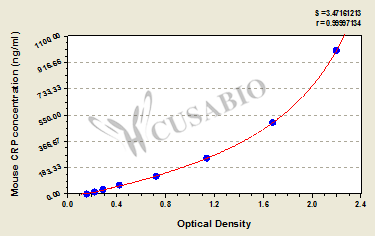
These standard curves are provided for demonstration only. A standard curve should be generated for each set of samples assayed.
ng/ml OD1 OD2 Average Corrected  
1000 2.206 2.124 2.165 1.995  
500 1.661 1.655 1.658 1.488  
250 1.138 1.122 1.130 0.960  
125 0.727 0.721 0.724 0.554  
62.5 0.424 0.435 0.430 0.260  
31.2 0.292 0.305 0.299 0.129  
15.6 0.228 0.234 0.231 0.061  
0 0.168 0.172 0.170    
Troubleshooting and FAQs
Datasheet & COA
Please contact us to get it.
Images
  • Mouse C-Reactive Protein,CRP ELISA Kit
Description

This Mouse CRP ELISA Kit was designed for the quantitative measurement of Mouse CRP protein in serum, plasma, cell culture supernates, tissue homogenates. It is a Sandwich ELISA kit, its detection range is 15.6 ng/mL-1000 ng/mL and the sensitivity is 3.9 ng/mL .

Customer Reviews and Q&A

 Customer Reviews
Average Rating:
5.0 - 3 reviews

Submit a Review here

Sample species : a:1:{i:0;a:2:{i:0;s:5:"Mouse";i:1;s:0:"";}}

Sample type: a:1:{i:0;a:2:{i:0;s:5:"Serum";i:1;s:0:"";}}

Sample dilution: a:1:{i:0;a:2:{i:0;s:5:"1:100";i:1;s:0:"";}}

Review: describe

By Anonymous

Sample species : a:1:{i:0;a:2:{i:0;s:5:"Mouse";i:1;s:0:"";}}

Sample type: a:1:{i:0;a:2:{i:0;s:5:"Serum";i:1;s:0:"";}}

Sample dilution: a:1:{i:0;a:2:{i:0;s:5:"1:100";i:1;s:0:"";}}

Review: describe

By Anonymous

Sample species : a:1:{i:0;a:2:{i:0;s:5:"Mouse";i:1;s:0:"";}}

Sample type: a:1:{i:0;a:2:{i:0;s:5:"Serum";i:1;s:0:"";}}

Sample dilution: a:1:{i:0;a:2:{i:0;s:5:"Other";i:1;s:4:"1:10";}}

Review: describe

By Anonymous

Citations

Target Background

Function
Displays several functions associated with host defense: it promotes agglutination, bacterial capsular swelling, phagocytosis and complement fixation through its calcium-dependent binding to phosphorylcholine. Can interact with DNA and histones and may scavenge nuclear material released from damaged circulating cells.
Gene References into Functions
  1. CRP is pathogenic in type-2 diabetes (T2DN). CRP may promote CD32b- NF-kappaB signaling to mediate renal inflammation; whereas, CRP may enhance renal fibrosis in T2DN via CD32b-Smad3-mTOR signaling. PMID:27221338
  2. FcgammaRIIb and FcgammaRIII are involved in the CRP-induced expression of MMPs and TIMP-1 and the CRP-induced phosphorylation of p38, whereas the FcgammaR-independent pathway may regulate the CRP-induced MMP-11 expression and the CRP-induced ERK1/2 phosphorylation. PMID:28539825
  3. C-reactive protein may promote acute kidney injury by impairing tubular epithelial cell regeneration via the CD32-Smad3-p27-driven inhibition of the CDK2/cyclin E complex. PMID:27470679
  4. These results suggested that CRP/oxidized low density lipoprotein/beta 2-Glycoprotein I complexes may induce lipid accumulation and inflammation in macrophages via the p38/MAPK and NFkappaB signaling pathways. PMID:27512978
  5. these data unexpectedly identify CBS as the major recognition site of mCRP and suggest that this motif may be exploited to tune the proinflammatory actions of mCRP. PMID:26907682
  6. CRP decreased adiponectin expression and multimerization, while CRP-induced decline in adiponectin might be mediated through the PI3K/Akt pathway. PMID:26812237
  7. mCRP may be responsible for promoting dementia after ischaemia and mCRP clearance could inform therapeutic avenues to reduce the risk of future dementia. PMID:26335098
  8. Effects of C-Reactive Protein on the Cardiac Differentiation of Mouse Embryonic Stem Cells PMID:26328491
  9. These data indicated that CRP may have a direct role on osteoclast and osteoblast differentiation via toll-like receptor signaling pathways. PMID:26687448
  10. Data suggest that serum amyloid P (SAP) activates CD209 DC-SIGN to regulate the innate immune system differently from C-reactive protein (CRP), and that DC-SIGN is a target for antifibrotics. PMID:26106150
  11. the acute phase protein C-reactive protein (CRP), a ligand for Fc receptors on phagocytes, enhances antibody-mediated platelet destruction by phagocytes in vivo PMID:25548320
  12. CRP has therapeutic potential against cancer through decreasing the accumulation of M2 macrophages and angiogenesis within tumors. PMID:25088786
  13. Orphan nuclear receptor Errgamma induces C-reactive protein gene expression through induction of ER-bound Bzip transmembrane transcription factor CREBH. PMID:24466039
  14. The interactions of CRP and the BBB are a two-phase process, with increased paracellular permeability at a high dose that enables its entry into the CNS and serves to induce reactive gliosis and impair CNS function. PMID:23018453
  15. In mice with photochemically induced thrombosis, acrolein produced at the locus of infarction increased the level of IL-6 and then CRP in plasma. PMID:23763486
  16. CRP directly inhibits tumoral lymphangiogenesis and lymph node metastasis in mice. PMID:23859309
  17. Which processes in glucose homeostasis are altered by CRP? Data suggest that CRP attenuates insulin-induced skeletal muscle blood flow; CRP contributes to insulin resistance via IgG receptor IIB-mediated inhibition of glucose delivery to muscle. PMID:23069625
  18. CRP is not only a biomarker, but also a mediator in DKD. PMID:21744073
  19. C-reactive protein promotes acute renal inflammation and fibrosis in unilateral ureteral obstructive nephropathy in mice. PMID:21383672
  20. These findings reveal a novel nutrient-dependent interaction between Sirt1 and HNF-1alpha which results in regulation of Crp expression. PMID:21176092
  21. Studies show that CRP itself may have a pathogenic role in the development of pressure overload-induced cardiac remodeling, possibly through enhanced inflammation and oxidative stress. PMID:21220701
  22. No reduction of atherosclerosis in C-reactive protein (CRP)-deficient mice. PMID:21149301
  23. Modified and natural C-reactive protein have opposite effects on atherosclerosis in apolipoprotein E-deficient mice. PMID:16087790
  24. the contribution of CRP's ability of activating the classical pathway of complement in the protection of mice from lethal infection with virulent Streptococcus pneumoniae type 3 PMID:16547275
  25. nCRP can facilitate cardiovascular disease through impairment of endothelium-dependent vasoreactivity, in a manner that involves increased iNOS activity and a potential for increased peroxynitrite formation. PMID:17669410
  26. the response to vascular injury provoked by human C-Reactive Protein in ovariectomized C-reactive protein transgenic mice depends on Fc gamma RI and probably requires its expression by F4/80+ cells PMID:18063701
  27. In vivo analyses revealed significant increases in TF expression and decreases in TFPI expression in carotid arteries of CRP-Tg mice versus WT mice. PMID:18276908
  28. CRP plays a crucial role in the induction, amplification, and prolongation of inflammatory processes, including atherosclerotic lesions PMID:18402807
  29. C-reactive protein has a role in impaired endothelial function PMID:18433756

Show More

Hide All

Subcellular Location
Secreted.
Protein Families
Pentraxin family
Tissue Specificity
Found in plasma.
Database Links
icon of phone
Call us
301-363-4651 (Available 9 a.m. to 5 p.m. CST from Monday to Friday)
icon of address
Address
7505 Fannin St., Ste 610, Room 7 (CUBIO Innovation Center), Houston, TX 77054, USA
icon of social media
Join us with

Subscribe newsletter

Leave a message

* To protect against spam, please pass the CAPTCHA test below.
CAPTCHA verification
© 2007-2025 CUSABIO TECHNOLOGY LLC All rights reserved. 鄂ICP备15011166号-1
Select 0 Products