* Sample kit cost can be deducted as a $30 credit for each 96-assay kit of the same analyte and brand you subsequently purchase within six months until depleted. More details >>
Interested in a trial size? Please leave a message below.


| Intra-assay Precision (Precision within an assay): CV%<8% | ||||||
| Three samples of known concentration were tested twenty times on one plate to assess. | ||||||
| Inter-assay Precision (Precision between assays): CV%<10% | ||||||
| Three samples of known concentration were tested in twenty assays to assess. | ||||||
| To assess the linearity of the assay, samples were spiked with high concentrations of human PC in various matrices and diluted with the Sample Diluent to produce samples with values within the dynamic range of the assay. | ||||||
| Sample | Serum(n=4) | |||||
| 1:100 | Average % | 84 | ||||
| Range % | 81-89 | |||||
| 1:200 | Average % | 94 | ||||
| Range % | 90-98 | |||||
| 1:400 | Average % | 99 | ||||
| Range % | 95-102 | |||||
| 1:800 | Average % | 101 | ||||
| Range % | 98-104 | |||||
| The recovery of human PC spiked to levels throughout the range of the assay in various matrices was evaluated. Samples were diluted prior to assay as directed in the Sample Preparation section. | ||||||
| Sample Type | Average % Recovery | Range | ||||
| Serum (n=5) | 97 | 93-100 | ||||
| EDTA plasma (n=4) | 104 | 100-108 | ||||
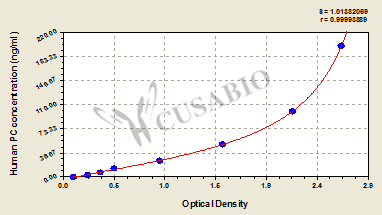
| These standard curves are provided for demonstration only. A standard curve should be generated for each set of samples assayed. | |||||||||||||||||||||||||||||||||||||||||||||||||||||||||||||||
| |||||||||||||||||||||||||||||||||||||||||||||||||||||||||||||||
The human protein C (PC) ELISA kit can quantify human protein C in serum, plasma, and tissue homogenates. This kit features a detection range of 3.12 ng/mL to 200 ng/mL and a sensitivity of 0.78 ng/mL. The assay principle is based on a sandwich ELISA method, where the human protein C within a sample is captured between two antibodies for accurate measurement. The assay can be completed within 1 to 5 hours, requiring a sample volume of 50-100 µl. The detection is performed at a wavelength of 450 nm, ensuring precise and reliable results.
Human protein C is a vital component in blood coagulation, being a vitamin K-dependent glycoprotein that circulates in plasma as an inactive zymogen. Studies have indicated that blocking the anticoagulant activity of human protein C can improve clotting defects in conditions like hemophilia. Deficiencies in protein C have been associated with congenital thrombotic diseases, underscoring the protein's significance in maintaining proper hemostasis [1].
References:
[1] J. Griffin, B. Evatt, T. Zimmerman, A. Kleiss, & C. Wideman, "Deficiency of protein c in congenital thrombotic disease.", Journal of Clinical Investigation, vol. 68, no. 5, p. 1370-1373, 1981. https://doi.org/10.1172/jci110385





