* Sample kit cost can be deducted as a $30 credit for each 96-assay kit of the same analyte and brand you subsequently purchase within six months until depleted. More details >>
Interested in a trial size? Please leave a message below.


| Intra-assay Precision (Precision within an assay): CV%<8% | ||||||
| Three samples of known concentration were tested twenty times on one plate to assess. | ||||||
| Inter-assay Precision (Precision between assays): CV%<10% | ||||||
| Three samples of known concentration were tested in twenty assays to assess. | ||||||
| To assess the linearity of the assay, samples were spiked with high concentrations of human THBS4 in various matrices and diluted with the Sample Diluent to produce samples with values within the dynamic range of the assay. | ||||||
| Sample | Serum(n=4) | |||||
| 1:1 | Average % | 93 | ||||
| Range % | 89-97 | |||||
| 1:2 | Average % | 101 | ||||
| Range % | 98-105 | |||||
| 1:4 | Average % | 99 | ||||
| Range % | 95-104 | |||||
| 1:8 | Average % | 92 | ||||
| Range % | 88-96 | |||||
| The recovery of human THBS4 spiked to levels throughout the range of the assay in various matrices was evaluated. Samples were diluted prior to assay as directed in the Sample Preparation section. | ||||||
| Sample Type | Average % Recovery | Range | ||||
| Serum (n=5) | 96 | 92-99 | ||||
| EDTA plasma (n=4) | 93 | 89-97 | ||||
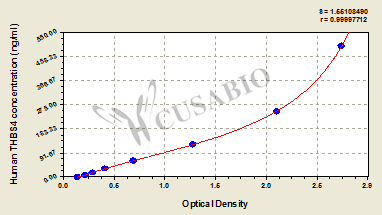
| These standard curves are provided for demonstration only. A standard curve should be generated for each set of samples assayed. | |||||||||||||||||||||||||||||||||||||||||||||||||||||||||||||||
| |||||||||||||||||||||||||||||||||||||||||||||||||||||||||||||||
Thrombospondin-4 (THBS4) is a matricellular glycoprotein belonging to the thrombospondin family, which plays important roles in extracellular matrix organization and cell-matrix interactions. This protein participates in various biological processes including angiogenesis, wound healing, and tissue remodeling. THBS4 expression occurs in multiple tissues and is particularly relevant in cardiovascular research, cancer biology, and inflammatory conditions. As a secreted protein, THBS4 can be detected in biological fluids. This makes it a valuable biomarker for research applications studying matrix remodeling and related pathological processes.
The Human Thrombospondin-4 ELISA kit (CSB-EL023490HU) is designed for quantitative measurement of THBS4 in human serum and plasma samples. This sandwich-based assay operates with a detection range of 7.8 ng/mL to 500 ng/mL and shows a sensitivity of 1.95 ng/mL. The assay requires 50-100 μL sample volume and can be completed within 1-5 hours. Detection occurs at 450 nm wavelength, providing researchers with a reliable tool for THBS4 quantification in Homo sapiens samples.
Application Examples
Note: The following application examples are drawn from a selection of publications citing this product. For additional applications, please refer to the full list of references in the "Citations" section.
This ELISA kit has been used in clinical research to measure circulating thrombospondin 4 levels in human biological samples. The applications span cardiovascular disease research and neurological studies, with researchers using the kit to quantify this biomarker in plasma and cerebrospinal fluid samples from patient populations.
• Cardiovascular disease research: Studies of thrombospondin 4 levels in patients with congenital heart disease and pulmonary arterial hypertension, comparing biomarker concentrations across different disease severity groups
• Neurological studies: Measurement of thrombospondin 4 concentrations in cerebrospinal fluid samples as part of biomarker profiling panels
• Clinical biomarker studies: Quantification of circulating thrombospondin 4 in serum samples from fasted patients for biomarker correlation studies
• Patient stratification research: Analysis of plasma biomarker levels to distinguish between different clinical presentations and disease severities





