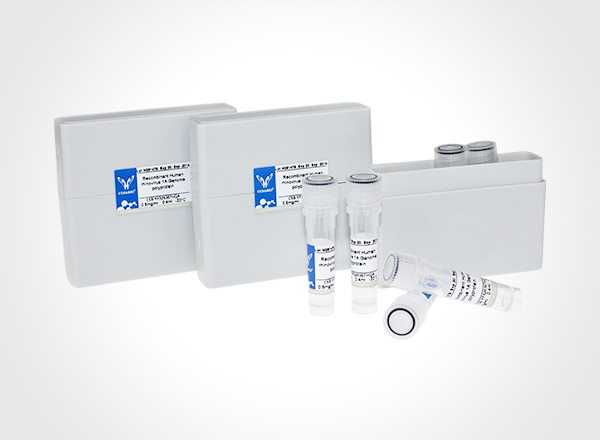
Ccr2; Cmkbr2; C-C chemokine receptor type 2; C-C CKR-2; CC-CKR-2; CCR-2; CCR2; CD antigen CD192
Species
Rattus norvegicus (Rat)
Source
in vitro E.coli expression system
Expression Region
1-373
Target Protein Sequence
MEDSNMLPQFIHGILSTSHSLFPRSIQELDEGATTPYDYDDGEPCHKTSVKQIGAWILPP LYSLVFIFGFVGNMLVIIILISCKKLKSMTDIYLFNLAISDLLFLLTLPFWAHYAANEWV FGNIMCKLFTGLYHIGYFGGIFFIILLTIDRYLAIVHAVFALKARTVTFGVITSVVTWVV AVFASLPGIIFTKSEQEDDQHTCGPYFPTIWKNFQTIMRNILSLILPLLVMVICYSGILH TLFRCRNEKKRHRAVRLIFAIMIVYFLFWTPYNIVLFLTTFQEFLGMSNCVVDMHLDQAM QVTETLGMTHCCVNPIIYAFVGEKFRRYLSIFFRKHIAKNLCKQCPVFYRETADRVSSTF TPSTGEQEVSVGL
Note: The complete
sequence may include tag sequence, target protein sequence, linker sequence and extra sequence that is
translated with the protein sequence for the purpose(s) of secretion, stability, solubility, etc.
If the exact amino acid sequence of this recombinant protein is critical to your application,
please explicitly request the full and complete sequence of this protein before ordering.
Protein Length
Full length protein
Tag Info
N-terminal 10xHis-tagged
The tag type will be determined during production process. If you have specified tag type, please tell us and we will develop the specified tag preferentially.
Storage Condition
Store at -20°C, for extended storage, conserve at -20°C or -80°C.
Shelf Life
The shelf life is related to many factors, storage state, buffer ingredients, storage temperature and the stability of the protein itself.
Generally, the shelf life of liquid form is 6 months at -20°C/-80°C. The shelf life of lyophilized form is 12 months at -20°C/-80°C.
Notes
Repeated freezing and thawing is not recommended. Store working aliquots at 4°C for up to one week.
Key functional receptor for CCL2 but can also bind CCL7 and CCL12. Its binding with CCL2 on monocytes and macrophages mediates chemotaxis and migration induction through the activation of the PI3K cascade, the small G protein Rac and lamellipodium protrusion Also acts as a receptor for the beta-defensin DEFB106A/DEFB106B. Regulates the expression of T-cell inflammatory cytokines and T-cell differentiation, promoting the differentiation of T-cells into T-helper 17 cells (Th17) during inflammation. Facilitates the export of mature thymocytes by enhancing directional movement of thymocytes to sphingosine-1-phosphate stimulation and up-regulation of S1P1R expression; signals through the JAK-STAT pathway to regulate FOXO1 activity leading to an increased expression of S1P1R. Plays an important role in mediating peripheral nerve injury-induced neuropathic pain. Increases NMDA-mediated synaptic transmission in both dopamine D1 and D2 receptor-containing neurons, which may be caused by MAPK/ERK-dependent phosphorylation of GRIN2B/NMDAR2B. Mediates the recruitment of macrophages and monocytes to the injury site following brain injury.
Gene References into Functions
CCR2 activation in nociceptive dorsal root ganglia neurons plays a role in the pathogenesis of gastric hyperalgesia associated with diabetic gastropathy.PMID:29359616
Light exposure led to apoptosis of photoreceptors, which expressed CCL2, accelerating an inflammation-mediated cascade by activating and attracting microglia and monocytes and promoting their secretion of CCL2 in the injured position.PMID:29142497
Expressions of CCR2 mRNA began to increase on the 1st day and reached to the peak on the 7th day, but then started to decrease gradually until 28th day.PMID:26062549
Results suggest that CCL2/CCR2 in the dorsal root ganglion and spinal cord is involved in the maintenance of lumbar disc herniation-induced painPMID:24462503
investigated the expression changes and cellular localization of spinal CCR2 in a rat model of bone cancer induced by Walker 256 cell inoculation. expression of CCR2 in the spinal cord was significantly increased on day 6, 12, and 18 in bone cancer ratsPMID:23511129
Report functional roles for CCL2/CCR2 signaling at the level of the urinary bladder in reducing voiding frequency and somatic sensitivity following CYP-induced cystitis.PMID:23594826
Overexpression of CCR2 in retinal microglia promotes their chemotaxis in response to chemokines.PMID:23288990
CCR2 is involved in the process of mast cell degranulation in bladder tissues.PMID:23049171
The IL-1beta and CCL2-CCR2 signaling cascades play a role in neuron-glia-cytokine interactions and the descending facilitation of neuropathic pain.PMID:22466130
the important role of CCR2 in neuropathic painPMID:21143971
The expressions of CCR2 mRNA and protein increase significantly in cerebral tissue of newborn rat with hypoxic-ischemic brain damage.PMID:18095591
The data show that CCR2 and CCL2 regulation in the hippocampus changes after pilocarpine-induced status epilepticus or seizures. These changes might be involved in detrimental neuroplasticity and neuroinflammatory changes that occur following seizures.PMID:20034406
expression of monocyte chemoattractant protein-1 (MCP-1/CCL2) and its receptor in the testis of rats undergoing autoimmune orchitisPMID:14638441
CCR1, CCR2, and CCR5 mRNA expression and tyrosine phosphorylation increased with peak inflammation in adjuvant induced arthritisPMID:14674010
Cultured neural progenitor cells from the subventricular zone of adult rat brain express chemokine receptor CCR2.PMID:14732474
Arterial wall and VSMC MCP-1/CCR2 increase with aging. MCP-1 enhances VSMC migration and invasion, and thus, MCP-1/CCR2 signaling may play a role in age-associated arterial remodeling.PMID:15178559
IFNG priming enhances migration to inflammatory chemokines; IFN-gamma-inducible gene expression is attenuated by high levels of Stat1; physiological regulation of the relative abundance of Stat1 and Stat3 impacts on gene expressionPMID:16148108
MCP-1/CCR2 signaling is directly involved with a chronic compression injury and may contribute to associated neuronal hyperexcitability and neuropathic pain.PMID:16174730
Data show that the preferential chemokine receptor (CCR)2 ligand, MCP-1/CCL2, elicits calcium transients in primary cultured neurons from various rat brain regions expressing CCR2.PMID:16196033
CCR2 mediates recruitment of both infiltrating macrophages and resident microglia to specific sites of central nervous system inflammation.PMID:17484785
These data suggest CCL2 and CCR2 as potential candidates for integrating inflammation and central neuropathic pain after spinal cord injuryPMID:18338959
CCR2 was also expressed in laser-induced CNV but did not increase after PDT.PMID:18421085
Ccr2 is upregulated by injury to sensory neurons in the lumbar dorsal root ganglia and MCP-1/Ccr2 signaling contributes to subsequent changes in neural activity. These changes may contribute to neuropathic pain.PMID:16174730
Show
More
Hide
All
Subcellular Location
Cell membrane; Multi-pass membrane protein.
Protein Families
G-protein coupled receptor 1 family
Tissue Specificity
Expressed in lung, spleen, kidney, thymus and macrophages.