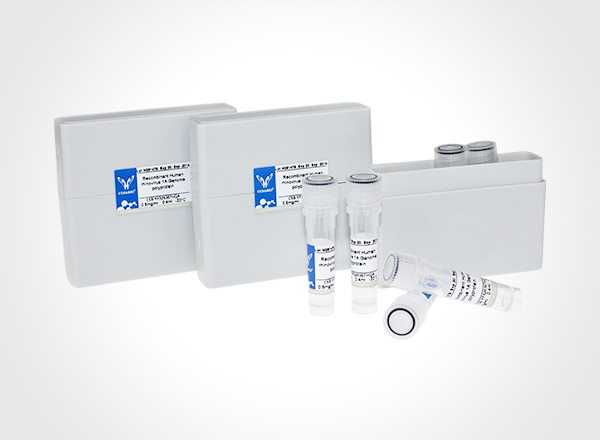
Htra2; Omi; Prss25; Serine protease HTRA2, mitochondrial; High temperature requirement protein A2; HtrA2; Omi stress-regulated endoprotease; Serine protease 25; Serine proteinase OMI
Species
Mus musculus (Mouse)
Source
in vitro E.coli expression system
Expression Region
134-458
Target Protein Sequence
AVPAPPPTSPRSQYNFIADVVEKTAPAVVYIEILDRHPFSGREVPISNGSGFVVASDGLI VTNAHVVADRRRVRVRLPSGDTYEAMVTAVDPVADIATLRIQTKEPLPTLPLGRSADVRQ GEFVVAMGSPFALQNTITSGIVSSAQRPARDLGLPQNNVEYIQTDAAIDFGNSGGPLVNL DGEVIGVNTMKVTAGISFAIPSDRLREFLHRGEKKNSWFGTSGSQRRYIGVMMLTLTPSI LIELQLREPSFPDVQHGVLIHKVILGSPAHRAGLRPGDVILAIGEKLAQNAEDVYEAVRT QSQLAVRIRRGSETLTLYVTPEVTE
Note: The complete
sequence may include tag sequence, target protein sequence, linker sequence and extra sequence that is
translated with the protein sequence for the purpose(s) of secretion, stability, solubility, etc.
If the exact amino acid sequence of this recombinant protein is critical to your application,
please explicitly request the full and complete sequence of this protein before ordering.
Protein Length
Full Length of Mature Protein
Tag Info
N-terminal 10xHis-tagged
The tag type will be determined during production process. If you have specified tag type, please tell us and we will develop the specified tag preferentially.
Storage Condition
Store at -20°C, for extended storage, conserve at -20°C or -80°C.
Shelf Life
The shelf life is related to many factors, storage state, buffer ingredients, storage temperature and the stability of the protein itself.
Generally, the shelf life of liquid form is 6 months at -20°C/-80°C. The shelf life of lyophilized form is 12 months at -20°C/-80°C.
Notes
Repeated freezing and thawing is not recommended. Store working aliquots at 4°C for up to one week.
Serine protease that shows proteolytic activity against a non-specific substrate beta-casein. Promotes or induces cell death either by direct binding to and inhibition of BIRC proteins (also called inhibitor of apoptosis proteins, IAPs), leading to an increase in caspase activity, or by a BIRC inhibition-independent, caspase-independent and serine protease activity-dependent mechanism. Cleaves THAP5 and promotes its degradation during apoptosis.
Gene References into Functions
Study show that overexpression of mitochondrial Omi/HtrA2 induces cardiac apoptosis and dysfunction.PMID:27924873
Mice overexpressing wild-type or G399S mutant HtrA2 have mitochondrial defects resulting in neurodegeneration.PMID:26604148
Protease Omi facilitates neurite outgrowth by cleaving the transcription factor E2F1 in differentiated neuroblastoma cells; E2F1 is a substrate of Omi.PMID:26238290
The NG2 proteoglycan protects oligodendrocyte precursor cells against oxidative stress via interaction with OMI/HtrA2.PMID:26340347
Loss of Omi protease activity results in an abnormal increase of GSK3b, leading to the degradation of PGC-1a, which causes an impairment of mitochondrial biogenesis and induces neurodegeneration.PMID:25118933
Neural-specific deletion of Htra2 causes cerebellar neurodegeneration and defective processing of mitochondrial OPA1.PMID:25531304
Our findings indicate that radiation-inducible gene therapy may have potential to be a more effective and specific therapy for uveal melanoma because the therapeutic gene can be spatially or temporally controlled by exogenous radiation.PMID:24606398
Inactivation of Omi/HtrA2 protease leads to the deregulation of mitochondrial Mulan E3 ubiquitin ligase and increased mitophagy.PMID:24709290
Phosphorylated HtrA2/Omi cleaves beta-actin and decreases the amount of filamentous actin (F-actin) in the cytosol.PMID:24662565
Downregulation of PARL after ischemia is a key step in ischemic neuronal injury, and that it decreases HtrA2 processing and increases neuronal vulnerability.PMID:23921894
increased expression and leakage of Omi/HtrA2 enhanced MI/R injury in aging hearts via degrading XIAP and promoting myocardial apoptosis.PMID:22535253
Results demonstrate that HtrA2 deficiency causes mtDNA damage through ROS generation and mutation, which may lead to mitochondrial dysfunction and consequent triggering of cell death in aging cells.PMID:23542127
HtrA2-knockout cells exhibit increased proton translocation through the ATP synthase, in combination with decreased ATP production and truncation of the F1 alpha-subunit, suggesting the ATP synthase as the source of the proton leak.PMID:22739987
Identification of a novel anti-apoptotic E3 ubiquitin ligase that ubiquitinates antagonists of inhibitor of apoptosis proteins SMAC, HtrA2, and ARTS.PMID:23479728
HtrA2 and Cdk5 interact in human and mouse cell lines and brain.PMID:21701498
HtrA2/Omi deletion leads to functional reduction in the activity of small-conductance Ca(2+)-activated potassium channels, causing substantia nigra compacta dopamine neurons to fire action potentials in an irregular pattern & enhancing burst firing.PMID:20926611
results identify Omi as a novel regulator of autophagy and suggest that Omi might be important in the cellular quality control of proteins involved in neurodegenerative diseasesPMID:20467442
found reduced AICD production in mitochondria isolated from Omi/HtrA2 knockout mouse embryonic fibroblasts, indicating a significant role of Omi/HtrA2 on gamma-secretase activityPMID:20705111
Omi/HtrA2 is associated with apoptotic signaling pathways in tubular epithelial cells activated by unilateral ureteral obstruction, thereby resulting in kidney fibrosis.PMID:20219823
A direct effect of loss of Omi/HtrA2 on mitochondrial morphology and a novel role of this mitochondrial serine protease in the modulation of OPA1.PMID:20064504
Omi interacts with caspase-inhibitor XIAP and induces enhanced caspase activity.PMID:11803371
The neurodegeneration and juvenile lethality in mnd2 mice result from a defect in mitochondrial Omi proteasePMID:14534547
mice entirely lacking expression of HtrA2/Omi suffer loss of a population of neurons in the striatum, resulting in a neurodegenerative disorder with a parkinsonian phenotypePMID:15509788
Ischemia/reperfusion results in Omi/HtrA2 translocation from the mitochondria to the cytosol, where it promotes cardiomyocyte apoptosis via a protease activity-dependent, caspase-mediated pathway.PMID:15611365
Omi/HtrA2 is an inducer of anoikis and an important regulator of ras-induced transformationPMID:16461771
HtrA2 has a role as a regulator of APP metabolism through endoplasmic reticulum-associated degradationPMID:17684015
Results suggest that the primary function of neuronal HtrA2/Omi might be to protect neurons against stress in contrast to its role in the somatic system.PMID:17707776
Hax1, is required to suppress apoptosis in lymphocytes and neurons; suppression requires the interaction of Hax1 with the mitochondrial proteases Parl and HtrA2PMID:18288109
HtrA2 molecules are occupied by autoproteolytic peptide products and reveal clues for an autoregulatory mechanism that might have significant importance in HtrA-associated virulence of ycobatc tuberculosis.PMID:18479146
These results collectively suggest that the homeostatic but not proapoptotic function of Omi/HtrA2 is linked to selective vulnerability of striatal neurons in HD pathology.PMID:18662332
identify Mpv17l as a unique interacting protein and regulator of HtrA2 protease mediating antioxidant and antiapoptotic function in mitochondriaPMID:18772386
Data show that loss of HtrA2 results in upregulation of integrated stress response genes in the brain, and accumulation of unfolded proteins in mitochondria, defective mitochondrial respiration and enhanced production of reactive oxygen species.PMID:19023330
Data show that the amyloid beta-binding serine protease Omi is a stress-relieving heat-shock protein that protects neurons against neurotoxic oligomeric amyloid beta.PMID:19435805
Show
More
Hide
All
Subcellular Location
Mitochondrion intermembrane space. Mitochondrion membrane; Single-pass membrane protein. Note=Predominantly present in the intermembrane space. Released into the cytosol following apoptotic stimuli, such as UV treatment, and stimulation of mitochondria with BID.