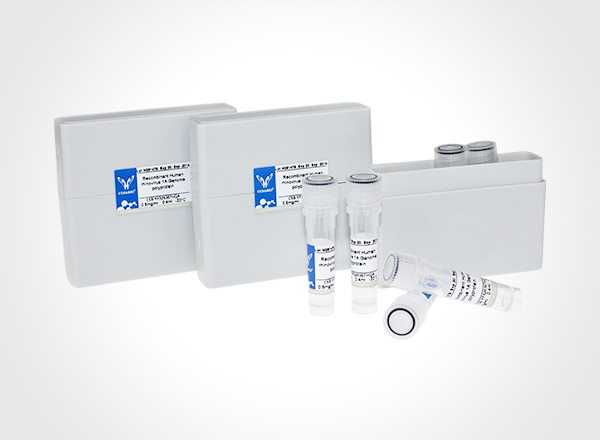
Lamp2; Lamp-2; Lysosome-associated membrane glycoprotein 2; LAMP-2; Lysosome-associated membrane protein 2; CD107 antigen-like family member B; Lysosomal membrane glycoprotein type B; LGP-B; CD antigen CD107b
Species
Mus musculus (Mouse)
Source
in vitro E.coli expression system
Expression Region
26-415
Target Protein Sequence
LIVNLTDSKGTCLYAEWEMNFTITYETTNQTNKTITIAVPDKATHDGSSCGDDRNSAKIMIQFGFAVSWAVNFTKEASHYSIHDIVLSYNTSDSTVFPGAVAKGVHTVKNPENFKVPLDVIFKCNSVLTYNLTPVVQKYWGIHLQAFVQNGTVSKNEQVCEEDQTPTTVAPIIHTTAPSTTTTLTPTSTPTPTPTPTPTVGNYSIRNGNTTCLLATMGLQLNITEEKVPFIFNINPATTNFTGSCQPQSAQLRLNNSQIKYLDFIFAVKNEKRFYLKEVNVYMYLANGSAFNISNKNLSFWDAPLGSSYMCNKEQVLSVSRAFQINTFNLKVQPFNVTKGQYSTAQDCSADEDNFLVPIAVGAALGGVLILVLLAYFIGLKRHHTGYEQF
Note: The complete
sequence may include tag sequence, target protein sequence, linker sequence and extra sequence that is
translated with the protein sequence for the purpose(s) of secretion, stability, solubility, etc.
If the exact amino acid sequence of this recombinant protein is critical to your application,
please explicitly request the full and complete sequence of this protein before ordering.
Protein Length
Full Length of Mature Protein
Tag Info
N-terminal 10xHis-tagged
The tag type will be determined during production process. If you have specified tag type, please tell us and we will develop the specified tag preferentially.
Storage Condition
Store at -20°C, for extended storage, conserve at -20°C or -80°C.
Shelf Life
The shelf life is related to many factors, storage state, buffer ingredients, storage temperature and the stability of the protein itself.
Generally, the shelf life of liquid form is 6 months at -20°C/-80°C. The shelf life of lyophilized form is 12 months at -20°C/-80°C.
Notes
Repeated freezing and thawing is not recommended. Store working aliquots at 4°C for up to one week.
Plays an important role in chaperone-mediated autophagy, a process that mediates lysosomal degradation of proteins in response to various stresses and as part of the normal turnover of proteins with a long biological half-live. Functions by binding target proteins, such as GAPDH and MLLT11, and targeting them for lysosomal degradation. Required for the fusion of autophagosomes with lysosomes during autophagy. Cells that lack LAMP2 express normal levels of VAMP8, but fail to accumulate STX17 on autophagosomes, which is the most likely explanation for the lack of fusion between autophagosomes and lysosomes. Required for normal degradation of the contents of autophagosomes. Plays a role in lysosomal protein degradation in response to starvation. Required for efficient MHCII-mediated presentation of exogenous antigens via its function in lysosomal protein degradation; antigenic peptides generated by proteases in the endosomal/lysosomal compartment are captured by nascent MHCII subunits. Is not required for efficient MHCII-mediated presentation of endogenous antigens.
Gene References into Functions
Lysosomal p38 MAPK directly phosphorylates LAMP2A at T211 and T213, which causes its membrane accumulation and active conformational change, activating chaperone-mediated autophagy.PMID:29176575
The up-regulation of Rab11, Rab7, or RILP, but not its truncated form RILP-C33, rescued LAMP2A-defective trafficking in cystinosis, whereas dominant-negative Rab11 or Rab7 impaired LAMP2A trafficking.PMID:28465352
LAMP-2 in the central nervous system has a possible role in the degradation of the various macromolecules in lysosomes and an additional function concerning protection from oxidative stress, especially in the substantia nigra.PMID:25998250
The absence of LAMP-2 in murine brain led to inflammation and abnormal behavior, including motor deficits and impaired learning.PMID:25637286
Lamp-2 deficiency prevents high-fat diet-induced obese diabetes via enhancing energy expenditure.PMID:26271596
These results suggest that VPS35 deficiency or mutation promotes Parkinson Disease (PD) pathogenesis, and reveals a crucial pathway, VPS35-Lamp2a-alpha-synuclein, to prevent PD pathogenesis.PMID:26203154
The chaperone-mediated autophagy receptor LAMP2A is downregulated in cystinotic cells.PMID:25586965
deletion of the gene encoding LAMP-2A in T cells caused deficient in vivo responses to immunization or infection with Listeria monocytogenes.PMID:25263126
Restoration of lysosome-associated membrane protein-2 levels synergizes with partial BECLIN-1 knockdown to restore autophagosome processing and to attenuate cell death after hypoxia-reoxygenation.PMID:22592897
results suggest that LAMP-2, its luminal domain in particular, plays a critical role in endosomal cholesterol transport and that this is distinct from the chaperone-mediated autophagy function of LAMP-2PMID:19929948
LAMP-2 has a role in lysosome biogenesis and autophagyPMID:12221139
Danon's disease resulted from a yet undescribed deletion in exon 7 of lamp-2 gene.PMID:12398843
Sequencing of LAMP-2 gene showed a novel S157X mutation in exon 4.PMID:15792868
This study describe two cases of Danon disease with different clinical presentation, in whom we identified the same exon skipping mutation c.928G>A in the LAMP-2 gene.PMID:16217705
results support that changes in the dynamic distribution of LAMP-2A into and out of discrete microdomains of the lysosomal membrane contribute to regulate CMAPMID:16917501
This study underlines the importance of LAMP-2 for the maturation of phagosomes in polymorphonuclear leukocytes.PMID:18097049
Results show that LAMP-2A organizes at the lysosomal membrane into protein complexes of different sizes.PMID:18644871
Experimental investigation of five specific genes, AP3B1, ATP6AP1, BLOC1S1, LAMP2, and RAB11A, has confirmed novel roles for these proteins in the proper initiation of macroautophagy in amino acid-starved fibroblasts.PMID:19246570
Show
More
Hide
All
Subcellular Location
Cell membrane; Single-pass type I membrane protein. Endosome membrane; Single-pass type I membrane protein. Cytoplasmic vesicle, autophagosome membrane. Lysosome membrane; Single-pass type I membrane protein. Note=This protein shuttles between lysosomes, endosomes, and the plasma membrane.
Protein Families
LAMP family
Tissue Specificity
Detected in liver and kidney (at protein level). Detected in liver and kidney.