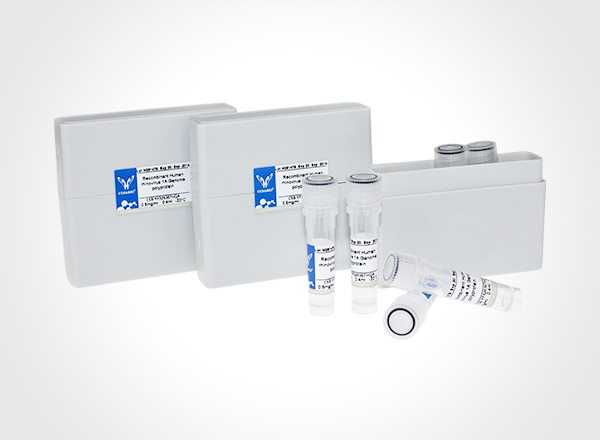
Ms4a2; Fce1b; Fcer1b; Ms4a1; High affinity immunoglobulin epsilon receptor subunit beta; FcERI; Fc epsilon receptor I beta-chain; IgE Fc receptor subunit beta; Membrane-spanning 4-domains subfamily A member 2
Species
Mus musculus (Mouse)
Source
in vitro E.coli expression system
Expression Region
1-235
Target Protein Sequence
MDTENRSRADLALPNPQESSSAPDIELLEASPAKAAPPKQTWRTFLKKELEFLGATQILV GLICLCFGTIVCSVLYVSDFDEEVLLLYKLGYPFWGAVLFVLSGFLSIISERKNTLYLVR GSLGANIVSSIAAGTGIAMLILNLTNNFAYMNNCKNVTEDDGCFVASFTTELVLMMLFLT ILAFCSAVLFTIYRIGQELESKKVPDDRLYEELNVYSPIYSELEDKGETSSPVDS
Note: The complete
sequence may include tag sequence, target protein sequence, linker sequence and extra sequence that is
translated with the protein sequence for the purpose(s) of secretion, stability, solubility, etc.
If the exact amino acid sequence of this recombinant protein is critical to your application,
please explicitly request the full and complete sequence of this protein before ordering.
Protein Length
Full length protein
Tag Info
N-terminal 10xHis-tagged
The tag type will be determined during production process. If you have specified tag type, please tell us and we will develop the specified tag preferentially.
Storage Condition
Store at -20°C, for extended storage, conserve at -20°C or -80°C.
Shelf Life
The shelf life is related to many factors, storage state, buffer ingredients, storage temperature and the stability of the protein itself.
Generally, the shelf life of liquid form is 6 months at -20°C/-80°C. The shelf life of lyophilized form is 12 months at -20°C/-80°C.
Notes
Repeated freezing and thawing is not recommended. Store working aliquots at 4°C for up to one week.
High affinity receptor that binds to the Fc region of immunoglobulins epsilon. Aggregation of FCER1 by multivalent antigens is required for the full mast cell response, including the release of preformed mediators (such as histamine) by degranulation and de novo production of lipid mediators and cytokines. Also mediates the secretion of important lymphokines. Binding of allergen to receptor-bound IgE leads to cell activation and the release of mediators responsible for the manifestations of allergy.
Gene References into Functions
Analysis of the conformation and thermal stability of the high-affinity IgE Fc receptor beta chain polymorphic proteins has been presented.PMID:26940508
These observations strongly suggest a novel signaling pathway mediated by the cytoplasmic tail downstream of the FcepsilonRIbeta immunoreceptor tyrosine-based activation motif.PMID:21683687
FcRbeta is a critical element in mast cell synergistic degranulation response through FcepsilonRI & adenosine receptors. PI3K-signaling through FcRbeta-ITAM is a crucial participant in augmentation of FcepsilonRI-mediated degranulation by adenosine.PMID:20101614
inhibition of FcepsilonRI-dependent mast cell activation can suppress allergic contact dermatitisPMID:19741711
Gene expression profiling after stimulation via high-affinity Fcepsilon receptor I (FcepsilonRI), showed the transcriptional levels of several CC chemokines were markedly increased.PMID:12393595
The mouse Fc epsilon RI beta-chain gene promoter is functional only in mouse mast cell line PT18, but not in mono-macrophage and lymphoma cell lines.PMID:12496417
FcepsilonRIbeta functions to both selectively amplify (degranulation and leukotriene secretion) and dampen (lymphokine) mast cell effector responsesPMID:15355979
IgE receptors are expressed on sensory neurons in mice. Immunostaining revealed that the high affinity IgE receptor FcepsilonRI was expressed in cultured dorsal root ganglion cells.PMID:15486476
FcepsilonRI beta-chain regulates calcium uptake in mast cells via the immunoreceptor tyrosine-based activation motif.PMID:18243160