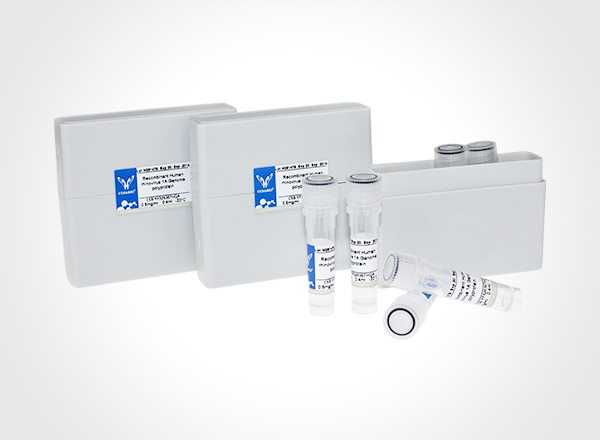
GPR132; G2A; Probable G-protein coupled receptor 132; G2 accumulation protein
Species
Homo sapiens (Human)
Source
in vitro E.coli expression system
Expression Region
1-380
Target Protein Sequence
MCPMLLKNGYNGNATPVTTTAPWASLGLSAKTCNNVSFEESRIVLVVVYSAVCTLGVPAN CLTAWLALLQVLQGNVLAVYLLCLALCELLYTGTLPLWVIYIRNQHRWTLGLLACKVTAY IFFCNIYVSILFLCCISCDRFVAVVYALESRGRRRRRTAILISACIFILVGIVHYPVFQT EDKETCFDMLQMDSRIAGYYYARFTVGFAIPLSIIAFTNHRIFRSIKQSMGLSAAQKAKV KHSAIAVVVIFLVCFAPYHLVLLVKAAAFSYYRGDRNAMCGLEERLYTASVVFLCLSTVN GVADPIIYVLATDHSRQEVSRIHKGWKEWSMKTDVTRLTHSRDTEELQSPVALADHYTFS RPVHPPGSPCPAKRLIEESC
Note: The complete
sequence may include tag sequence, target protein sequence, linker sequence and extra sequence that is
translated with the protein sequence for the purpose(s) of secretion, stability, solubility, etc.
If the exact amino acid sequence of this recombinant protein is critical to your application,
please explicitly request the full and complete sequence of this protein before ordering.
Protein Length
full length protein
Tag Info
N-terminal 10xHis-tagged
The tag type will be determined during production process. If you have specified tag type, please tell us and we will develop the specified tag preferentially.
Storage Condition
Store at -20°C, for extended storage, conserve at -20°C or -80°C.
Shelf Life
The shelf life is related to many factors, storage state, buffer ingredients, storage temperature and the stability of the protein itself.
Generally, the shelf life of liquid form is 6 months at -20°C/-80°C. The shelf life of lyophilized form is 12 months at -20°C/-80°C.
Notes
Repeated freezing and thawing is not recommended. Store working aliquots at 4°C for up to one week.
May be a receptor for oxidized free fatty acids derived from linoleic and arachidonic acids such as 9-hydroxyoctadecadienoic acid (9-HODE). Activates a G alpha protein, most likely G alpha(q). May be involved in apoptosis. Functions at the G2/M checkpoint to delay mitosis. May function as a sensor that monitors the oxidative states and mediates appropriate cellular responses such as secretion of paracrine signals and attenuation of proliferation. May mediate ths accumulation of intracellular inositol phosphates at acidic pH through proton-sensing activity.
Gene References into Functions
G protein-coupled receptor 132 (Gpr132) functions as a key macrophage sensor of the rising lactate in the acidic tumor milieu to mediate the reciprocal interaction between cancer cells and macrophages during breast cancer metastasis. Lactate activates macrophage Gpr132 to promote the alternatively activated macrophage (M2)-like phenotype, which, in turn, facilitates cancer cell adhesion, migration, and invasion.PMID:28049847
High GPR132 expression is associated with acute lymphoblastic leukemia.PMID:27588474
coexpression of OGR1- and G2A-enhanced proton sensitivity and proton-induced calcium signals. This alteration is attributed to oligomerization of OGR1 and G2A. The oligomeric potential locates receptors at a specific site, which leads to enhancedPMID:27049592
we found an additional novel G2A variant (G2A-b) that is the major transcript with functional response to ligand stimulation as well as G2A-a, and succeeded in discriminating proton-sensing and oxidized fatty acid-sensing activities of G2A.PMID:19855098
G2A is a negative modifier of lymphoid leukemogenesis initiated by the BCR-ABL oncogenePMID:12086852
In atherosclerotic plaques of human coronary arterial specimens, G2A is expressed by macrophages within the lipid-rich plaques, whereas no immunoreactivity of G2A is observed in fibrous plaques where macrophages do not exist.PMID:12482833
G2A can activate a specific combination of G proteins, and G2A/LPC-induced apoptosis involves both G alpha(13)- and G alpha(s)-mediated pathwaysPMID:12586833
G2A was not detected in either brain or skin vascular endothelial cell type.PMID:12805023
G2A is a proton-sensing G-protein-coupled receptor antagonized by lysophosphatidylcholinePMID:15280385
Activity of the human G2A receptor is less sensitive to pH fluctuations as measured by inositol phosphate and cAMP accumulation.PMID:15665078
results indicate that G protein-coupled receptor G2A is a receptor for 9-hydroxyoctadecadienoic acid (9-HODE) and other oxidized free fatty acids and is activated by oxidized free fatty acidsPMID:16236715
G2A latent within neutrophil secretory vesicles may facilitate signaling through lysophospholipids for neutrophil activation and calcium flux.PMID:17475884
9-HODE-G2A signaling plays proinflammatory roles in skin under oxidative conditionsPMID:18034171
the G-protein-coupled receptor G2A, unlike its relative GPR4, is involved in the chemotaxis of monocytic cells.PMID:18089568
Show
More
Hide
All
Subcellular Location
Cell membrane; Multi-pass membrane protein.
Protein Families
G-protein coupled receptor 1 family
Tissue Specificity
Highly expressed in macrophages and hematopoietic tissues rich in lymphocytes, like spleen and thymus. Weakly expressed in heart and lung. In atherosclerotic plaques, expression is observed around the lipid core and at the shoulder region.