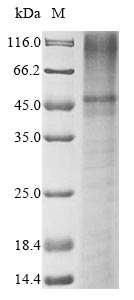
Purity
Greater than 85% as determined by SDS-PAGE.
Alternative Names
KCNK3; TASK; TASK1; Potassium channel subfamily K member 3; Acid-sensitive potassium channel protein TASK-1; TWIK-related acid-sensitive K(+ channel 1; Two pore potassium channel KT3.1; Two pore K(+ channel KT3.1
Species
Homo sapiens (Human)
Source
in vitro E.coli expression system
Expression Region
1-394aa
Target Protein Sequence
MKRQNVRTLALIVCTFTYLLVGAAVFDALESEPELIERQRLELRQQELRARYNLSQGGYEELERVVLRLKPHKAGVQWRFAGSFYFAITVITTIGYGHAAPSTDGGKVFCMFYALLGIPLTLVMFQSLGERINTLVRYLLHRAKKGLGMRRADVSMANMVLIGFFSCISTLCIGAAAFSHYEHWTFFQAYYYCFITLTTIGFGDYVALQKDQALQTQPQYVAFSFVYILTGLTVIGAFLNLVVLRFMTMNAEDEKRDAEHRALLTRNGQAGGGGGGGSAHTTDTASSTAAAGGGGFRNVYAEVLHFQSMCSCLWYKSREKLQYSIPMIIPRDLSTSDTCVEQSHSSPGGGGRYSDTPSRRCLCSGAPRSAISSVSTGLHSLSTFRGLMKRRSSV
Note: The complete
sequence may include tag sequence, target protein sequence, linker sequence and extra sequence that is
translated with the protein sequence for the purpose(s) of secretion, stability, solubility, etc.
If the exact amino acid sequence of this recombinant protein is critical to your application,
please explicitly request the full and complete sequence of this protein before ordering.
Protein Length
Full Length
Tag Info
N-terminal 10xHis-tagged and C-terminal Myc-tagged
The tag type will be determined during production process. If you have specified tag type, please tell us and we will develop the specified tag preferentially.
Reconstitution
We recommend that this vial be briefly centrifuged prior to opening to bring the contents to the bottom. Please reconstitute protein in deionized sterile water to a concentration of 0.1-1.0 mg/mL.We recommend to add 5-50% of glycerol (final concentration) and aliquot for long-term storage at -20°C/-80°C. Our default final concentration of glycerol is 50%. Customers could use it as reference.
Storage Condition
The shelf life is related to many factors, storage state, buffer ingredients, storage temperature and the stability of the protein itself.
Generally, the shelf life of liquid form is 6 months at -20°C/-80°C. The shelf life of lyophilized form is 12 months at -20°C/-80°C.
Shelf Life
The shelf life is related to many factors, storage state, buffer ingredients, storage temperature and the stability of the protein itself.
Generally, the shelf life of liquid form is 6 months at -20°C/-80°C. The shelf life of lyophilized form is 12 months at -20°C/-80°C.
Lead Time
3-7 business days
Note: All of our proteins are default shipped with normal blue ice packs, if you request to ship with dry ice, please communicate with us in advance and extra fees will be charged.
Notes
Repeated freezing and thawing is not recommended. Store working aliquots at 4°C for up to one week.
Datasheet & COA
Please contact us to get it.
Description
This recombinant HumanKCNK3 protein is an in vitro E.coli (cell-free) expressed Full Length protein. Its purity is 85%+ determined by SDS-PAGE. Cell-free protein expression is the in vitro synthesis of a protein using translation-compatible extracts of whole cells. In principle, whole-cell extracts contain all the macromolecules and components needed for transcription, translation, and even post-translational modification. These components include RNA polymerase, regulatory protein factors, transcription factors, ribosomes, and tRNA. When supplemented with cofactors, nucleotides, and the specific gene template, these extracts can synthesize proteins of interest in a few hours.
KCNK3 is an acid-sensitive potassium channel responsible for the regulation of plasma membrane resting potential of human pulmonary artery smooth muscle cells (PASMCs). It mediates outward potassium ions current to counteract depolarization-induced calcium ions influx. Mutations in KCNK3 have been considered as a rare cause of both familial and idiopathic pulmonary arterial hypertension (PAH). The reduced KCNK3 activities caused by mutations probably lead to depolarization of the resting membrane potential, which could result in vasoconstriction and pulmonary artery remodeling. Besides, KCNK3 negatively modulates thermogenesis by inhibiting cAMP-PKA signaling.