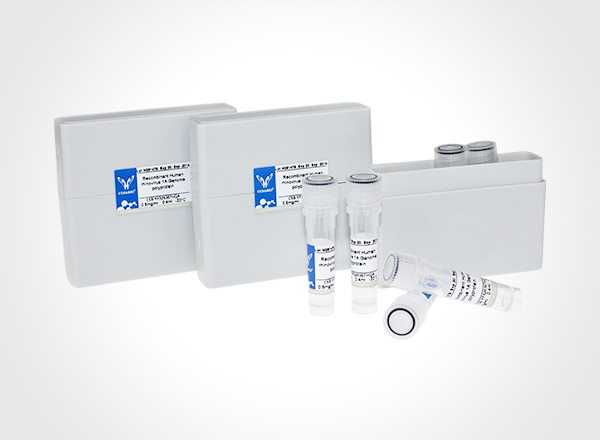
CD antigen CD159c; CD159 antigen like family member C; CD159 antigen-like family member C; CD159c; Killer cell lectin like receptor subfamily C, member 2; KLRC2; NK cell receptor C; NKG2-C type II integral membrane protein; NKG2-C-activating NK receptor; NKG2C activating NK receptor; NKG2C; NKG2C_HUMAN
Species
Homo sapiens (Human)
Source
in vitro E.coli expression system
Expression Region
1-231
Target Protein Sequence
MSKQRGTFSEVSLAQDPKRQQRKPKGNKSSISGTEQEIFQVELNLQNPSLNHQGIDKIYDCQGLLPPPEKLTAEVLGIICIVLMATVLKTIVLIPFLEQNNSSPNTRTQKARHCGHCPEEWITYSNSCYYIGKERRTWEESLLACTSKNSSLLSIDNEEEMKFLASILPSSWIGVFRNSSHHPWVTINGLAFKHKIKDSDNAELNCAVLQVNRLKSAQCGSSMIYHCKHKL
Note: The complete
sequence may include tag sequence, target protein sequence, linker sequence and extra sequence that is
translated with the protein sequence for the purpose(s) of secretion, stability, solubility, etc.
If the exact amino acid sequence of this recombinant protein is critical to your application,
please explicitly request the full and complete sequence of this protein before ordering.
Protein Length
full length protein
Tag Info
10xHis-SUMO-tag
The tag type will be determined during production process. If you have specified tag type, please tell us and we will develop the specified tag preferentially.
Storage Condition
Store at -20°C, for extended storage, conserve at -20°C or -80°C.
Shelf Life
The shelf life is related to many factors, storage state, buffer ingredients, storage temperature and the stability of the protein itself.
Generally, the shelf life of liquid form is 6 months at -20°C/-80°C. The shelf life of lyophilized form is 12 months at -20°C/-80°C.
Notes
Repeated freezing and thawing is not recommended. Store working aliquots at 4°C for up to one week.
Immune activating receptor involved in self-nonself discrimination. In complex with KLRD1 on cytotoxic lymphocyte subsets, recognizes non-classical major histocompatibility (MHC) class Ib HLA-E loaded with signal sequence-derived peptides from non-classical MHC class Ib HLA-G molecules, likely playing a role in the generation and effector functions of adaptive natural killer (NK) cells and in maternal-fetal tolerance during pregnancy. Regulates the effector functions of terminally differentiated cytotoxic lymphocyte subsets, and in particular may play a role in adaptive NK cell response to viral infection. Upon HLA-E-peptide binding, transmits intracellular signals via the adapter protein TYROBP/DAP12, triggering the phosphorylation of proximal signaling molecules and cell activation.
Gene References into Functions
a 16kb deletion encompassing the NKG2C gene is associated with lower carotid intimal media thickness values and higher humoral and T-cell responses to cytomegalovirus in renal transplant recipientsPMID:28987961
the data of this study extend the characterization of adaptive NK cell subsets that differentiate in response to human Cytomegalovirus, supporting a relationship between their distribution and NKG2C copy numberPMID:26994220
The new method offers the potential to use SNP arrays from genome wide association studies to study the frequency of KLRC2 deletion in other populations and its association with other diseasesPMID:27312142
Assessment of NK cell repertoires in 60 NKG2C(-/-) donors revealed a broad range of NK cell populations displaying characteristic footprints of adaptive NK cells, including a terminally differentiated phenotype, functional reprogramming, and epigenetic remodeling of the interferon (IFN)-gamma promoter.PMID:27117418
HLA-E regulates NKG2C+ natural killer cell function through presentation of a restricted peptide repertoirePMID:26382247
genetic polymorphism is not associated with nasopharyngeal carcinoma in ChinaPMID:25636564
Data suggest the proinflammatory potential of NKG2C(bright) NK cells.PMID:25667418
lack of expression of NKG2C may be associated with altered control of human cytomegalovirus infection in childhoodPMID:25150297
No difference in the prevalence of NKG2C deletion was observed.PMID:24305414
NKG2C receptor deletion and a functional polymorphism in its ligand HLA-E may play a role in psoriasis susceptibilityPMID:24079744
NKG2C(hi)CD57+ NK cells respond specifically to acute infection with cytomegalovirus and not Epstein-Barr virus.PMID:24740502
NKG2Cnull does not seem to constitute a risk factor for HPV-induced cervical lesions.PMID:23911737
NKG2C zygosity influences CD94/NKG2C receptor function and the NK-cell compartment redistribution in response to human cytomegalovirus.PMID:24030638
coexpression of killer cell Ig-like receptor (KIR) and NKG2C on expanded NK cell subsets could be related to a functional contribution of KIR in cytomegalovirus infectionPMID:23918974
NKG2Chi CD57hi natural killer cells are highly responsive to human cytomegalovirus-infected macrophages only in the presence of HCMV-specific antibodies, whereas they are functionally poor effectors of natural cytotoxicity.PMID:23637420
The increased expression of NKG2C in HIV patients indicate that NKG2C is important in the defense against HIV infection and progression.PMID:22074011
A significantly elevated proportion of ex vivo peripheral blood CD4 T cells, but not CD8 T cells or natural killer (NK) cells, from multiple sclerosis patients express NKG2C, which contributes to tissue injury.PMID:23396942
HCMV-infected NKG2C(+/+) children displayed higher absolute numbers of NKG2A(+) and total NK cells than NKG2C(+/-) individuals.PMID:22965785
expression by Vdelta2+ T cells is lower in pregnant womenPMID:19395088
CD94/NKG2C might be involved in triggering cytotoxic lymphocytes in patients with Toxic epidermal necrolysis and Stevens-Johnson syndromePMID:20132973
Common occurrence of NKG2-C gene deletion in the general population.PMID:12618865
NKG2C is not essential for survival and reproduction, and is not associated with rheumatic diseasesPMID:14688071
strict gene regulatory mechanisms for CD94 and NKG2 gene expression on CD4+ cellsPMID:15550116
CD94/NKG2C may constitute an alternative T cell activation pathway capable of driving the expansion and triggering the effector functions of a cytotoxic T cell subset.PMID:15940674
Show
More
Hide
All
Subcellular Location
Cell membrane; Single-pass type II membrane protein.
Tissue Specificity
Expressed in NK cell subsets, in particular in adaptive CD57-positive NK cells (at protein level). Expressed in terminally differentiated cytotoxic gamma-delta T cells (at protein level). Expressed in alpha-beta T cells subsets (at protein level). KLRD1-K