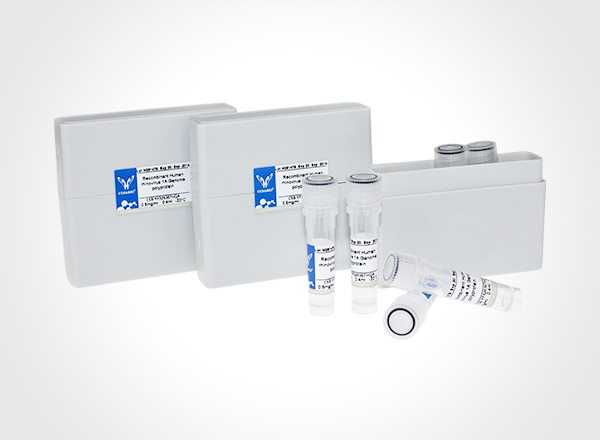
Recombinant Danio rerio Rhodopsin (rho)

Code: CSB-CF019681DIL
Size:
20μg
20μg100μg
US$5143
Quantity:
Express system: in vitro E.coli expression system
Species: Danio rerio (Zebrafish) (Brachydanio rerio)
Tag Info: N-terminal 10xHis-tagged
For inquiries on large quantities or another requirements
Send an Inquiry
Start an on-line Chat
Online ordering is currently available for U.S. customers only. For orders outside the U.S., please kindly submit an inquiry or start a chat with us.

Product Details

Target Names
rho
Uniprot NO.
Alternative Names
rho; zfo2; Rhodopsin
Species
Danio rerio (Zebrafish) (Brachydanio rerio)
Source
in vitro E.coli expression system
Expression Region
1-354
Target Protein Sequence
MNGTEGPAFYVPMSNATGVVRSPYEYPQYYLVAPWAYGLLAAYMFFLIITGFPVNFLTLY VTIEHKKLRTPLNYILLNLAIADLFMVFGGFTTTMYTSLHGYFVFGRLGCNLEGFFATLG GEMGLWSLVVLAIERWMVVCKPVSNFRFGENHAIMGVAFTWVMACSCAVPPLVGWSRYIP EGMQCSCGVDYYTRTPGVNNESFVIYMFIVHFFIPLIVIFFCYGRLVCTVKEAAAQQQES ETTQRAEREVTRMVIIMVIAFLICWLPYAGVAWYIFTHQGSEFGPVFMTLPAFFAKTSAV YNPCIYICMNKQFRHCMITTLCCGKNPFEEEEGASTTASKTEASSVSSSSVSPA
Note: The complete sequence may include tag sequence, target protein sequence, linker sequence and extra sequence that is translated with the protein sequence for the purpose(s) of secretion, stability, solubility, etc.
If the exact amino acid sequence of this recombinant protein is critical to your application, please explicitly request the full and complete sequence of this protein before ordering.
Protein Length
full length protein
Tag Info
N-terminal 10xHis-tagged
The tag type will be determined during production process. If you have specified tag type, please tell us and we will develop the specified tag preferentially.
Storage Condition
Store at -20°C, for extended storage, conserve at -20°C or -80°C.
Shelf Life
The shelf life is related to many factors, storage state, buffer ingredients, storage temperature and the stability of the protein itself.
Generally, the shelf life of liquid form is 6 months at -20°C/-80°C. The shelf life of lyophilized form is 12 months at -20°C/-80°C.
Notes
Repeated freezing and thawing is not recommended. Store working aliquots at 4°C for up to one week.
Troubleshooting and FAQs
Datasheet & COA
Please contact us to get it.

Customer Reviews and Q&A

 Customer Reviews

Target Background

Function(From Uniprot)
Photoreceptor required for image-forming vision at low light intensity. While most salt water fish species use retinal as chromophore, most freshwater fish use 3-dehydroretinal, or a mixture of retinal and 3-dehydroretinal. Light-induced isomerization of 11-cis to all-trans retinal triggers a conformational change that activates signaling via G-proteins. Subsequent receptor phosphorylation mediates displacement of the bound G-protein alpha subunit by arrestin and terminates signaling.
Gene References into Functions
  1. The efficiency of CRISPR/Cas9 for gene targeting, coupled with the large number of mutations associated with retinitis pigmentosa, provided a backdrop for the rapid isolation of novel alleles in zebrafish that phenocopy disease. PMID:30210230
  2. overexpression of full-length rhodopsin or its cytoplasmic tail domain, but not of rhodopsin lacking the cytoplasmic tail, exacerbated rod degeneration in kif3a mutants, implying an important role of the cytoplasmic tail in rod degeneration. PMID:28855254
  3. expression as well as the protein localization of rhodopsin in the zebrafish from larval to adult stage were demonstrated; results demonstrated the involvement of rhodopsin in the zebrafish pineal gland physiology particularly in light capture during the zebrafish lifespan PMID:22306032
  4. Mitogen-associated protein kinase and protein kinase A regulate rhodopsin transcription through parallel signal transduction pathways PMID:17183589

Show More

Hide All

Subcellular Location
Membrane; Multi-pass membrane protein. Cell projection, cilium, photoreceptor outer segment.
Protein Families
G-protein coupled receptor 1 family, Opsin subfamily
Tissue Specificity
Retinal rod photoreceptor cells, predominantly in the outer segments (at protein level). Retinal rod photoreceptor cells.
Database Links

UNIGENE: Dr.354

KEGG: dre:30295

STRING: 7955.ENSDARP00000011562

icon of phone
Call us
301-363-4651 (Available 9 a.m. to 5 p.m. CST from Monday to Friday)

icon of address
Address
No. 269, Shendun 5th Road, Donghu Hi-Tech Development Area, Hubei Province, 430206, P.R.China
icon of social media
Join us with

Subscribe newsletter

Leave a message

* To protect against spam, please pass the CAPTCHA test below.
CAPTCHA verification
© 2007-2025 CUSABIO TECHNOLOGY LLC All rights reserved. 鄂ICP备15011166号-1
Select 0 Products