Tag-Free
The tag type will be determined during production process. If you have specified tag type, please tell us and we will develop the specified tag preferentially.
Buffer
35% FBS + 55% DMEM + 10% DMSO
Storage
Frozen in liquid nitrogen or -80°C
Lead Time
Basically, we can dispatch the products out in 1-3 working days after receiving your orders. Delivery time maybe differs from different purchasing way or location, please kindly consult your local distributors for specific delivery time.
Note: All of our proteins are default shipped with normal blue ice packs, if you request to ship with dry ice, please communicate with us in advance and extra fees will be charged.
Images
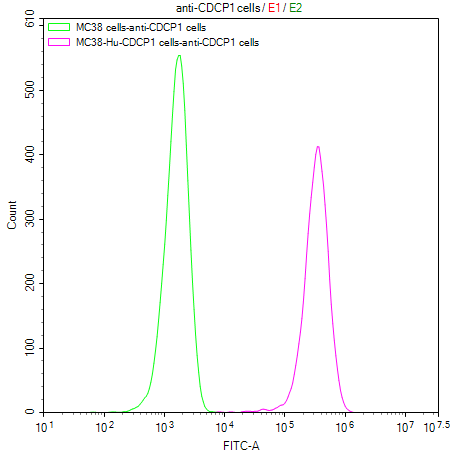
Untransfected MC38 cells (green line) and transfected Human CDCP1 MC38 stable cells (red line) were stained with anti-CDCP1 antibody (2µg/1*106cells), washed and then followed by FITC-conjugated anti-Human IgG Fc antibody and analyzed with flow cytometry.
May be involved in cell adhesion and cell matrix association. May play a role in the regulation of anchorage versus migration or proliferation versus differentiation via its phosphorylation. May be a novel marker for leukemia diagnosis and for immature hematopoietic stem cell subsets. Belongs to the tetraspanin web involved in tumor progression and metastasis.
Gene References into Functions
Expression of CDCP1 was reduced by AHCC treatment of KLM1-R cells, whereas expression of actin was not affected. The ratio of intensities of CDCP1/actin in AHCC-treated KLM1-R cells was significantly suppressed (p<0.05) compared to untreated cells.PMID:30396925
Co-expression of CDCP1 and AXL is often observed in EGFR-mutation-positive tumors, limiting the efficacy of EGFR TKIs. Co-treatment with EGFR TKI and TPX-0005 warrants testing.PMID:29433983
CDCP1 knockdown reduced 3D invasion, which can be rescued by ACSL3 co-knockdown. In vivo, inhibiting CDCP1 activity with an engineered blocking fragment (extracellular portion of cleaved CDCP1) lead to increased LD abundance in primary tumors, decreased metastasis, and increased ACSL activity in two animal models of TNBC.PMID:28739932
These results revealed that ADAM9 down-regulates miR-1 via activating EGFR signaling pathways, which in turn enhances CDCP1 expression to promote lung cancer progression.PMID:28537886
CDCP1 is a novel marker of the most aggressive N-positive triple-negative breast cancers; CDCP1 expression and gains in CDCP1 copy number synergized with nodal (N) status in determining disease-free and distant disease-free survivalPMID:27626701
High expression level of CDCP1 is associated with recurrence in glioblastoma.PMID:26956052
These studies have important implications for the development of a therapeutic to block CDCP1 activity and Triple-negative breast cancer (TNBC)metastasis.PMID:26876198
CDCP1 may facilitate loss of adhesion by promoting activation of EGFR and Src at sites of cell-cell and cell-substratum contact.PMID:27495374
Stromal expression patterns for both ADAM12 and CDCP1.PMID:27685922
these data demonstrated that HIF-2alpha could promote hepatocellular carcinoma cell migration by regulating CDCP1PMID:26307391
Our results establish that differential glycosylation, cell surface presentation and extracellular expression of CDCP1 are hallmarks of prostate cancer progression.PMID:26497208
High CDCP1 expression is associated with Colorectal Cancer.PMID:25820997
ADAM9 enhances CDCP1 protein expression by suppressing miR-218 for lung tumor metastasisPMID:26553452
Elevated CDCP1 was observed in 77% of HGSC cases. Silencing of CDCP1 reduced migration and non-adherent cell growth in vitro and tumour burden in vivo.PMID:26882065
CDCP1 protein plays an important role in the progression of ovarian clear cell carcinoma. Elevated CDCP1 levels correlates with poor patient outcome in ovarian clear cell carcinoma patients.PMID:25893298
Multiple tyrosine phosphorylation sites of CDCP1 are important for the functional regulation of SFKs in several tumor types.PMID:25728678
These data suggest CDCP1 expression can be used to identify a subset of marrow fibroblasts functionally distinct from CD146+ fibroblasts.PMID:25275584
The aim of this study was to examine whether activation of Trask may be potentially important in brain metastasis of lung cancers, the commonest site of organ spread and producing the deadliest consequences.PMID:25775948
decreased CDCP1 expression promoted the invasive and migratory abilities of esophageal cancer cell lines.PMID:24849519
CDCP1 protein induced by oncogenic Ras/Erk signaling is essential for Ras-mediated metastatic potential of cancer cells.PMID:24939643
CDCP1 modulates cell-substratum adhesion and motility in colon cancer cell lines.PMID:25301083
EGF increases the lifespan of CDCP1 promoting its availability on the cell surface where the data indicate it is available to mediate procancer phenotypes such as cell migration.PMID:24681947
CDCP1 is an essential regulator of the trafficking and function of MT1-MMP- and invadopodia-mediated invasion of cancer cells.PMID:23439492
CDCP1 represses the epithelial phenotype of pancreatic cancer cells.PMID:24384474
Complexing of beta1 integrin the 70-kDa with CDCP1 fragment induced intracellular phosphorylation signaling, involving focal adhesion kinase-1 (FAK) and PI3 kinase (PI3K)-dependent Akt activationPMID:23208492
Expression and phosphorylation of exogenous CDCP1 by Fyn kinase reduced the formation of autophagosomes.PMID:23510015
In migrating cancer stem cells isolated from primary human colorectal cancers, CD110(+) and CDCP1(+) subpopulations mediate organ-specific lung and liver metastasis.PMID:23747337
strongly expressed in tumors derived from lung, colon, ovary, or kidney. for a full transformation capacity, the intact amino- and carboxy-termini of CDCP1 are essential.PMID:23300860
These data support a critical role for CDCP1 as a unique HIF-2alpha target gene involved in the regulation of cancer metastasis.PMID:23378636
Secreted CDCP1 can be a useful genetic marker for the diagnosis of metastatic prostate cancer.PMID:22457534
a novel role for CDCP1 in EGF/EGFR-induced cell migration and indicate that targeting of CDCP1 may be a rational approach to inhibit progression of cancers driven by EGFR signalingPMID:22315226
Data show that the signaling events that accompany the CDCP1 tyrosine phosphorylation observed in cell lines and lung tumors may explain how the CDCP1/SFK complex regulates motility and adhesion.PMID:21725358
Trask as one of several potential candidates for functionally relevant tumor suppressors on the 3p21.3 region of the genome frequently lost in human cancers.PMID:21706059
analysis of cellular settings mediating Src Substrate switching between focal adhesion kinase tyrosine 861 and CUB-domain-containing protein 1 (CDCP1) tyrosine 734PMID:21994943
CDCP1 is selectively expressed in ovarian tumor vasculaturePMID:21617380
CUB domain-containing protein 1 (CDCP1) is a substrate of Src family kinases and has been shown to regulate anoikis resistance, migration and matrix degradation during tumor invasion and metastasis in a tyrosine phosphorylation-dependent manner. Review.PMID:21812858
analysis of structural features of Trask that mediate its anti-adhesive functionsPMID:21559459
Src-Trask signaling and Src-focal adhesion signaling inactivate each other, constituting two opposing modes of phosphotyrosine signaling that define a switch underlining cell anchorage state.PMID:21490433
Data provide molecular mechanisms for the metastasis-enhancing functions of CDCP1.PMID:21220330
Signal transduction from CDCP1 to PKCdelta leads to its activation, increasing migration of CC-RCC. Furthermore, patient survival can be stratified by CDCP1 expression at the cell surface of the tumorPMID:21233420
Trask signaling and focal adhesion signaling inactivate each other and signal in exclusion with each other, constituting a switch that underlies cell anchorage state.PMID:21189288
biological role of this protein and, potentially, its function in cancer, may be mediated by both 70-kDa cell retained and 65-kDa shed fragments, as well as the full-length 135-kDa protein.PMID:20551327
Overexpression of CDCP1 is associated with pancreatic cancers.PMID:20501830
In endometrioid adenocarcinoma low CDCP1 and advanced stage were independent poor prognostic factors for both overall and disease-free survival.PMID:20372833
findings indicate a functional role for CDCP1 in cancer and underscore the therapeutic potential of function-blocking anti-CDCP1 antibodies targeting both primary and metastatic carcinoma cellsPMID:19916495
antibodies generated by subtractive immunization used to purify, identify and partially characterize SIMA135/CDCP1; properties indicate it is a multidomain cell surface antigen, highly expressed by certain cancer cells and normal and cancerous colonPMID:12660814
tyrosine phosphorylation of CDCP1 is regulated by adhesion or plasmin in epithelial cellsPMID:14739293
CDCP1 is not only a novel marker for immature hematopoietic progenitor cell subsets but also unique in its property to recognize cells with phenotypes reminiscent of MSC and NPC.PMID:15153610
When CDCP1 promoter was transfected exogenously, Jurkat showed comparable promoter activity with K562, suggesting that the factor to enhance transcription was present but interfered to function in JurkatPMID:16926850
Show
More
Hide
All
Subcellular Location
[Isoform 1]: Cell membrane; Single-pass membrane protein. Note=Shedding may also lead to a soluble peptide.; [Isoform 3]: Secreted.
Tissue Specificity
Highly expressed in mitotic cells with low expression during interphase. Detected at highest levels in skeletal muscle and colon with lower levels in kidney, small intestine, placenta and lung. Up-regulated in a number of human tumor cell lines, as well a