Tag-Free
The tag type will be determined during production process. If you have specified tag type, please tell us and we will develop the specified tag preferentially.
Buffer
35% FBS + 55% DMEM + 10% DMSO
Storage
Frozen in liquid nitrogen or -80°C
Lead Time
Basically, we can dispatch the products out in 1-3 working days after receiving your orders. Delivery time maybe differs from different purchasing way or location, please kindly consult your local distributors for specific delivery time.
Note: All of our proteins are default shipped with normal blue ice packs, if you request to ship with dry ice, please communicate with us in advance and extra fees will be charged.
Images
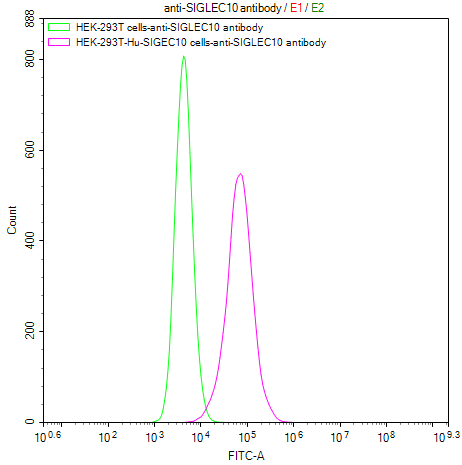
Untransfected HEK-293T cells (green line) and transfected Human SIGLEC10 HEK-293T stable cells (red line) were stained with anti-SIGLEC10 antibody (CSB-RA842706MA1HU) (2µg/1*106cells), washed and then followed by FITC-conjugated anti-Human IgG Fc antibody and analyzed with flow cytometry.
Putative adhesion molecule that mediates sialic-acid dependent binding to cells. Preferentially binds to alpha-2,3- or alpha-2,6-linked sialic acid. The sialic acid recognition site may be masked by cis interactions with sialic acids on the same cell surface. In the immune response, seems to act as an inhibitory receptor upon ligand induced tyrosine phosphorylation by recruiting cytoplasmic phosphatase(s) via their SH2 domain(s) that block signal transduction through dephosphorylation of signaling molecules. Involved in negative regulation of B-cell antigen receptor signaling. The inhibition of B cell activation is dependent on PTPN6/SHP-1. In association with CD24 may be involved in the selective suppression of the immune response to danger-associated molecular patterns (DAMPs) such as HMGB1, HSP70 and HSP90. In association with CD24 may regulate the immune repsonse of natural killer (NK) cells. Plays a role in the control of autoimmunity. During initiation of adaptive immune responses by CD8-alpha(+) dendritic cells inhibits cross-presentation by impairing the formation of MHC class I-peptide complexes. The function seems to implicate recruitment of PTPN6/SHP-1, which dephosphorylates NCF1 of the NADPH oxidase complex consequently promoting phagosomal acidification.
Gene References into Functions
soluble CD52 exerts a concerted immunosuppressive effect by first sequestering HMGB1 to nullify its proinflammatory Box B, followed by binding to the inhibitory Siglec-10 receptor, triggering recruitment of SHP1 to the intracellular immunoreceptor tyrosine-based inhibitory motif of Siglec-10 and its interaction with the TCR.PMID:29997173
Siglec-10 is associated with decreased survival and impaired NK cell function in human hepatocellular carcinoma (HCC).PMID:25450598
Siglec-10-VAP-1 interaction seems to mediate lymphocyte adhesion to endotheliumPMID:19861682
Show
More
Hide
All
Subcellular Location
[Isoform 1]: Cell membrane; Single-pass type I membrane protein.; [Isoform 2]: Cell membrane; Single-pass type I membrane protein.; [Isoform 3]: Cell membrane; Single-pass type I membrane protein.; [Isoform 4]: Cell membrane; Single-pass type I membrane protein.; [Isoform 5]: Secreted.
Protein Families
Immunoglobulin superfamily, SIGLEC (sialic acid binding Ig-like lectin) family
Tissue Specificity
Expressed by peripheral blood leukocytes (eosinophils, monocytes and a natural killer cell subpopulation). Isoform 5 is found to be the most abundant isoform. Found in lymph node, lung, ovary and appendix. Isoform 1 is found at high levels and isoform 2 a