Tag-Free
The tag type will be determined during production process. If you have specified tag type, please tell us and we will develop the specified tag preferentially.
Buffer
35% FBS + 55% F-12K + 10% DMSO
Storage
Frozen in liquid nitrogen or stored at -80°C
Lead Time
Basically, we can dispatch the products out in 1-3 working days after receiving your orders. Delivery time maybe differs from different purchasing way or location, please kindly consult your local distributors for specific delivery time.
Note: All of our proteins are default shipped with normal blue ice packs, if you request to ship with dry ice, please communicate with us in advance and extra fees will be charged.
Images
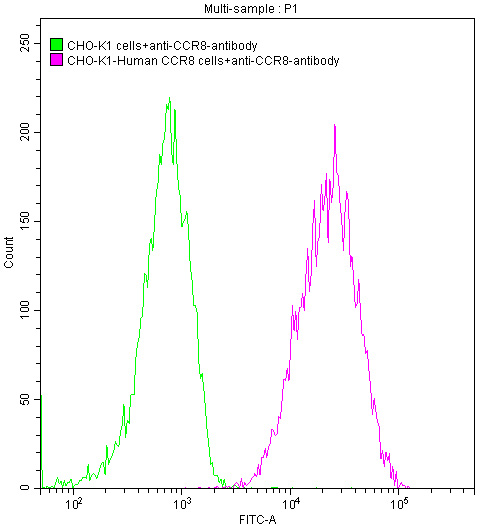
Untransfected CHO-K1 cells (green line) and transfected Human CCR8 CHO-K1 stable cells (red line) were stained with anti-CCR8 antibody (CSB-RA004847A1HU) (2µg/1*106cells), washed and then followed by FITC-conjugated anti-Human IgG Fc antibody and analyzed with flow cytometry.
Receptor for the chemokine CCL1/SCYA1/I-309. May regulate monocyte chemotaxis and thymic cell line apoptosis. Alternative coreceptor with CD4 for HIV-1 infection.
Gene References into Functions
Authors demonstrate the pivotal role of CCR8(+) Treg cells in restraining immunity and highlight the potential clinical implications of this discovery.PMID:28533380
Role of Conserved Disulfide Bridges and Aromatic Residues in Extracellular Loop 2 of Chemokine Receptor CCR8 for Chemokine and Small Molecule Binding.PMID:27226537
High CCR8 expression is associated with high recurrence in kidney cancer.PMID:26716905
findings suggest that CCR8 expression in ALCL is more closely related to the presence of DUSP22 rearrangements than to cutaneous involvement and that the function of CCR8 may extend beyond its skin-homing properties in this diseasePMID:25390351
Epidermal-derived vitamin D3 metabolites and prostaglandins provide an essential cue for the localization of CCR8+ immune surveillance T cells within healthy human skin.PMID:26002980
CCL1-CCR8 interaction may play a critical role in lymphocytic recruitment in IgG4-related sclerosing cholangitis and type 1 autoimmune pancreatitis, leading to duct-centred inflammation and obliterative phlebitis.PMID:23811304
Identification of human CCR8 as a CCL18 receptor.PMID:23999500
CCR8(+) myeloid cell subset is expanded in patients with cancer.PMID:23363815
Data show that CCR8 expression by newly activated naive T cells is regulated by skin-specific factor(s) derived primarily from epidermal keratinocytes.PMID:23043070
C-terminal clipping of chemokine CCL1/I-309 enhances CCR8-mediated intracellular calcium release and anti-apoptotic activityPMID:22479563
The functional data from human macrophages suggest a potential cross talk between the CCR8 and the Toll-like receptor 4 (TLR4) pathways, both of which are present in chronic obstructive pulmonary disease patients.PMID:21976223
There may be a role for CCR8 in the recruitment of T cells to the lung in asthmatics.PMID:20455898
CCR8 mediates rescue from dexamethasone-induced apoptosis via an ERK-dependent pathwayPMID:12525579
found in the central nervous system and is associated with phagocytic macrophagesPMID:12547701
CCR8 genes and surrounding genomic regions these genes are the result of the duplication of an ancestral gene prior to the divergence of teleost fish.PMID:12551893
Transfected human CCR8-dependent activation of the RAS/MAPK pathway mediates anti-apoptotic activity of I-309/ CCL1 and vMIP-I.PMID:12645948
The induction of CCR8 under conditions associated with vascular smooth muscle cell proliferation and migration raises the possibility that CCR8 may play an important role in vessel wall pathology.PMID:14576057
the axis CCL1-CCR8 links adaptive and innate immune functions that play a role in the initiation and amplification of atopic skin inflammationPMID:15814739
CCR8 ligands are allotropic, binding to distinct sites within CCR8; the human immune system may have evolved to use CCL7 as a selective antagonist of viral chemokine activity at CCR8 but not those of the host ligandPMID:17023422
CCR8 is expressed by a small and heterogeneous population of peripheral blood CD4 memory T cells enriched in T helper type 2 (Th2) effector and T regulatory (Treg) cells.PMID:17082609
CCR8-expressing CD4-positive T lymphocytes are preferentially recruited from the periphery into the lungs of asthmatic individuals, driven by elevated CCL1 levels produced almost exclusively by mast cells and basophils.PMID:17641040
The combination of 17beta-E(2) with the environmental pollutant TCDD is involved in the pathogenesis of endometriosis via up-regulating the chemokine CCR8-I-309.PMID:17693327