Recombinant rat Receptor-interacting serine/threonine-protein kinase 3 (Ripk3)

Code: CSB-BP897497RA
Size:
20ug
20ug100ug1mg(1mg*1 or 500ug*2)
US$528
Quantity:
Express system: Baculovirus
Species: Rattus norvegicus (Rat)
Tag Info: N-terminal 10xHis-tagged and C-terminal Myc-tagged
For inquiries on large quantities or another requirements
Send an Inquiry
Start an on-line Chat
Online ordering is currently available for U.S. customers only. For orders outside the U.S., please kindly submit an inquiry or start a chat with us.

Product Details

Purity
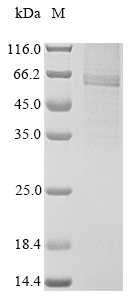
Greater than 85% as determined by SDS-PAGE.
Target Names
Ripk3
Uniprot NO.
Research Area
Cancer
Species
Rattus norvegicus (Rat)
Source
Baculovirus
Expression Region
1-478aa
Target Protein Sequence
MSSVKLWLNGASSISLVGSEELENLGFVGKGGFGAVFRARHTAWNLDVAVKIVNSKKISREVKAMVNLRHENVLLLLGVTENLEWDYVYGPALVTGFMENGSLSGLLQPSCPRPWPLLCRLLEEVVLGMCYLHSLNPSLLHRDLKPSNVLLDPELHAKLADFGLSTFQGGSQSGSGSGSRDSGGTLAYLAPELLDNDGKASKASDVYSFGVLVWTVLAGREAEVVDKTSLIRGAVCNRQRRPPLTELPPDSPETPGLEGLKELMTHCWSSEPKDRPSFQDCESKTNNVYILVQDKVDAAVSKVKHYLSQYRSSDTKLSARESSQKGTEVDCPRETIVYEMLDRLHLEEPSGSVPERLTSLTERRGKEASFGHATPAGTSSDTLAGTPQIPHTLPSRGTTPRPAFTETPGPDPQRNQGDGRNSNPWYTWNAPNPMTGLQSIVLNNCSEVQIGQHNCMSVQPRTAFPKKEPAQFGRGRGW
Note: The complete sequence may include tag sequence, target protein sequence, linker sequence and extra sequence that is translated with the protein sequence for the purpose(s) of secretion, stability, solubility, etc.
If the exact amino acid sequence of this recombinant protein is critical to your application, please explicitly request the full and complete sequence of this protein before ordering.
Mol. Weight
56.1
Protein Length
Full Length
Tag Info
N-terminal 10xHis-tagged and C-terminal Myc-tagged
The tag type will be determined during production process. If you have specified tag type, please tell us and we will develop the specified tag preferentially.
Buffer
Tris-based buffer,50% glycerol
Storage
The shelf life is related to many factors, storage state, buffer ingredients, storage temperature and the stability of the protein itself. Generally, the shelf life of liquid form is 6 months at -20°C/-80°C. The shelf life of lyophilized form is 12 months at -20°C/-80°C.
Shelf Life
The shelf life is related to many factors, storage state, buffer ingredients, storage temperature and the stability of the protein itself.
Generally, the shelf life of liquid form is 6 months at -20°C/-80°C. The shelf life of lyophilized form is 12 months at -20°C/-80°C.
Notes
Repeated freezing and thawing is not recommended. Store working aliquots at 4°C for up to one week.
Troubleshooting and FAQs
Datasheet & COA
Please contact us to get it.
Images
  • (Tris-Glycine gel) Discontinuous SDS-PAGE (reduced) with 5% enrichment gel and 15% separation gel.

Customer Reviews and Q&A

 Customer Reviews

Target Background

Function(From Uniprot)
Serine/threonine-protein kinase that activates necroptosis and apoptosis, two parallel forms of cell death. Necroptosis, a programmed cell death process in response to death-inducing TNF-alpha family members, is triggered by RIPK3 following activation by ZBP1. Activated RIPK3 forms a necrosis-inducing complex and mediates phosphorylation of MLKL, promoting MLKL localization to the plasma membrane and execution of programmed necrosis characterized by calcium influx and plasma membrane damage. In addition to TNF-induced necroptosis, necroptosis can also take place in the nucleus in response to orthomyxoviruses infection: following ZBP1 activation, which senses double-stranded Z-RNA structures, nuclear RIPK3 catalyzes phosphorylation and activation of MLKL, promoting disruption of the nuclear envelope and leakage of cellular DNA into the cytosol. Also regulates apoptosis: apoptosis depends on RIPK1, FADD and CASP8, and is independent of MLKL and RIPK3 kinase activity. Phosphorylates RIPK1: RIPK1 and RIPK3 undergo reciprocal auto- and trans-phosphorylation. In some cell types, also able to restrict viral replication by promoting cell death-independent responses. In response to flavivirus infection in neurons, promotes a cell death-independent pathway that restricts viral replication: together with ZBP1, promotes a death-independent transcriptional program that modifies the cellular metabolism via up-regulation expression of the enzyme ACOD1/IRG1 and production of the metabolite itaconate. Itaconate inhibits the activity of succinate dehydrogenase, generating a metabolic state in neurons that suppresses replication of viral genomes. RIPK3 binds to and enhances the activity of three metabolic enzymes: GLUL, GLUD1, and PYGL. These metabolic enzymes may eventually stimulate the tricarboxylic acid cycle and oxidative phosphorylation, which could result in enhanced ROS production.
Gene References into Functions
  1. Data found another important signaling pathway of RIP3 in the nucleus in the neuronal programmed necrosis induced by cerebral ischemia/reperfusion (I/R) injury. The formation of a RIP3-AIF complex and its nuclear translocation are critical to ischemic neuronal DNA degradation and programmed necrosis. PMID:27377128
  2. RIPK1/RIPK3/MLKL-mediated necroptosis may play an important role in nucleus pulposus (NP) cell death induced by continuous mechanical stress. Treatment strategies which aim to regulate necroptosis may prove beneficial, by both reducing NP cells death and slowing IVD degeneration. PMID:28289909
  3. Shikonin induces glioma cell necroptosis in vitro by reactive oxygen species overproduction and promoting RIP1/RIP3 necrosome formation. PMID:28816233
  4. High receptor-interacting protein 3 expression is associated with Chronic Kidney Disease Progression. PMID:27281190
  5. The levels of receptor-interacting serine/threonine protein kinase 1 (RIP1) and RIP3 in osteocytes were significantly increased at 8 weeks after ovariectomy. PMID:26985994
  6. RIP3-induced activation of CaMKII, via phosphorylation or oxidation or both, triggers opening of the mitochondrial permeability transition pore and myocardial necroptosis. PMID:26726877
  7. These results indicated that necroptosis mediated by RIP1 and RIP3 participates in the loss of renal cells of subtotal nephrectomised rats. PMID:25907058
  8. RIP3-dependent necroptosis modulates post-ischaemic adverse remodelling in a mouse model of myocardial infarction PMID:24920296

Show More

Hide All

Subcellular Location
Cytoplasm, cytosol. Nucleus.
Protein Families
Protein kinase superfamily, TKL Ser/Thr protein kinase family
Database Links
icon of phone
Call us
301-363-4651 (Available 9 a.m. to 5 p.m. CST from Monday to Friday)

icon of address
Address
No. 269, Shendun 5th Road, Donghu Hi-Tech Development Area, Hubei Province, 430206, P.R.China
icon of social media
Join us with

Subscribe newsletter

Leave a message

* To protect against spam, please pass the CAPTCHA test below.
CAPTCHA verification
© 2007-2025 CUSABIO TECHNOLOGY LLC All rights reserved. 鄂ICP备15011166号-1
Select 0 Products