Recombinant Mouse Alpha-fetoprotein (Afp)

In Stock
Code: CSB-YP001421MO
Size:
20ug
20ug100ug1mg(1mg*1 or 500ug*2)
US$368
Quantity:
Express system: Yeast
Species: Mus musculus (Mouse)
Tag Info: N-terminal 6xHis-tagged
For inquiries on large quantities or another requirements
Send an Inquiry
Start an on-line Chat
Online ordering is currently available for U.S. customers only. For orders outside the U.S., please kindly submit an inquiry or start a chat with us.

Product Details

Purity
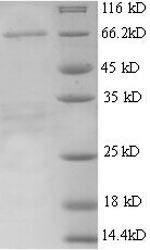
Greater than 90% as determined by SDS-PAGE.
Target Names
Afp
Uniprot NO.
Research Area
Others
Alternative Names
Alpha-1-fetoprotein;Alpha-fetoglobulin
Species
Mus musculus (Mouse)
Source
Yeast
Expression Region
19-605aa
Target Protein Sequence
KALHENEFGIASTLDSSQCVTEKNVLSIATITFTQFVPEATEEEVNKMTSDVLAAMKKNSGDGCLESQLSVFLDEICHETELSNKYGLSGCCSQSGVERHQCLLARKKTAPASVPPFQFPEPAESCKAHEENRAVFMNRFIYEVSRRNPFMYAPAILSLAAQYDKVVLACCKADNKEECFQTKRASIAKELREGSMLNEHVCSVIRKFGSRNLQATTIIKLSQKLTEANFTEIQKLALDVAHIHEECCQGNSLECLQDGEKVMTYICSQQNILSSKIAECCKLPMIQLGFCIIHAENGVKPEGLSLNPSQFLGDRNFAQFSSEEKIMFMASFLHEYSRTHPNLPVSVILRIAKTYQEILEKCSQSGNLPGCQDNLEEELQKHIEESQALSKQSCALYQTLGDYKLQNLFLIGYTRKAPQLTSAELIDLTGKMVSIASTCCQLSEEKWSGCGEGMADIFIGHLCIRNEASPVNSGISHCCNSSYSNRRLCITSFLRDETYAPPPFSEDKFIFHKDLCQAQGKALQTMKQELLINLVKQKPELTEEQLAAVTADFSGLLEKCCKAQDQEVCFTEEGPKLISKTRDALGV
Note: The complete sequence may include tag sequence, target protein sequence, linker sequence and extra sequence that is translated with the protein sequence for the purpose(s) of secretion, stability, solubility, etc.
If the exact amino acid sequence of this recombinant protein is critical to your application, please explicitly request the full and complete sequence of this protein before ordering.
Mol. Weight
67.3kDa
Protein Length
Full Length of Mature Protein
Tag Info
N-terminal 6xHis-tagged
The tag type will be determined during production process. If you have specified tag type, please tell us and we will develop the specified tag preferentially.
Reconstitution
We recommend that this vial be briefly centrifuged prior to opening to bring the contents to the bottom. Please reconstitute protein in deionized sterile water to a concentration of 0.1-1.0 mg/mL.We recommend to add 5-50% of glycerol (final concentration) and aliquot for long-term storage at -20°C/-80°C. Our default final concentration of glycerol is 50%. Customers could use it as reference.
Storage
The shelf life is related to many factors, storage state, buffer ingredients, storage temperature and the stability of the protein itself. Generally, the shelf life of liquid form is 6 months at -20°C/-80°C. The shelf life of lyophilized form is 12 months at -20°C/-80°C.
Shelf Life
The shelf life is related to many factors, storage state, buffer ingredients, storage temperature and the stability of the protein itself.
Generally, the shelf life of liquid form is 6 months at -20°C/-80°C. The shelf life of lyophilized form is 12 months at -20°C/-80°C.
Lead Time
3-7 business days
Note: All of our proteins are default shipped with normal blue ice packs, if you request to ship with dry ice, please communicate with us in advance and extra fees will be charged.
Notes
Repeated freezing and thawing is not recommended. Store working aliquots at 4°C for up to one week.
Troubleshooting and FAQs
Datasheet & COA
Please contact us to get it.
Images
  • (Tris-Glycine gel) Discontinuous SDS-PAGE (reduced) with 5% enrichment gel and 15% separation gel.

Customer Reviews and Q&A

 Customer Reviews

Target Background

Function(From Uniprot)
Binds estrogens, fatty acids and metals.
Gene References into Functions
  1. endogenous AFP expression in the perinatal liver is reduced in the absence of beta-catenin, suggesting that beta-catenin regulates AFP during liver development. PMID:22544812
  2. Findings indicate that AFP expressed under experimental cryptorchid conditions plays a role as a regulatory factor in spermatogenesis and in hepatic generation. PMID:21573244
  3. AFP mRNA and VEGF-C mRNA in peripheral blood were significantly correlated with recurrence and metastasis of hepatocellular carcinoma. PMID:20506647
  4. A DEHP treatment-induced phenotype was identified with lack of glycogen accumula-tion and intracytoplasmic localization of beta-catenin which was associated with increased AFP gene expression. PMID:20307648
  5. The deficits observed in parental behavior of AFP knockout females could not be explained by any changes in olfactory function, novelty recognition or anxiety PMID:20109458
  6. Foxa1 acts as a pioneer transcription factor in de novo activation of Afp, by exploiting a lack of methylation at juxtaposed transposed elements PMID:20348100
  7. The level of AFP mRNA in peripheral blood may indicate recurrence and/or metastasis after curative resection of hepatocellular carcinoma. PMID:12113675
  8. AFP affects cell proliferation by binding its receptor to trigger the signal transduction pathway of cAMP-PKA and alter the expression of K- ras p21 genes PMID:12118941
  9. A murine Nkx2.8 was isolated from the Hepal-6 cell line and showed oligonucleotide binding competitive with fetoprotein transcription factor. PMID:12167706
  10. The mouse alpha-fetoprotein promoter is repressed in HepG2 hepatoma cells by hepatocyte nuclear factor-3 PMID:12215259
  11. AFP has a role in female fertility, but not in male fertility or survival, in mice PMID:12297623
  12. mouse and human alpha-fetoprotein enhancers are strikingly different PMID:15028291
  13. AFP protects the developing female brain from the adverse effects of prenatal estrogen exposure and clarify a long-running debate on the role of this fetal protein in brain sexual differentiation PMID:16479017
  14. 30-kDa protein is a novel isoform of AUF1 family and is the main component of the DAP-II complex that binds to the DAS sequence PMID:16514630
  15. The sex difference in the ability to show preovulatory LH surges depends on the prenatal actions of estrogens in the male hypothalamus, is lost in Afp(-/-) females. PMID:18202134
  16. data indicate that this enhancer region is required for alpha-fetoprotein and albumin activation early in liver development and alpha-fetoprotein reactivation during liver regeneration PMID:19782060

Show More

Hide All

Subcellular Location
Secreted.
Protein Families
ALB/AFP/VDB family
Tissue Specificity
Plasma.
Database Links
icon of phone
Call us
301-363-4651 (Available 9 a.m. to 5 p.m. CST from Monday to Friday)
icon of address
Address
No. 269, Shendun 5th Road, Donghu Hi-Tech Development Area, Hubei Province, 430206, P.R.China
icon of social media
Join us with

Subscribe newsletter

Leave a message

* To protect against spam, please pass the CAPTCHA test below.
CAPTCHA verification
© 2007-2025 CUSABIO TECHNOLOGY LLC All rights reserved. 鄂ICP备15011166号-1
Select 0 Products