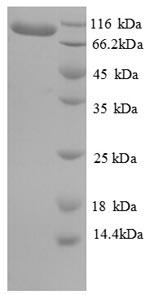
Purity
Greater than 90% as determined by SDS-PAGE.
Research Area
Epigenetics and Nuclear Signaling
Alternative Names
EEF 2; Eef2; EF-2; EF2; EF2_HUMAN; Elongation factor 2; Eukaryotic translation elongation factor 2; Polypeptidyl tRNA translocase; SCA26
Species
Homo sapiens (Human)
Expression Region
2-858aa
Target Protein Sequence
VNFTVDQIRAIMDKKANIRNMSVIAHVDHGKSTLTDSLVCKAGIIASARAGETRFTDTRKDEQERCITIKSTAISLFYELSENDLNFIKQSKDGAGFLINLIDSPGHVDFSSEVTAALRVTDGALVVVDCVSGVCVQTETVLRQAIAERIKPVLMMNKMDRALLELQLEPEELYQTFQRIVENVNVIISTYGEGESGPMGNIMIDPVLGTVGFGSGLHGWAFTLKQFAEMYVAKFAAKGEGQLGPAERAKKVEDMMKKLWGDRYFDPANGKFSKSATSPEGKKLPRTFCQLILDPIFKVFDAIMNFKKEETAKLIEKLDIKLDSEDKDKEGKPLLKAVMRRWLPAGDALLQMITIHLPSPVTAQKYRCELLYEGPPDDEAAMGIKSCDPKGPLMMYISKMVPTSDKGRFYAFGRVFSGLVSTGLKVRIMGPNYTPGKKEDLYLKPIQRTILMMGRYVEPIEDVPCGNIVGLVGVDQFLVKTGTITTFEHAHNMRVMKFSVSPVVRVAVEAKNPADLPKLVEGLKRLAKSDPMVQCIIEESGEHIIAGAGELHLEICLKDLEEDHACIPIKKSDPVVSYRETVSEESNVLCLSKSPNKHNRLYMKARPFPDGLAEDIDKGEVSARQELKQRARYLAEKYEWDVAEARKIWCFGPDGTGPNILTDITKGVQYLNEIKDSVVAGFQWATKEGALCEENMRGVRFDVHDVTLHADAIHRGGGQIIPTARRCLYASVLTAQPRLMEPIYLVEIQCPEQVVGGIYGVLNRKRGHVFEESQVAGTPMFVVKAYLPVNESFGFTADLRSNTGGQAFPQCVFDHWQILPGDPFDNSSRPSQVVAETRKRKGLKEGIPALDNFLDKL
Note: The complete
sequence may include tag sequence, target protein sequence, linker sequence and extra sequence that is
translated with the protein sequence for the purpose(s) of secretion, stability, solubility, etc.
If the exact amino acid sequence of this recombinant protein is critical to your application,
please explicitly request the full and complete sequence of this protein before ordering.
Protein Length
Full Length of Mature Protein
Tag Info
N-terminal 6xHis-tagged
The tag type will be determined during production process. If you have specified tag type, please tell us and we will develop the specified tag preferentially.
Reconstitution
We recommend that this vial be briefly centrifuged prior to opening to bring the contents to the bottom. Please reconstitute protein in deionized sterile water to a concentration of 0.1-1.0 mg/mL.We recommend to add 5-50% of glycerol (final concentration) and aliquot for long-term storage at -20°C/-80°C. Our default final concentration of glycerol is 50%. Customers could use it as reference.
Storage Condition
The shelf life is related to many factors, storage state, buffer ingredients, storage temperature and the stability of the protein itself.
Generally, the shelf life of liquid form is 6 months at -20°C/-80°C. The shelf life of lyophilized form is 12 months at -20°C/-80°C.
Shelf Life
The shelf life is related to many factors, storage state, buffer ingredients, storage temperature and the stability of the protein itself.
Generally, the shelf life of liquid form is 6 months at -20°C/-80°C. The shelf life of lyophilized form is 12 months at -20°C/-80°C.
Lead Time
3-7 business days
Note: All of our proteins are default shipped with normal blue ice packs, if you request to ship with dry ice, please communicate with us in advance and extra fees will be charged.
Notes
Repeated freezing and thawing is not recommended. Store working aliquots at 4°C for up to one week.
Datasheet & COA
Please contact us to get it.
Description
The expression region of this recombinant Human EEF2 covers amino acids 2-858. This EEF2 protein is expected to have a theoretical molecular weight of 99.2 kDa. The EEF2 protein was expressed in e.coli. The EEF2 gene fragment has been modified by fusing the N-terminal 6xHis tag, providing convenience in detecting and purifying the recombinant EEF2 protein during the following stages.
Human elongation factor 2 (EEF2) is a crucial protein involved in the process of translation during protein synthesis. It plays a central role in the elongation phase, where it facilitates the movement of tRNA and mRNA through the ribosome. EEF2 functions by promoting the translocation of the ribosome along the mRNA, allowing the addition of amino acids to the growing polypeptide chain. This GTPase activity of EEF2 is essential for the accurate and efficient synthesis of proteins. Beyond its primary role in translation, EEF2 has been implicated in cellular processes such as apoptosis and regulation of gene expression. Research on EEF2 contributes to the understanding of fundamental cellular mechanisms and can provide insights into diseases related to aberrant protein synthesis.