
Call us
301-363-4651 (Available 9 a.m. to 5 p.m. CST from Monday to Friday)

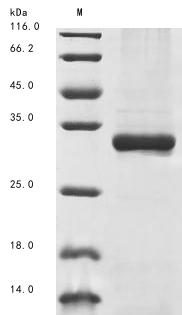
Recombinant Macaca mulatta Oncostatin M (OSM) is produced using a baculovirus expression system and contains the 22-252 amino acid region of the protein. The partial protein carries an N-terminal 10xHistidine tag, which helps with purification and detection processes. SDS-PAGE analysis confirms the product achieves over 85% purity, though this may vary slightly between batches. Endotoxin levels have been reduced to accommodate most experimental requirements.
Oncostatin M (OSM) appears to be a cytokine that regulates several cellular processes, particularly growth and differentiation. The protein seems to play an important role in immune response and inflammatory pathways. Because of its involvement in these biological processes, OSM has become a valuable research tool for studying cytokine signaling mechanisms and immune-related disorders, potentially offering insights into regulatory pathways that aren't fully understood yet.
Potential Applications
Note: The applications listed below are based on what we know about this protein's biological functions, published research, and experience from experts in the field. However, we haven't fully tested all of these applications ourselves yet. We'd recommend running some preliminary tests first to make sure they work for your specific research goals.
The Macaca mulatta OSM is a cytokine that requires precise folding, proper disulfide bond formation, and a tetrameric structure for its functional activity through gp130 receptor binding. The baculovirus-insect cell expression system provides a eukaryotic environment that supports proper protein folding, disulfide bond formation, and some post-translational modifications. However, as a complex cytokine requiring specific quaternary structure, the N-terminal 10xHis-tag may interfere with the protein's functional domains or receptor-binding interfaces. While the expression system increases folding probability, experimental validation remains essential to confirm structural integrity and receptor-binding activity.
1. Protein-Protein Interaction Studies
This application requires rigorous validation due to OSM's complex receptor binding mechanism. Functional OSM interactions require precise tertiary and quaternary structure formation for gp130 receptor binding. If correctly folded and active (verified), the protein may be suitable for receptor interaction studies. If misfolded/inactive (unverified), there is a high risk of non-specific binding or failure to identify genuine physiological interactions. The N-terminal His-tag may sterically interfere with receptor-binding interfaces.
2. Antibody Development and Validation
This application is highly suitable regardless of folding status. Antibody development relies primarily on antigenic sequence recognition rather than functional conformation. The full-length protein provides comprehensive epitope coverage for generating both linear and potential conformational antibodies. The high purity (>85%) ensures minimal contamination-related issues in immunization protocols.
3. Comparative Evolutionary Studies
Meaningful comparative studies require native protein conformation and functional activity. If correctly folded and active (verified), the protein enables valid evolutionary comparisons of structural and functional properties across primate species. If misfolded/inactive (unverified), comparative analyses would yield misleading evolutionary insights about OSM conservation and divergence.
4. Cell Culture Research Applications
This application carries a high risk without functional validation. OSM's biological activity in cell culture depends on precise receptor binding and signaling capability. If incorrectly folded, the protein may exhibit non-specific effects or fail to elicit physiological responses. The His-tag may potentially alter receptor binding characteristics or induce immune responses in cell systems.
Final Recommendation & Action Plan
The baculovirus expression system provides favorable eukaryotic folding conditions for this primate cytokine, but the uncharacterized nature of OSM and potential tag interference necessitate rigorous validation before functional applications. Begin with a comprehensive biophysical characterization to assess folding quality through size-exclusion chromatography (tetramer formation), circular dichroism spectroscopy, and validate receptor-binding activity using known gp130 receptor components. Application 2 (antibody development) can proceed immediately. For Applications 1 and 3 (interaction studies and comparative analyses), first confirm functional activity through receptor-binding assays. Avoid Application 4 (cell culture studies) entirely without functional validation. Given OSM's uncharacterized status, prioritize basic characterization over functional studies, and consider using tag-free constructs for critical functional applications to minimize potential tag interference.


Email: support@cusabio.com
Distributors Worldwide



