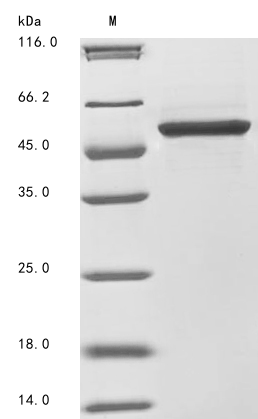
MRIPVDASTSRRFTPPSTALSPGKMSEALPLGAPDGGAALASKLRSGDRSMVEVLADHPGELVRTDSPNFLCSVLPTHWRCNKTLPIAFKVVALGDVPDGTLVTVMAGNDENYSAELRNATAAMKNQVARFNDLRFVGRSGRGKSFTLTITVFTNPPQVATYHRAIKITVDGPREPRRHRQKLDDQTKPGSLSFSERLSELEQLRRTAMRVSPHHPAPTPNPRASLNHSTAFNPQPQSQMQDARQIQPSPPWSYDQSYQYLGSITSSVHPATPISPGRASGMTSLSAELSSRLSTAPDLTAFGDPRQFPTLPSISDPRMHYPGAFTYSPPVTSGIGIGMSAMSSTSRYHTYLPPPYPGSSQAQAGPFQTGSPSYHLYYGTSAGSYQFSMVGGERSPPRILPPCTNASTGAALLNPSLPSQSDVVETEGSHSNSPTNMPPARLEEAVWRPY
Note: The complete
sequence may include tag sequence, target protein sequence, linker sequence and extra sequence that is
translated with the protein sequence for the purpose(s) of secretion, stability, solubility, etc.
If the exact amino acid sequence of this recombinant protein is critical to your application,
please explicitly request the full and complete sequence of this protein before ordering.
Mol. Weight
52.6 kDa
Protein Length
Full Length
Tag Info
N-terminal 6xHis-tagged
The tag type will be determined during production process. If you have specified tag type, please tell us and we will develop the specified tag preferentially.
Buffer
Tris-based buffer,50% glycerol
Storage
The shelf life is related to many factors, storage state, buffer ingredients, storage temperature and the stability of the protein itself.
Generally, the shelf life of liquid form is 6 months at -20°C/-80°C. The shelf life of lyophilized form is 12 months at -20°C/-80°C.
Shelf Life
The shelf life is related to many factors, storage state, buffer ingredients, storage temperature and the stability of the protein itself.
Generally, the shelf life of liquid form is 6 months at -20°C/-80°C. The shelf life of lyophilized form is 12 months at -20°C/-80°C.
Notes
Repeated freezing and thawing is not recommended. Store working aliquots at 4°C for up to one week.
CBF binds to the core site, 5'-PYGPYGGT-3', of a number of enhancers and promoters, including murine leukemia virus, polyomavirus enhancer, T-cell receptor enhancers, LCK, IL-3 and GM-CSF promoters. The alpha subunit binds DNA and appears to have a role in the development of normal hematopoiesis. Isoform AML-1L interferes with the transactivation activity of RUNX1. Acts synergistically with ELF4 to transactivate the IL-3 promoter and with ELF2 to transactivate the BLK promoter. Inhibits KAT6B-dependent transcriptional activation. Controls the anergy and suppressive function of regulatory T-cells (Treg) by associating with FOXP3. Activates the expression of IL2 and IFNG and down-regulates the expression of TNFRSF18, IL2RA and CTLA4, in conventional T-cells. Positively regulates the expression of RORC in T-helper 17 cells.
Site-directed mutagenesis of the proximal Runx1 and C/EBPbeta consensus elements in the P2X3 promoter decrease Runx1- and C/EBPbeta-mediated transcriptional activity.PMID:21678417
Strong overexpression of NCAM(CD56) and RUNX1(AML1) is a constant and characteristic feature of cardiomyocytes within or adjacent to scars in ICM.PMID:12937148
RUNX1 and RUNX2 regulate TIMP1 gene expressionPMID:15051730
hormonally regulated expression of Runx1 in periovulatory follicles, its involvement in progesterone production, and regulation of preovulatory gene expression suggest important roles of RUNX1 in the periovulatory processPMID:16675540
findings provide experimental evidence that the LH-dependent induction of Ptgs2 expression results, in part, from RUNX1-mediated transactivation of the Ptgs2 promoter.PMID:19342459