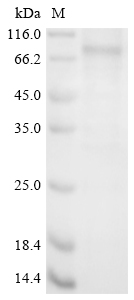
MATSLSADSPQQLSSLSTQQTILLLLVSVLAIVHLGQWLLRQWRRKPWSSPPGPFPWPLIGNAASVGRASHLYFARLARRYGDVFQIRLGSCPVVVLNGESAIHQALVQQGGVFADRPPFASFRVVSGGRSLAFGHYSERWKERRRAAYGTMRAFSTRHPRSRGLLEGHALGEARELVAVLVRRCAGGACLDPTQPIIVAVANVMSAVCFGCRYNHDDAEFLELLSHNEEFGRTVGAGSLVDVMPWLQLFPNPVRTIFREFEQINRNFSNFVLDKFLRHRESLVPGAAPRDMMDAFILSAEKKATGDPGDSPSGLDLEDVPATITDIFGASQDTLSTALLWLLILFTRYPDVQARVQAELDQVVGRDRLPCMSDQPNLPYVMAFLYESMRFTSFLPVTLPHATTANTFVLGYYIPKNTVVFVNQWSVNHDPAKWSNPEDFDPARFLDKDGFINKALASSVMIFSVGKRRCIGEELSKTLLFLFISILAHQCNFKANQNEPSNMSFSYGLSIKPKSFKIHVSLRESMKLLDSAVEKLQAEEACQ
Note: The complete
sequence may include tag sequence, target protein sequence, linker sequence and extra sequence that is
translated with the protein sequence for the purpose(s) of secretion, stability, solubility, etc.
If the exact amino acid sequence of this recombinant protein is critical to your application,
please explicitly request the full and complete sequence of this protein before ordering.
Mol. Weight
61.9 kDa
Protein Length
Full Length
Tag Info
N-terminal 6xHis-tagged
The tag type will be determined during production process. If you have specified tag type, please tell us and we will develop the specified tag preferentially.
Buffer
Tris-based buffer,50% glycerol
Storage Condition
The shelf life is related to many factors, storage state, buffer ingredients, storage temperature and the stability of the protein itself.
Generally, the shelf life of liquid form is 6 months at -20°C/-80°C. The shelf life of lyophilized form is 12 months at -20°C/-80°C.
Shelf Life
The shelf life is related to many factors, storage state, buffer ingredients, storage temperature and the stability of the protein itself.
Generally, the shelf life of liquid form is 6 months at -20°C/-80°C. The shelf life of lyophilized form is 12 months at -20°C/-80°C.
Notes
Repeated freezing and thawing is not recommended. Store working aliquots at 4°C for up to one week.
A cytochrome P450 monooxygenase involved in the metabolism of various endogenous substrates, including fatty acids, steroid hormones and vitamins. Mechanistically, uses molecular oxygen inserting one oxygen atom into a substrate, and reducing the second into a water molecule, with two electrons provided by NADPH via cytochrome P450 reductase (NADPH--hemoprotein reductase). Exhibits catalytic activity for the formation of hydroxyestrogens from 17beta-estradiol (E2), namely 2- and 4-hydroxy E2. Metabolizes testosterone and progesterone to B or D ring hydroxylated metabolites. May act as a major enzyme for all-trans retinoic acid biosynthesis in extrahepatic tissues. Catalyzes two successive oxidative transformation of all-trans retinol to all-trans retinal and then to the active form all-trans retinoic acid. Catalyzes the epoxidation of double bonds of certain PUFA. Converts arachidonic acid toward epoxyeicosatrienoic acid (EpETrE) regioisomers, 8,9-, 11,12-, and 14,15- EpETrE, that function as lipid mediators in the vascular system. Additionally, displays dehydratase activity toward oxygenated eicosanoids including hydroperoxyeicosatetraenoates (HpETEs). This activity is independent of cytochrome P450 reductase, NADPH, and O2. Also involved in the oxidative metabolism of xenobiotics, particularly converting polycyclic aromatic hydrocarbons and heterocyclic aryl amines procarcinogens to DNA-damaging products. Plays an important role in retinal vascular development. Under ambient/hyperoxic O2 conditions, promotes angiogenesis and capillary morphogenesis of retinal endothelial cells and pericytes, likely by metabolizing the oxygenated products symptomatic of oxidative stress. Also, contributes to oxidative homeostasis and ultrastructural organization and function of trabecular meshwork tissue through modulation of POSTN expression.
Gene References into Functions
CYP1A1 and CYP1B1 mRNA expression levels were significantly reduced from day 7 and 10, respectively. These results suggested that CpG island hypermethylation of the CYP1A1 and CYP1B1 promoters regulate the low expression of genes involved in the occurrence of isoniazidinduced liver injuryPMID:29115507
Incense smoke exposure significantly induced the expression of CYP1A1, CYP1A2, and CYP1B1 mRNAs in both lung and liver tissues.PMID:24557852
The influence of dietary lipids on the ontogeny of XMEs was also evaluated. mRNA and protein levels of phase I (CYP1A1, CYP1A2, and CYP1B1) and phase II (NAD(P)H:quinone acceptor oxidoreductase 1 and GSTP1) enzymes were analyzed.PMID:25164943
Increased oxidative stress generated by CYP1B1 contributes to hypertension.PMID:24477449
Diphenylarsinic acid induced the expression of CYP1B1 in the liver and caused oxidative DNA damage.PMID:23999541
Luteinizing hormone upregulates CYP1B1 protein expression in rat R2C leydig cells.PMID:21389345
Data suggest that CYP1B1 contributes to deoxycorticosterone-salt-induced hypertension and associated pathophysiological changes, most likely as a result of increased ROS production and ERK1/2 and p38 MAPK activity.PMID:20852048
Data suggest that cytochrome P450 1B1 contributes to angiotensin II-induced hypertension and associated pathophysiological changes.PMID:20805442
Cytochrome P450 1B1 catalyzes the conversion of 17-beta-estradiol (E2) to thecatechol estrogen metabolites 2-OH-E2 and 4-OH-E2 that have been postulated to be involved in mammary carcinogenesis.PMID:12010864
the expressions of CYP1A1, CYP1B1 and ER-mRNA in rat ovarian tissues were examined throughout the estrous cycle to establish any correlation in the expressions of these mRNAs in rat ovaryPMID:12223220
cAMP induction was mediated either by a 189bp far upstream enhancer region (FUER, -5110 to -5298) or by a 230bp AhR-responsive enhancer region (AhER) (-797 to -1026)PMID:12859982
While increasing AhR binding to both CYP1A1 and CYP1B1, 2,3,7,8-tetrachlorodibenzo-p-dioxin induced CYP1A1 mRNA in both a malignant and non-malignant line but increased only CYP1B1 mRNA in the malignant linePMID:18059014
expression of CYP1B1 in hyperplasia, squamous cell carcinomas in situ, or in association with inflammation may increase the production of carcinogenic metabolites, which may promote esophageal tumorigenesisPMID:18618592