Recombinant Rat Chemokine (C-X-C motif) ligand 13 (Cxcl13), partial

In Stock
Code: CSB-EP006243RA
Size:
20ug
20ug100ug1mg(1mg*1 or 500ug*2)
US$224
Quantity:
Express system: E.coli
Species: Rattus norvegicus (Rat)
Tag Info: N-terminal 6xHis-GST-tagged
For inquiries on large quantities or another requirements
Send an Inquiry
Start an on-line Chat
Online ordering is currently available for U.S. customers only. For orders outside the U.S., please kindly submit an inquiry or start a chat with us.

Product Details

Purity
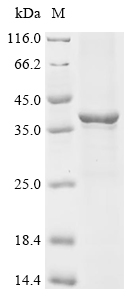
Greater than 85% as determined by SDS-PAGE.
Target Names
Cxcl13
Uniprot NO.
Research Area
Immunology
Species
Rattus norvegicus (Rat)
Source
E.coli
Expression Region
23-108aa
Target Protein Sequence
LETHYTNLKCRCSKVSSTFINLILVDWIQVIRPGNGCPKTEIIFWTKAKKAICVNPTARWLPKVLKFVRRSITSTPQAPVSKKRAA
Note: The complete sequence may include tag sequence, target protein sequence, linker sequence and extra sequence that is translated with the protein sequence for the purpose(s) of secretion, stability, solubility, etc.
If the exact amino acid sequence of this recombinant protein is critical to your application, please explicitly request the full and complete sequence of this protein before ordering.
Mol. Weight
41.3
Protein Length
Partial
Tag Info
N-terminal 6xHis-GST-tagged
The tag type will be determined during production process. If you have specified tag type, please tell us and we will develop the specified tag preferentially.
Form
Liquid or Lyophilized powder
Note: We will preferentially ship the format that we have in stock, however, if you have any special requirement for the format, please remark your requirement when placing the order, we will prepare according to your demand.
Buffer
If the delivery form is liquid, the default storage buffer is Tris/PBS-based buffer, 5%-50% glycerol. If the delivery form is lyophilized powder, the buffer before lyophilization is Tris/PBS-based buffer, 6% Trehalose.
Reconstitution
We recommend that this vial be briefly centrifuged prior to opening to bring the contents to the bottom. Please reconstitute protein in deionized sterile water to a concentration of 0.1-1.0 mg/mL.We recommend to add 5-50% of glycerol (final concentration) and aliquot for long-term storage at -20℃/-80℃. Our default final concentration of glycerol is 50%. Customers could use it as reference.
Storage
The shelf life is related to many factors, storage state, buffer ingredients, storage temperature and the stability of the protein itself. Generally, the shelf life of liquid form is 6 months at -20°C/-80°C. The shelf life of lyophilized form is 12 months at -20°C/-80°C.
Shelf Life
The shelf life is related to many factors, storage state, buffer ingredients, storage temperature and the stability of the protein itself.
Generally, the shelf life of liquid form is 6 months at -20°C/-80°C. The shelf life of lyophilized form is 12 months at -20°C/-80°C.
Lead Time
3-7 business days
Note: All of our proteins are default shipped with normal blue ice packs, if you request to ship with dry ice, please communicate with us in advance and extra fees will be charged.
Notes
Repeated freezing and thawing is not recommended. Store working aliquots at 4℃ for up to one week.
Troubleshooting and FAQs
Datasheet & COA
Please contact us to get it.
Images
  • (Tris-Glycine gel) Discontinuous SDS-PAGE (reduced) with 5% enrichment gel and 15% separation gel.
Description

The production of recombinant rat Cxcl13 in E. coli begins with co-cloning the target gene into an expression vector with an N-terminal 6xHis-GST-tag gene, followed by transformation into E. coli cells. These cells are grown under conditions that promote protein expression. Once adequate growth is achieved, the cells are lysed to release the recombinant Cxcl13 protein. Purification involves the affinity chromatography technique. The purity of the recombinant Cxcl13 protein is assessed using SDS-PAGE, reaching over 85%.

Rat Cxcl13 is a chemokine that plays a crucial role in various physiological and pathological processes. Studies have shown that CXCL13 is involved in promoting chronic postsurgical pain and astrocyte activation in rats by targeting NLRP3 [1]. Evidence indicated that inhibiting CXCL13 expression can improve neuropathic pain by modulating the expression of chemokines and inflammatory factors in the spinal cord and interfering with glial cell polarization [2].

Furthermore, CXCL13 is associated with bone marrow mesenchymal stem cell (BMSC) function. It has been demonstrated that CXCL13 can promote osteogenic differentiation of BMSCs by inhibiting miR-23a expression [3]. Research has revealed that CXCL13 enhances the effect of BMSCs on tendon bone healing in rats [4].

In the context of cancer-induced bone pain, CXCL13 attenuates morphine analgesia in rats with cancer-induced bone pain, suggesting a role in pain modulation [5]. Additionally, CXCL13 has been linked to morphine analgesia regulation in bone cancer pain rats through specific signaling pathways [6].

References:
[1] H. Yi, Cxcl13/cxcr5 promote chronic postsurgical pain and astrocyte activation in rats by targeting nlrp3, Neuroreport, vol. 35, no. 6, p. 406-412, 2024. https://doi.org/10.1097/wnr.0000000000002023
[2] T. Zhang, W. Liang, M. Zhang, S. Cui, X. Huang, W. Ouet al., Daphnetin improves neuropathic pain by inhibiting the expression of chemokines and inflammatory factors in the spinal cord and interfering with glial cell polarization, Pharmaceuticals, vol. 16, no. 2, p. 243, 2023. https://doi.org/10.3390/ph16020243
[3] F. Tian, X. Ji, W. Xiao, B. Wang, & F. Wang, Cxcl13 promotes osteogenic differentiation of mesenchymal stem cells by inhibiting mir-23a expression, Stem Cells International, vol. 2015, p. 1-8, 2015. https://doi.org/10.1155/2015/632305
[4] F. Tian, X. Ji, W. Xiao, B. Wang, & F. Wang, Cxcl13 promotes the effect of bone marrow mesenchymal stem cells (mscs) on tendon-bone healing in rats and in c3hiot1/2 cells, International Journal of Molecular Sciences, vol. 16, no. 2, p. 3178-3187, 2015. https://doi.org/10.3390/ijms16023178
[5] S. Wang, C. Dong, X. Yang, & J. Yin, Upregulation of (c-x-c motif) ligand 13 (cxcl13) attenuates morphine analgesia in rats with cancer-induced bone pain, Medical Science Monitor, vol. 22, p. 4612-4622, 2016. https://doi.org/10.12659/msm.897702
[6] H. Bu, P. Jiao, X. Fan, Y. Gao, L. Zhang, & H. Guo, The role of botulinum toxin type a related axon transport in neuropathic pain induced by chronic constriction injury, The Korean Journal of Pain, vol. 35, no. 4, p. 391-402, 2022. https://doi.org/10.3344/kjp.2022.35.4.391

Customer Reviews and Q&A

 Customer Reviews

Target Background

icon of phone
Call us
301-363-4651 (Available 9 a.m. to 5 p.m. CST from Monday to Friday)

icon of address
Address
No. 269, Shendun 5th Road, Donghu Hi-Tech Development Area, Hubei Province, 430206, P.R.China
icon of social media
Join us with

Subscribe newsletter

Leave a message

* To protect against spam, please pass the CAPTCHA test below.
CAPTCHA verification
© 2007-2025 CUSABIO TECHNOLOGY LLC All rights reserved. 鄂ICP备15011166号-1
Select 0 Products