Recombinant Rat Angiopoietin-1 (Angpt1)

In Stock
Code: CSB-MP001706RAc7
Size:
20ug
20ug100ug1mg(1mg*1 or 500ug*2)
US$660
Quantity:
Express system: Mammalian cell
Species: Rattus norvegicus (Rat)
Tag Info: C-terminal 6xHis-tagged
For inquiries on large quantities or another requirements
Send an Inquiry
Start an on-line Chat
Online ordering is currently available for U.S. customers only. For orders outside the U.S., please kindly submit an inquiry or start a chat with us.

Product Details

Purity
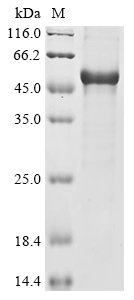
Greater than 85% as determined by SDS-PAGE.
Target Names
Angpt1
Uniprot NO.
Research Area
Others
Species
Rattus norvegicus (Rat)
Source
Mammalian cell
Expression Region
20-497aa
Target Protein Sequence
SNQRRSPENGGRRYNRIQHGQCAYTFILPEHDGNCRESATEQYNTNALQRDAPHVETDFSSQKLQHLEHVMENYTQWLQKLENYIVENMKSEMAQIQQNAVQNHTATMLEIGTSLLSQTAEQTRKLTDVETQVLNQTSRLEIQLLENSLSTYELEKQLLQQTNEILKIQEKNSLLEHKILEMEGKHKEELDTLKEEKENLQGLVTRQTFIIQELEKQLSRATSNNSVLQKQQLELMDTVHNLVSLCTKEVLLKGGKREEEKPFRDCADVYQAGFNKSGIYTIYFNNMPEPKKVFCNMDVNEGGWTVIQHREDGSLDFQRGWKEYKMGFGNPSGEYWLGNEFIFAITSQRQYMLRIELMDWEGNRAYSQYDRFHIGNQKQNYRLYLKGHTGTAGKQSSLILHGADFSTKDADNDNCMCKCALMLTGGWWFDACGPSNLNGMFYTAGQNHGKLNGIKWHYFKGPSYSLRSTTMMIRPLDF
Note: The complete sequence may include tag sequence, target protein sequence, linker sequence and extra sequence that is translated with the protein sequence for the purpose(s) of secretion, stability, solubility, etc.
If the exact amino acid sequence of this recombinant protein is critical to your application, please explicitly request the full and complete sequence of this protein before ordering.
Mol. Weight
56.5 kDa
Protein Length
Full Length of Mature Protein
Tag Info
C-terminal 6xHis-tagged
The tag type will be determined during production process. If you have specified tag type, please tell us and we will develop the specified tag preferentially.
Form
Liquid or Lyophilized powder
Note: We will preferentially ship the format that we have in stock, however, if you have any special requirement for the format, please remark your requirement when placing the order, we will prepare according to your demand.
Buffer
If the delivery form is liquid, the default storage buffer is Tris/PBS-based buffer, 5%-50% glycerol. If the delivery form is lyophilized powder, the buffer before lyophilization is Tris/PBS-based buffer, 6% Trehalose.
Reconstitution
We recommend that this vial be briefly centrifuged prior to opening to bring the contents to the bottom. Please reconstitute protein in deionized sterile water to a concentration of 0.1-1.0 mg/mL.We recommend to add 5-50% of glycerol (final concentration) and aliquot for long-term storage at -20℃/-80℃. Our default final concentration of glycerol is 50%. Customers could use it as reference.
Storage
The shelf life is related to many factors, storage state, buffer ingredients, storage temperature and the stability of the protein itself. Generally, the shelf life of liquid form is 6 months at -20°C/-80°C. The shelf life of lyophilized form is 12 months at -20°C/-80°C.
Shelf Life
The shelf life is related to many factors, storage state, buffer ingredients, storage temperature and the stability of the protein itself.
Generally, the shelf life of liquid form is 6 months at -20°C/-80°C. The shelf life of lyophilized form is 12 months at -20°C/-80°C.
Lead Time
3-7 business days
Note: All of our proteins are default shipped with normal blue ice packs, if you request to ship with dry ice, please communicate with us in advance and extra fees will be charged.
Notes
Repeated freezing and thawing is not recommended. Store working aliquots at 4°C for up to one week.
Troubleshooting and FAQs
Datasheet & COA
Please contact us to get it.
Images
  • (Tris-Glycine gel) Discontinuous SDS-PAGE (reduced) with 5% enrichment gel and 15% separation gel.

Customer Reviews and Q&A

 Customer Reviews

Target Background

Function(From Uniprot)
Binds and activates TIE2 receptor by inducing its tyrosine phosphorylation. Implicated in endothelial developmental processes later and distinct from that of VEGF. Appears to play a crucial role in mediating reciprocal interactions between the endothelium and surrounding matrix and mesenchyme. Mediates blood vessel maturation/stability. It may play an important role in the heart early development.
Gene References into Functions
  1. Overexpression of Ang-1 enhanced the tube formation, migration, and proliferation ability of endothelial progenitor cells. EPC transplantation facilitated occlusion of carotid aneurysms. PMID:29197611
  2. The study showed for the first time that ANG-1 plays a vital role in the early rather than late phase of adjuvant-induced arthritis pathogenesis making it an attractive non-invasive tool for early diagnosis and prediction of disease prognosis PMID:24664592
  3. Ang-1-EPC improved cell survival during inflammation. PMID:24606182
  4. Ang1 was implicated in ASC-induced suppression of neointimal formation. PMID:23486192
  5. Endothelin-1 regulates ANG-1 production and vascular endothelial growth factor (VEGF)A in proliferating astrocytes. PMID:22927341
  6. responsible for the vascular hyperreactivity at early hemorrhagic shock through the Tie2-Akt-eNOS pathway PMID:22869617
  7. The expression of Ang-1 mRNA and TSP-1 in renal tissue of rats after subtotal nephrectomy was significantly up-regulated. PMID:19821086
  8. Angiopoietin-1 preconditioning enhances survival and functional recovery of mesenchymal stem cell transplantation PMID:22843181
  9. Prolonged exposure of high concentration of oxygen may cause impairment of lung vascular development by inhibiting expression of Ang-1 in neonatal rats. PMID:22336306
  10. The change of Ang-1, which is early upregulation and late downregulation, exists in diabetic renal tissue. PMID:17294737
  11. Wenyang Huoxue Recipe can up-regulate the expression of Ang-l mRNA rats with chronic aristolochic acid nephropathy. PMID:18471417
  12. Expression of angiopoietin-1 and the angiopoietin receptor dropped markedly after stroke in SHR stroke-prone rats, but was not different after ischemia in SHR and WKY rat strains PMID:11822892
  13. ang 1 stabilizes testicular microvessels under basal conditions and that a shift in this balance caused by increased ang 2, together with increased VEGF-A, allows vascular leakage, high endothelial cell proliferation PMID:12773423
  14. Rats engineered to express angiopoietin 1 (Ang-1) constitutively in the lung develop severe pulmonary hypertension. PMID:14512515
  15. Overexpression of angiopoietin-1 using an adeno-associated virus vector causes pulmonary hypertension in rats. These data provide a novel physiologic animal model for pulmonary hypertension. PMID:14759414
  16. E2 increases Ang-1 and enhances capillary density in brain under basal conditions through estrogen receptor-alpha, priming the middle cerebral artery territory for survival after experimental focal ischemia PMID:15637314
  17. Ang-1 promotes neurite outgrowth from dorsal root ganglia cells positive for Tie2. PMID:15714275
  18. It is concluded that adipocyte-secreted Ang-1 supports neurite outgrowth, which is involved in synaptogenesis. The novel function of Ang-1 appears to play a physiological role in WAT plasticity. PMID:16493688
  19. Ang1 protects cardiomyocytes from oxidative stress-induced apoptosis by regulating the activity of Proto-Oncogene Proteins c-akt PMID:17559808
  20. ANGPT1 is necessary for follicular development induced by gonadotropins. PMID:17989359
  21. Expression of angiopoietin-1 significantly decreased in the pulmonary arteries in chronic hypoxic pulmonary hypertension. PMID:18073453
  22. Abnormal expression and reciprocal egulation of Angpt1 may play important roles in the development of chronic allograft nephropathy in rat renal allografts. PMID:18929864
  23. Ang1 modifies basal microvessel permeability coefficients, in keeping with previous reports demonstrating reduced solute flux in inflamed vessels. PMID:19297368
  24. Ang1 induces neurite outgrowth in PC12 cells in a Tie2-independent, beta1-integrin-FAK-PI3K-Akt-dependent manner. NGF and Ang1 mediate neurite outgrowth via two independent signaling mechanisms. PMID:19379779
  25. Vascular endothelial growth factor and angiopoietin-1 are involved in liver regeneration following partial hepatectomy. PMID:11549276

Show More

Hide All

Subcellular Location
Secreted.
Database Links
icon of phone
Call us
301-363-4651 (Available 9 a.m. to 5 p.m. CST from Monday to Friday)
icon of address
Address
No. 269, Shendun 5th Road, Donghu Hi-Tech Development Area, Hubei Province, 430206, P.R.China
icon of social media
Join us with

Subscribe newsletter

Leave a message

* To protect against spam, please pass the CAPTCHA test below.
CAPTCHA verification
© 2007-2025 CUSABIO TECHNOLOGY LLC All rights reserved. 鄂ICP备15011166号-1
Select 0 Products