MDVFMKGLSKAKEGVVAAAEKTKQGVAEAAGKTKEGVLYVGSKTKEGVVHGVTTVAEKTKEQVTNVGGAVVTGVTAVAQKTVEGAGNIAAATGFVKKDQMGKGEEGYPQEGILEDMPVDPSSEAYEMPSEEGYQDYEPEA
Note: The complete
sequence may include tag sequence, target protein sequence, linker sequence and extra sequence that is
translated with the protein sequence for the purpose(s) of secretion, stability, solubility, etc.
If the exact amino acid sequence of this recombinant protein is critical to your application,
please explicitly request the full and complete sequence of this protein before ordering.
Mol. Weight
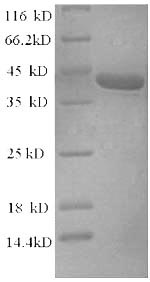
41.5kDa
Protein Length
Full Length
Tag Info
N-terminal GST-tagged
The tag type will be determined during production process. If you have specified tag type, please tell us and we will develop the specified tag preferentially.
Reconstitution
We recommend that this vial be briefly centrifuged prior to opening to bring the contents to the bottom. Please reconstitute protein in deionized sterile water to a concentration of 0.1-1.0 mg/mL.We recommend to add 5-50% of glycerol (final concentration) and aliquot for long-term storage at -20°C/-80°C. Our default final concentration of glycerol is 50%. Customers could use it as reference.
Storage
The shelf life is related to many factors, storage state, buffer ingredients, storage temperature and the stability of the protein itself.
Generally, the shelf life of liquid form is 6 months at -20°C/-80°C. The shelf life of lyophilized form is 12 months at -20°C/-80°C.
Shelf Life
The shelf life is related to many factors, storage state, buffer ingredients, storage temperature and the stability of the protein itself.
Generally, the shelf life of liquid form is 6 months at -20°C/-80°C. The shelf life of lyophilized form is 12 months at -20°C/-80°C.
Lead Time
3-7 business days
Note: All of our proteins are default shipped with normal blue ice packs, if you request to ship with dry ice, please communicate with us in advance and extra fees will be charged.
Notes
Repeated freezing and thawing is not recommended. Store working aliquots at 4°C for up to one week.
Neuronal protein that plays several roles in synaptic activity such as regulation of synaptic vesicle trafficking and subsequent neurotransmitter release. Participates as a monomer in synaptic vesicle exocytosis by enhancing vesicle priming, fusion and dilation of exocytotic fusion pores. Mechanistically, acts by increasing local Ca(2+) release from microdomains which is essential for the enhancement of ATP-induced exocytosis. Acts also as a molecular chaperone in its multimeric membrane-bound state, assisting in the folding of synaptic fusion components called SNAREs (Soluble NSF Attachment Protein REceptors) at presynaptic plasma membrane in conjunction with cysteine string protein-alpha/DNAJC5. This chaperone activity is important to sustain normal SNARE-complex assembly during aging. Plays also a role in the regulation of the dopamine neurotransmission by associating with the dopamine transporter (DAT1) and thereby modulating its activity.
Gene References into Functions
Calcium binds to the C terminus of alpha-synuclein, therewith increasing its lipid-binding capacity. Using CEST-NMR, we reveal that alpha-synuclein interacts with isolated synaptic vesicles with two regions, the N terminus, already known from studies on SUVs, and additionally via its C terminus, which is regulated by the binding of calcium.PMID:29459792
alphasynuclein induces apoptosis of astrocytes by causing dysfunction of the endoplasmic reticulumGolgi compartment.PMID:29749529
induces the clustering of synaptic vesicles by double-anchor mechanismPMID:27640673
The results suggest that Zn caused Ubiquitin proteasome system impairment, resulting in alpha-synuclein aggregation subsequently leading to dopaminergic neurodegeneration, and that Zn-induced Parkinsonism exhibited positive L-Dopa response similar to sporadic PD.PMID:29198021
FKBP12 contributes to alpha-synuclein toxicity by regulating the calcineurin-dependent phosphoproteome.PMID:29229832
Exposure to the Functional Bacterial Amyloid Protein Curli Enhances Alpha-Synuclein Aggregation in Aged Fischer 344 Rats and Caenorhabditis elegansPMID:27708338
E46K alpha-synuclein pathological mutation causes cell-autonomous toxicity without altering protein turnover or aggregation.PMID:28900007
These findings provide evidence for a novel mechanism underlying the protective effects of PINK1 against alpha-syn-induced neurodegeneration and highlight a novel therapeutic target for Parkinson's disease treatment.PMID:28933786
Using single-molecule microscopy and photo-bleaching approaches, the authors most frequently found 70 alpha-synuclein-green fluorescent fusion proteins per vesicle. Although this number is high enough to modulate physical membrane properties, it is also strikingly similar to the number of synaptobrevins, a putative interaction partner of alpha-synuclein, per vesicle.PMID:27477055
TMEM175 deficiency impairs lysosomal and mitochondrial function and increases alpha-synuclein aggregation.PMID:28193887
we documented that ceftriaxone interacts with alpha-synuclein inhibiting its pathological aggregation and that a cyclical treatment with this molecule in a patient with adult-onset Alexander's disease halted, and partly reversed, the progression of neurodegeneration, suggests the possibility of a chaperone-like effect of ceftriaxone on protein involved in specific neurodegenerative diseases.PMID:27133445
The findings of this study confirm that alpha-synuclein interacts with membranes to affect Ca(2+) signalling in a structure-specific manner and the oligomeric beta-sheet-rich alpha-synuclein species ultimately leads to Ca(2+) dysregulation and Ca(2+)-dependent cell death.PMID:26989132
alpha-synuclein plays a crucial role in motor and sensory function regulation, in which, the underlying mechanism may be linked to the regulation of apoptosis associated with apoptotic gene (Bax, Bcl2) and neurotrophic factors expression (NGF, BDNF and NT3).PMID:26822976
the unaltered SNCA levels observed following ZSCAN21 down-regulation in the rat brain, possibly due to compensatory mechanisms, imply that ZSCAN21 is not a master regulator of SNCA in vivo.PMID:26907683
that loss of glucocerebrosidase function may contribute to SNCA accumulation through inhibition of autophagy via PPP2A inactivationPMID:26378614
We conclude that alphaSyn overexpression impairs neurite outgrowth and augments axonal degeneration, whereas axonal vesicle transport and autophagy are severely altered.PMID:26158517
The destabilization of physiological tetramers by PD-causing missense mutations and the neurotoxicity and inclusions induced by markedly decreasing tetramers suggest that decreased alpha-helical tetramers and increased unfolded monomers initiate pathogenesis.PMID:26076669
Results show that hydrostatic pressure is associated with a transition from monomeric to higher order alpha-synuclein aggregates and that increased pressure reduces the level of PLCbeta1 and the amount of alpha-synuclein/PLCbeta1 complexes.PMID:26434717
The data suggest that a-syn is involved in the regulation of synaptic plasticity in the ENS during early postnatal life and adult age.PMID:25896939
Mitochondrial impairment disturbs the autophagic flux and leads to the accumulation of exogenously applied alpha-synucleinPMID:26212128
the major toxic role of SNCA is related to its extracellular species and further supports a protective role of intracellular SNCA aggregationPMID:25484190
comparison between two types of alpha-synuclein showed that A53T mutated alpha-synuclein was more effective to establish a Parkinson disease (PD) model, and the model based A53T mutated alpha-synuclein was a suitable model for early-onset PDPMID:26192120
LRRK2 inhibition alleviates alpha-synuclein gene-induced neurodegeneration in the rat Parkinson's disease model.PMID:26078453
alpha-synuclein knockdown is neuroprotective in the rotenone model of PD and indicates that endogenous alpha-synuclein contributes to the specific vulnerability of dopaminergic neurons to systemic mitochondrial inhibitionPMID:26075822
shed light on the potential roles of mutant alpha-synuclein in the pathogenesis of Parkinson's diseasePMID:24833599
suggest that the N terminus of alpha-Syn is essential for the regulation of mitochondrial membrane permeabilityPMID:25446002
In the neuronal plasma membrane, alpha-synuclein caused synaptotoxic failure associated with a decrease in membrane proteins.PMID:25669123
a tight link between the intracellular level of alpha-synuclein and maturation capacity of primary oligodendrocyte progenitor cellsPMID:25019582
These results suggest alpha-synuclein as a pathological link between chronic effects of traumatic brain injury and Parkinson's disease.PMID:25251017
It impairs maturation of oligodendrocyte progenitors thereby contributing to multiple system atrophy.PMID:24698767
CHIP can mediate the degradation of alpha synuclein aggregates in vivoPMID:24664141
extracellular ASN is involved in GSK-3beta-dependent Tau hyperphosphorylation, which leads to microtubule destabilizationPMID:24722055
Results indicate the critical involvement of PAR2-NF-kappaB signaling in the upregulation of alpha-synuclein and motor dysfunction in the rodent model of Parkinsons disease.PMID:24747612
S-Nitrosylating protein disulphide isomerase plays a significant role in neurological disorders related to alpha-syn aggregation.PMID:25090657
LRRK2 expression in the wild-type rat midbrain remained undetected under nonpathological conditions, LRRK2 became highly expressed in iNOS-positive myeloid cells in the substantia nigra in response to alpha-synuclein overexpression or LPS exposuresPMID:24927544
onjisaponin B was able to induce autophagy and accelerate both the removal of mutant huntingtin and A53T alpha-synuclein, which are highly associated with Huntington disease and Parkinson disease, respectivelyPMID:24248062
Changes in alpha-synuclein expression with age, including a baseline of accumulating synucleinopathies in the healthy aging submucosal plexusPMID:23809578
Our data show that changes in the S129 residue of alpha-synuclein influence the rate of pathology and neurodegenerationPMID:23567651
Extracellular alpha-synuclein induces calpain-dependent overactivation of cyclin-dependent kinase 5 in vitro.PMID:23954626
Inhibition of Nrf2/HO-1 leads to more alpha-syn aggregation and greater toxicity induced by iron, creating a vicious cycle of iron accumulation, alpha-syn aggregation and HO-1 disruption in PD.PMID:23454680
VDAC1 has a role in alpha-synuclein-induced dopaminergic neuron toxicity in ratsPMID:23291291
Results suggest that macrophages play an active phagocytotic role in removing alpha-SYNC aggregates that accumulate with age in the neural circuitry of the gut.PMID:23441091
Accumulation of aggregated alpha-synuclein is triggered in substantia nigra in response to environmental toxins later in life.PMID:23567316
Exophagy, with or without expression of TPPP, may be an important physiological mechanism for unconventional secretion of alpha-synuclein from dopaminergic neurons.PMID:23629650
TFEB is a key player in the induction of alpha-synuclein-induced toxicity and Parkinson disease pathogenesisPMID:23610405
Our study is the first to evidence that enteric neurons are capable of secreting alpha-synuclein, thereby providing new insights into the role of the enteric nervous system in the pathophysiology of Parkinson disease.PMID:23278133
This study demonistrated that Deletion in exon 5 of the SNCA gene and exposure to rotenone leads to oligomerization of alpha-synuclein and toxicity to PC12 cells.PMID:23128054
Large alpha-Syn oligomers preferentially bind to the N-terminal domain of a vesicular SNARE protein, synaptobrevin-2, which blocks SNARE-mediated lipid mixing by preventing SNARE complex formation.PMID:23431141
Primary oligodendrocytes from rat brain and oligodendroglial cell lines take-up neuronal-secreted or exogenously added synuclein alpha from their conditioning medium.PMID:23077527