Recombinant Rat Alkaline phosphatase, tissue-nonspecific isozyme (Alpl)

In Stock
Code: CSB-EP001631RA
Size:
20μg
20μg100μg1mg(1mg*1 or 500ug*2)
US$306
Quantity:
Express system: E.coli
Species: Rattus norvegicus (Rat)
Tag Info: N-terminal 6xHis-SUMO-tagged
For inquiries on large quantities or another requirements
Send an Inquiry
Start an on-line Chat
Online ordering is currently available for U.S. customers only. For orders outside the U.S., please kindly submit an inquiry or start a chat with us.

Product Details

Purity
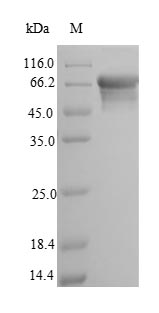
Greater than 90% as determined by SDS-PAGE.
Target Names
Alpl
Uniprot NO.
Research Area
Cell Biology
Alternative Names
Alkaline phosphatase liver/bone/kidney isozyme
Species
Rattus norvegicus (Rat)
Source
E.coli
Expression Region
18-501aa
Target Protein Sequence
FVPEKEKDPSYWRQQAQETLKNALKLQKLNTNVAKNIIMFLGDGMGVSTVTAARILKGQLHHNTGEETRLEMDKFPFVALSKTYNTNAQVPDSAGTATAYLCGVKANEGTVGVSAATERTRCNTTQGNEVTSILRWAKDAGKSVGIVTTTRVNHATPSAAYAHSADRDWYSDNEMPPEALSQGCKDIAYQLMHNIKDIDVIMGGGRKYMYPKNRTDVEYELDEKARGTRLDGLDLISIWKSFKPRHKHSHYVWNRTELLALDPSRVDYLLGLFEPGDMQYELNRNNLTDPSLSEMVEVALRILTKNPKGFFLLVEGGRIDHGHHEGKAKQALHEAVEMDEAIGKAGTMTSQKDTLTVVTADHSHVFTFGGYTPRGNSIFGLAPMVSDTDKKPFTAILYGNGPGYKVVDGERENVSMVDYAHNNYQAQSAVPLRHETHGGEDVAVFAKGPMAHLLHGVHEQNYIPHVMAYASCIGANLDHCAWAS
Note: The complete sequence may include tag sequence, target protein sequence, linker sequence and extra sequence that is translated with the protein sequence for the purpose(s) of secretion, stability, solubility, etc.
If the exact amino acid sequence of this recombinant protein is critical to your application, please explicitly request the full and complete sequence of this protein before ordering.
Mol. Weight
69.5kDa
Protein Length
Full Length of Mature Protein
Tag Info
N-terminal 6xHis-SUMO-tagged
The tag type will be determined during production process. If you have specified tag type, please tell us and we will develop the specified tag preferentially.
Reconstitution
We recommend that this vial be briefly centrifuged prior to opening to bring the contents to the bottom. Please reconstitute protein in deionized sterile water to a concentration of 0.1-1.0 mg/mL.We recommend to add 5-50% of glycerol (final concentration) and aliquot for long-term storage at -20°C/-80°C. Our default final concentration of glycerol is 50%. Customers could use it as reference.
Storage
The shelf life is related to many factors, storage state, buffer ingredients, storage temperature and the stability of the protein itself. Generally, the shelf life of liquid form is 6 months at -20°C/-80°C. The shelf life of lyophilized form is 12 months at -20°C/-80°C.
Shelf Life
The shelf life is related to many factors, storage state, buffer ingredients, storage temperature and the stability of the protein itself.
Generally, the shelf life of liquid form is 6 months at -20°C/-80°C. The shelf life of lyophilized form is 12 months at -20°C/-80°C.
Lead Time
3-7 business days
Note: All of our proteins are default shipped with normal blue ice packs, if you request to ship with dry ice, please communicate with us in advance and extra fees will be charged.
Notes
Repeated freezing and thawing is not recommended. Store working aliquots at 4°C for up to one week.
Troubleshooting and FAQs
Datasheet & COA
Please contact us to get it.
Images
  • (Tris-Glycine gel) Discontinuous SDS-PAGE (reduced) with 5% enrichment gel and 15% separation gel.

Customer Reviews and Q&A

 Customer Reviews

Target Background

Function(From Uniprot)
Alkaline phosphatase that metabolizes various phosphate compounds and plays a key role in skeletal mineralization and adaptive thermogenesis. Has broad substrate specificity and can hydrolyze a considerable variety of compounds: however, only a few substrates, such as diphosphate (inorganic pyrophosphate; PPi), pyridoxal 5'-phosphate (PLP) and N-phosphocreatine are natural substrates. Plays an essential role in skeletal and dental mineralization via its ability to hydrolyze extracellular diphosphate, a potent mineralization inhibitor, to phosphate: it thereby promotes hydroxyapatite crystal formation and increases inorganic phosphate concentration. Acts in a non-redundant manner with PHOSPHO1 in skeletal mineralization: while PHOSPHO1 mediates the initiation of hydroxyapatite crystallization in the matrix vesicles (MVs), ALPL/TNAP catalyzes the spread of hydroxyapatite crystallization in the extracellular matrix. Also promotes dephosphorylation of osteopontin (SSP1), an inhibitor of hydroxyapatite crystallization in its phosphorylated state; it is however unclear whether ALPL/TNAP mediates SSP1 dephosphorylation via a direct or indirect manner. Catalyzes dephosphorylation of PLP to pyridoxal (PL), the transportable form of vitamin B6, in order to provide a sufficient amount of PLP in the brain, an essential cofactor for enzymes catalyzing the synthesis of diverse neurotransmitters. Additionally, also able to mediate ATP degradation in a stepwise manner to adenosine, thereby regulating the availability of ligands for purinergic receptors. Also capable of dephosphorylating microbial products, such as lipopolysaccharides (LPS) as well as other phosphorylated small-molecules, such as poly-inosine:cytosine (poly I:C). Acts as a key regulator of adaptive thermogenesis as part of the futile creatine cycle: localizes to the mitochondria of thermogenic fat cells and acts by mediating hydrolysis of N-phosphocreatine to initiate a futile cycle of creatine dephosphorylation and phosphorylation. During the futile creatine cycle, creatine and N-phosphocreatine are in a futile cycle, which dissipates the high energy charge of N-phosphocreatine as heat without performing any mechanical or chemical work.
Gene References into Functions
  1. he rats body weight were decreased, the cartilage histological structure were disrupted, the cartilage and serum contents of Al and the serum level of C-telopeptide of type II collagen were all increased, the serum level of type II collagen (Col II) and alkaline phosphatase (ALP), and the mRNA expressions of TGF-beta1, BMP-2, ALP and Col II were all decreased in the AlCl3-treated groups compared with those in control g... PMID:27885436
  2. Data show that nonylphenol (NP) increased serum alkaline phosphatase, lead to liver damage and can increase the expression of heme oxygenase-1 (HO1) and growth arrest and DNA-damage-inducible 45 beta protein (Gadd45b) genes and may modify the toxic effects on liver through induction of oxidative stress. PMID:27590577
  3. TNAP contributes to the hypertrophic effect of phenylephrine, as well as its ability to produce cardiomyocyte calcification. These responses are minimized by CD73-dependent endogenously produced adenosine. PMID:24894822
  4. TNAP histochemistry offers a more straightforward, but also more sensitive, method for investigating retinal strata and their diabetes-induced degeneration. PMID:25411053
  5. Rat pups fed IAP had decreased mRNA expression of the inflammatory cytokines TNFalpha, IL-6 and iNOS. PMID:24888842
  6. BMP-2 and ALP gene expression is induced by a BMP-2 gene-fibronectin-apatite composite layer PMID:21636885
  7. The expression of ENPP1, TNAP and ANK proteins could be detected in each generation of endplate chondrocytes. With the continuing passage of cells, the level of protein expression declined gradually. PMID:21418901
  8. Data show that alkaline phosphatase (AP) activity in brain vessels and parenchyma in which AP exhibits specific patterns is attributable to TNAP. PMID:21191615
  9. Forty SNPs in ALPL and 14 SNPs in ENPP1 genetic loci as well as pairwise haplotypes were tested for association with bone strength related traits. PMID:19931660
  10. Characterization of rat Alpl isoforms by hplc and agar gel electrophoresis are reported. PMID:19084045
  11. ATP-mediated DBS, forming a negative feedback loop. The duodenal epithelial brush border IAP-P2Y-HCO(3-) surface microclimate pH regulatory system effectively protects the mucosa from acid injury. PMID:19451200

Show More

Hide All

Subcellular Location
Cell membrane; Lipid-anchor, GPI-anchor. Extracellular vesicle membrane; Lipid-anchor, GPI-anchor. Mitochondrion membrane; Lipid-anchor, GPI-anchor. Mitochondrion intermembrane space.
Protein Families
Alkaline phosphatase family
Database Links
icon of phone
Call us
301-363-4651 (Available 9 a.m. to 5 p.m. CST from Monday to Friday)
icon of address
Address
No. 269, Shendun 5th Road, Donghu Hi-Tech Development Area, Hubei Province, 430206, P.R.China
icon of social media
Join us with

Subscribe newsletter

Leave a message

* To protect against spam, please pass the CAPTCHA test below.
CAPTCHA verification
© 2007-2025 CUSABIO TECHNOLOGY LLC All rights reserved. 鄂ICP备15011166号-1
Select 0 Products