Recombinant Rat Acetyl-CoA carboxylase 1 (Acaca), partial

Code: CSB-YP001119RA
Size:
20ug
20ug100ug1mg(1mg*1 or 500ug*2)
US$368
Quantity:
Express system: Yeast
Species: Rattus norvegicus (Rat)
Tag Info: N-terminal 6xHis-tagged
For inquiries on large quantities or another requirements
Send an Inquiry
Start an on-line Chat
Online ordering is currently available for U.S. customers only. For orders outside the U.S., please kindly submit an inquiry or start a chat with us.

Product Details

Purity
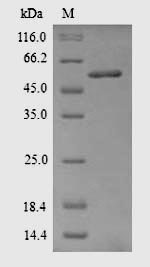
Greater than 90% as determined by SDS-PAGE.
Target Names
Acaca
Uniprot NO.
Research Area
Cancer
Alternative Names
Acaca; AcacAcetyl-CoA carboxylase 1; ACC1; EC 6.4.1.2; ACC-alpha
Species
Rattus norvegicus (Rat)
Source
Yeast
Expression Region
116-617aa
Target Protein Sequence
VIEKVLIANNGIAAVKCMRSIRRWSYEMFRNERAIRFVVMVTPEDLKANAEYIKMADHYVPVPGGANNNNYANVELILDIAKRIPVQAVWAGWGHASENPKLPELLLKNGIAFMGPPSQAMWALGDKIASSIVAQTAGIPTLPWSGSGLRVDWQENDFSKRILNVPQDLYEKGYVKDVDDGLKAAEEVGYPVMIKASEGGGGKGIRKVNNADDFPNLFRQVQAEVPGSPIFVMRLAKQSRHLEVQILADQYGNAISLFGRDCSVQRRHQKIIEEAPAAIATPAVFEHMEQCAVKLAKMVGYVSAGTVEYLYSQDGSFYFLELNPRLQVEHPCTEMVADVNLPAAQLQIAMGIPLFRIKDIRMMYGVSPWGDAPIDFENSAHVPCPRGHVIAARITSENPDEGFKPSSGTVQELNFRSNKNVWGYFSVAAAGGLHEFADSQFGHCFSWGENREEAISNMVVALKELSIRGDFRTTVEYLIKLLETESFQLNRIDTGWLDRLIA
Note: The complete sequence may include tag sequence, target protein sequence, linker sequence and extra sequence that is translated with the protein sequence for the purpose(s) of secretion, stability, solubility, etc.
If the exact amino acid sequence of this recombinant protein is critical to your application, please explicitly request the full and complete sequence of this protein before ordering.
Mol. Weight
57.8kDa
Protein Length
Partial
Tag Info
N-terminal 6xHis-tagged
The tag type will be determined during production process. If you have specified tag type, please tell us and we will develop the specified tag preferentially.
Buffer
Tris-based buffer,50% glycerol
Reconstitution
We recommend that this vial be briefly centrifuged prior to opening to bring the contents to the bottom. Please reconstitute protein in deionized sterile water to a concentration of 0.1-1.0 mg/mL.We recommend to add 5-50% of glycerol (final concentration) and aliquot for long-term storage at -20°C/-80°C. Our default final concentration of glycerol is 50%. Customers could use it as reference.
Storage Condition
The shelf life is related to many factors, storage state, buffer ingredients, storage temperature and the stability of the protein itself. Generally, the shelf life of liquid form is 6 months at -20°C/-80°C. The shelf life of lyophilized form is 12 months at -20°C/-80°C.
Shelf Life
The shelf life is related to many factors, storage state, buffer ingredients, storage temperature and the stability of the protein itself.
Generally, the shelf life of liquid form is 6 months at -20°C/-80°C. The shelf life of lyophilized form is 12 months at -20°C/-80°C.
Notes
Repeated freezing and thawing is not recommended. Store working aliquots at 4°C for up to one week.
Troubleshooting and FAQs
Datasheet & COA
Please contact us to get it.
Images
  • (Tris-Glycine gel) Discontinuous SDS-PAGE (reduced) with 5% enrichment gel and 15% separation gel.

Customer Reviews and Q&A

 Customer Reviews

Target Background

Function(From Uniprot)
Cytosolic enzyme that catalyzes the carboxylation of acetyl-CoA to malonyl-CoA, the first and rate-limiting step of de novo fatty acid biosynthesis. This is a 2 steps reaction starting with the ATP-dependent carboxylation of the biotin carried by the biotin carboxyl carrier (BCC) domain followed by the transfer of the carboxyl group from carboxylated biotin to acetyl-CoA.
Gene References into Functions
  1. suppression of ACC1 activity impairs glucose-stimulated insulin secretion via inhibition of glucose rather than lipid metabolism. PMID:18381287
  2. highlight site-specific impacts of hypothalamic acetyl-CoA carboxylase activation in leptin's anorectic signaling cascade. PMID:17956983
  3. Consistent with pathways of hepatic triglyceride synthesis, expression of diacylglycerol acyltransferase-1 and -2 was increased, as were delta-5- and delta-6- fatty acid desaturase mRNA levels. PMID:18280001
  4. The citrate produced by mitochondria may modulate ACC phosphorylation in the hypothalamus, controlling food intake and coordinating a multiorgan network that controls glucose homeostasis and energy uptake through the adrenergic system. PMID:18534630
  5. data support a potential role for Acetyl-CoA carboxylases (ACC) 1 and 2 in the development of obesity and diabetes in rats; results point towards major differences in ACC tissue distribution between humans and rats PMID:19618481

Show More

Hide All

Subcellular Location
Cytoplasm, cytosol.
Database Links
icon of phone
Call us
301-363-4651 (Available 9 a.m. to 5 p.m. CST from Monday to Friday)

icon of address
Address
No. 269, Shendun 5th Road, Donghu Hi-Tech Development Area, Hubei Province, 430206, P.R.China
icon of social media
Join us with

Subscribe newsletter

Leave a message

* To protect against spam, please pass the CAPTCHA test below.
CAPTCHA verification
© 2007-2025 CUSABIO TECHNOLOGY LLC All rights reserved. 鄂ICP备15011166号-1
Select 0 Products