Recombinant Pig Integrin beta-1 (ITGB1), partial

In Stock
Code: CSB-EP884398PI
Size:
20μg
20μg100μg1mg(1mg*1 or 500ug*2)
US$388
Quantity:
Express system: E.coli
Species: Sus scrofa (Pig)
Tag Info: N-terminal 10xHis-tagged and C-terminal Myc-tagged
For inquiries on large quantities or another requirements
Send an Inquiry
Start an on-line Chat
Online ordering is currently available for U.S. customers only. For orders outside the U.S., please kindly submit an inquiry or start a chat with us.

Product Details

Abbreviation
ITGB1
Purity
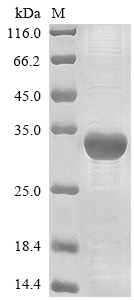
Greater than 85% as determined by SDS-PAGE.
Target Names
ITGB1
Uniprot NO.
Research Area
Signal Transduction
Species
Sus scrofa (Pig)
Source
E.coli
Expression Region
140-378aa
Target Protein Sequence
DYPIDLYYLMDLSYSMKDDLENVKSLGTDLMNEMRRITSDFRIGFGSFVEKTVMPYISTTPAKLRNPCTSEQNCTSPFSYKNVLSLTDKGEVFNELVGKQRISGNLDSPEGGFDAIMQVAVCGSLIGWRNVTRLLVFSTDAGFHFAGDGKLGGIVLPNDGHCHLENDVYTMSHYYDYPSIAHLVQKLSENNIQTIFAVTEEFQPVYKELKNLIPKSAVGTLSANSSNVIQLIIDAYNSL
Note: The complete sequence may include tag sequence, target protein sequence, linker sequence and extra sequence that is translated with the protein sequence for the purpose(s) of secretion, stability, solubility, etc.
If the exact amino acid sequence of this recombinant protein is critical to your application, please explicitly request the full and complete sequence of this protein before ordering.
Mol. Weight
34.1 kDa
Protein Length
Partial
Tag Info
N-terminal 10xHis-tagged and C-terminal Myc-tagged
The tag type will be determined during production process. If you have specified tag type, please tell us and we will develop the specified tag preferentially.
Buffer
Tris-based buffer,50% glycerol
Storage
The shelf life is related to many factors, storage state, buffer ingredients, storage temperature and the stability of the protein itself. Generally, the shelf life of liquid form is 6 months at -20°C/-80°C. The shelf life of lyophilized form is 12 months at -20°C/-80°C.
Shelf Life
The shelf life is related to many factors, storage state, buffer ingredients, storage temperature and the stability of the protein itself.
Generally, the shelf life of liquid form is 6 months at -20°C/-80°C. The shelf life of lyophilized form is 12 months at -20°C/-80°C.
Lead Time
3-7 business days
Note: All of our proteins are default shipped with normal blue ice packs, if you request to ship with dry ice, please communicate with us in advance and extra fees will be charged.
Notes
Repeated freezing and thawing is not recommended. Store working aliquots at 4°C for up to one week.
Troubleshooting and FAQs
Datasheet & COA
Please contact us to get it.
Images
  • (Tris-Glycine gel) Discontinuous SDS-PAGE (reduced) with 5% enrichment gel and 15% separation gel.
Description

Recombinant Pig Integrin beta-1 (ITGB1) is expressed in E. coli and comprises the amino acid residues 140-378. This partial protein comes engineered with an N-terminal 10xHis-tag and a C-terminal Myc-tag, which helps with purification and detection. The protein shows purity greater than 85% as assessed by SDS-PAGE, ensuring reliable performance in research applications. This product is intended for research use only.

Integrin beta-1 (ITGB1) appears to be a crucial component of the integrin family, playing what seems to be a significant role in cell adhesion and signal transduction. It's involved in various biological processes, including extracellular matrix interactions and cellular responses to the environment. ITGB1 is likely essential for understanding cell movement, proliferation, and survival. This makes it a valuable target for research in cellular biology and pathology.

Potential Applications

Note: The applications listed below are based on what we know about this protein's biological functions, published research, and experience from experts in the field. However, we haven't fully tested all of these applications ourselves yet. We'd recommend running some preliminary tests first to make sure they work for your specific research goals.

Pig ITGB1 is a transmembrane receptor that requires precise folding, proper disulfide bond formation, and specific tertiary structure for its functional activity in cell adhesion and signaling. The E. coli expression system cannot provide the eukaryotic folding environment, membrane integration, or post-translational modifications required for this complex protein. The partial fragment (140-378aa) lacks critical domains, including the transmembrane region and cytoplasmic tail, essential for full functionality. The dual N-terminal 10xHis-tag and C-terminal Myc-tag may cause significant steric interference with the protein's functional domains. The probability of correct folding with functional integrin activity is extremely low.

This E. coli-expressed ITGB1 fragment with dual tags is unsuitable for functional studies due to the essential requirements for membrane integration and proper folding that cannot be met in this expression system. The recombinant ITGB1 fragment can serve as an effective immunogen for antibody generation, as antibodies primarily recognize linear epitopes. The substantial fragment size (239aa) provides comprehensive epitope coverage. However, antibodies generated against misfolded protein may not optimally recognize conformation-dependent epitopes of native ITGB1 in biological systems. The dual tags enable epitope mapping but may also lead to tag-specific antibodies.

For reliable ITGB1 research, use a full-length protein expressed in mammalian systems that supports proper membrane integration, disulfide bond formation, and preserves native conformational epitopes.

Customer Reviews and Q&A

 Customer Reviews

Target Background

Function(From Uniprot)
Integrins alpha-1/beta-1, alpha-2/beta-1, alpha-10/beta-1 and alpha-11/beta-1 are receptors for collagen. Integrins alpha-1/beta-1 and alpha-2/beta-2 recognize the proline-hydroxylated sequence G-F-P-G-E-R in collagen. Integrins alpha-2/beta-1, alpha-3/beta-1, alpha-4/beta-1, alpha-5/beta-1, alpha-8/beta-1, alpha-10/beta-1, alpha-11/beta-1 and alpha-V/beta-1 are receptors for fibronectin. Alpha-4/beta-1 recognizes one or more domains within the alternatively spliced CS-1 and CS-5 regions of fibronectin. Integrin alpha-5/beta-1 is a receptor for fibrinogen. Integrin alpha-1/beta-1, alpha-2/beta-1, alpha-6/beta-1 and alpha-7/beta-1 are receptors for lamimin. Integrin alpha-6/beta-1 (ITGA6:ITGB1) is present in oocytes and is involved in sperm-egg fusion. Integrin alpha-4/beta-1 is a receptor for VCAM1 and recognizes the sequence Q-I-D-S in VCAM1. Integrin alpha-9/beta-1 is a receptor for VCAM1, cytotactin and osteopontin. It recognizes the sequence A-E-I-D-G-I-E-L in cytotactin. Integrin alpha-3/beta-1 is a receptor for epiligrin, thrombospondin and CSPG4. Integrin alpha-3/beta-1 provides a docking site for FAP (seprase) at invadopodia plasma membranes in a collagen-dependent manner and hence may participate in the adhesion, formation of invadopodia and matrix degradation processes, promoting cell invasion. Alpha-3/beta-1 may mediate with LGALS3 the stimulation by CSPG4 of endothelial cells migration. Integrin alpha-V/beta-1 is a receptor for vitronectin. Beta-1 integrins recognize the sequence R-G-D in a wide array of ligands. When associated with alpha-7/beta-1 integrin, regulates cell adhesion and laminin matrix deposition. Involved in promoting endothelial cell motility and angiogenesis. Involved in osteoblast compaction through the fibronectin fibrillogenesis cell-mediated matrix assembly process and the formation of mineralized bone nodules. May be involved in up-regulation of the activity of kinases such as PKC via binding to KRT1. Together with KRT1 and RACK1, serves as a platform for SRC activation or inactivation. Plays a mechanistic adhesive role during telophase, required for the successful completion of cytokinesis. ITGA4:ITGB1 binds to fractalkine (CX3CL1) and may act as its coreceptor in CX3CR1-dependent fractalkine signaling. ITGA4:ITGB1 and ITGA5:ITGB1 bind to PLA2G2A via a site (site 2) which is distinct from the classical ligand-binding site (site 1) and this induces integrin conformational changes and enhanced ligand binding to site 1. ITGA5:ITGB1 acts as a receptor for fibrillin-1 (FBN1) and mediates R-G-D-dependent cell adhesion to FBN1. ITGA5:ITGB1 is a receptor for IL1B and binding is essential for IL1B signaling. ITGA5:ITGB3 is a receptor for soluble CD40LG and is required for CD40/CD40LG signaling.
Gene References into Functions
  1. The results suggested that the effect of G allele of integrin beta1 gene on litter size is significant in Large White and Landrace. PMID:22805214
  2. beta1-integrin antigen-antibody interactions and the distribution of beta1-integrin protein on spermatogonial stem cell membrane were demonstrated using atomic force microscopy PMID:22237019
  3. Verotoxin 2 enhances adherence of enterohemorrhagic Escherichia coli O157:H7 to intestinal epithelial cells and expression of {beta}1-integrin by IPEC-J2 cells. PMID:20453145

Show More

Hide All

Subcellular Location
Cell membrane; Single-pass type I membrane protein. Cell projection, invadopodium membrane; Single-pass type I membrane protein. Cell projection, ruffle membrane; Single-pass type I membrane protein. Recycling endosome. Melanosome. Cell projection, lamellipodium. Cell projection, ruffle. Cell junction, focal adhesion. Cell surface.
Protein Families
Integrin beta chain family
Tissue Specificity
Widely expressed.
Database Links
icon of phone
Call us
301-363-4651 (Available 9 a.m. to 5 p.m. CST from Monday to Friday)

icon of address
Address
No. 269, Shendun 5th Road, Donghu Hi-Tech Development Area, Hubei Province, 430206, P.R.China
icon of social media
Join us with

Subscribe newsletter

Leave a message

* To protect against spam, please pass the CAPTCHA test below.
CAPTCHA verification
© 2007-2025 CUSABIO TECHNOLOGY LLC All rights reserved. 鄂ICP备15011166号-1
Select 0 Products