Recombinant Pan troglodytes Lymphotoxin-beta (LTB), partial

In Stock
Code: CSB-EP771253EQVa2
Size:
20μg
20μg100μg1mg(1mg*1 or 500ug*2)
US$388
Quantity:
Express system: E.coli
Species: Pan troglodytes (Chimpanzee)
Tag Info: N-terminal 6xHis-SUMO-tagged
For inquiries on large quantities or another requirements
Send an Inquiry
Start an on-line Chat
Online ordering is currently available for U.S. customers only. For orders outside the U.S., please kindly submit an inquiry or start a chat with us.

Product Details

Purity
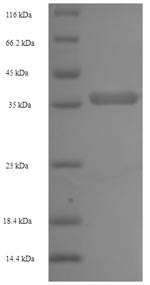
Greater than 90% as determined by SDS-PAGE.
Target Names
LTB
Uniprot NO.
Research Area
Others
Alternative Names
LTB; TNFC; TNFSF3; Lymphotoxin-beta; LT-beta; Tumor necrosis factor C; TNF-C; Tumor necrosis factor ligand superfamily member 3
Species
Pan troglodytes (Chimpanzee)
Source
E.coli
Expression Region
49-244aa
Target Protein Sequence
QDQGGLVTETADPGAQAQQGLGFQKLPEEEPETDLSPGLPAAHLIGAPLKGQGLGWETTKEQAFLTSGTQFSDAEGLALPQDGLYYLYCLVGYRGRTPPGGGDPQGRSVTLRSSLYRAGGAYGPGTPELLLEGAETVTPVLDPARRQGYGPLWYTSVGFGGLVQLRRGERVYVNISHPDMVDFARGKTFFGAVMVG
Note: The complete sequence may include tag sequence, target protein sequence, linker sequence and extra sequence that is translated with the protein sequence for the purpose(s) of secretion, stability, solubility, etc.
If the exact amino acid sequence of this recombinant protein is critical to your application, please explicitly request the full and complete sequence of this protein before ordering.
Mol. Weight
36.8kDa
Protein Length
Extracellular Domain
Tag Info
N-terminal 6xHis-SUMO-tagged
The tag type will be determined during production process. If you have specified tag type, please tell us and we will develop the specified tag preferentially.
Reconstitution
We recommend that this vial be briefly centrifuged prior to opening to bring the contents to the bottom. Please reconstitute protein in deionized sterile water to a concentration of 0.1-1.0 mg/mL.We recommend to add 5-50% of glycerol (final concentration) and aliquot for long-term storage at -20°C/-80°C. Our default final concentration of glycerol is 50%. Customers could use it as reference.
Storage Condition
The shelf life is related to many factors, storage state, buffer ingredients, storage temperature and the stability of the protein itself. Generally, the shelf life of liquid form is 6 months at -20°C/-80°C. The shelf life of lyophilized form is 12 months at -20°C/-80°C.
Shelf Life
The shelf life is related to many factors, storage state, buffer ingredients, storage temperature and the stability of the protein itself.
Generally, the shelf life of liquid form is 6 months at -20°C/-80°C. The shelf life of lyophilized form is 12 months at -20°C/-80°C.
Lead Time
3-7 business days
Note: All of our proteins are default shipped with normal blue ice packs, if you request to ship with dry ice, please communicate with us in advance and extra fees will be charged.
Notes
Repeated freezing and thawing is not recommended. Store working aliquots at 4°C for up to one week.
Troubleshooting and FAQs
Datasheet & COA
Please contact us to get it.
Images
  • (Tris-Glycine gel) Discontinuous SDS-PAGE (reduced) with 5% enrichment gel and 15% separation gel.
Description

Recombinant Pan troglodytes Lymphotoxin-beta (LTB) is produced using an E. coli expression system, covering the 49-244 amino acid region of the extracellular domain. The protein carries an N-terminal 6xHis-SUMO tag to simplify purification and analysis. SDS-PAGE confirms the product shows greater than 90% purity, which appears suitable for various research applications. This recombinant protein is designed for research use only and is not intended for therapeutic or diagnostic purposes.

Lymphotoxin-beta (LTB) plays a central role in the immune system, mainly through signaling pathways that control lymphoid tissue development and organization. It belongs to the tumor necrosis factor superfamily and seems crucial for maintaining the structure of secondary lymphoid organs. LTB's involvement in immune response regulation has made it an important target in immunology research, especially in studies exploring lymphoid organogenesis and immune system development.

Potential Applications

Note: The applications listed below are based on what we know about this protein's biological functions, published research, and experience from experts in the field. However, we haven't fully tested all of these applications ourselves yet. We'd recommend running some preliminary tests first to make sure they work for your specific research goals.

Pan troglodytes Lymphotoxin-beta (LTB) is a cytokine that requires precise folding, proper trimerization with its partner LTA (Lymphotoxin-alpha), and specific tertiary structure for its functional activity in TNF receptor signaling. The E. coli expression system cannot provide the eukaryotic folding environment necessary for correct trimerization and lacks the required partner protein LTA. The N-terminal 6xHis-SUMO tag (~15 kDa), while not larger than the LTB extracellular domain itself (~22 kDa), is still substantial and may sterically interfere with the protein's critical trimerization interfaces and receptor-binding domains. The probability of correct folding leading to a functional, trimerization-competent form is extremely low.

1. Antibody Development and Cross-Reactivity Testing

This application has severe limitations. While antibodies can be generated against linear epitopes, the immune response will be heavily biased towards the large, foreign SUMO tag. Consequently, the antibodies are unlikely to recognize conformational epitopes on the native, trimerized LTB-LTA complex in a physiological context.

2. Protein Stability and Folding Studies

Basic biophysical characterization can be performed, but the results will not reflect the stability of the native trimer. The properties measured (e.g., thermal stability) will be those of a monomeric, tag-fusion protein. The SUMO tag will dominate the biophysical behavior, providing no meaningful insight into the stability of the functional cytokine complex.

Final Recommendation & Action Plan

This SUMO-tagged LTB fragment expressed in E. coli is unsuitable for studies aiming to understand the native biology of Lymphotoxin-beta. The fundamental limitation is its inability to form the mandatory heterotrimeric complex with LTA, a requirement for all functional activity. Comparative and interaction studies should be avoided entirely as they will produce biologically misleading data. Applications 1 and 2 have severe, inherent limitations and will not yield insights relevant to the functional protein. For reliable LTB research, it is essential to use a system that co-expresses LTB with LTA (e.g., in mammalian cells) to produce the correct, trimerized complex.

Customer Reviews and Q&A

 Customer Reviews

Target Background

Function(From Uniprot)
Cytokine that binds to LTBR/TNFRSF3. May play a specific role in immune response regulation. Provides the membrane anchor for the attachment of the heterotrimeric complex to the cell surface.
Subcellular Location
Membrane; Single-pass type II membrane protein.
Protein Families
Tumor necrosis factor family
Database Links
icon of phone
Call us
301-363-4651 (Available 9 a.m. to 5 p.m. CST from Monday to Friday)

icon of address
Address
No. 269, Shendun 5th Road, Donghu Hi-Tech Development Area, Hubei Province, 430206, P.R.China
icon of social media
Join us with

Subscribe newsletter

Leave a message

* To protect against spam, please pass the CAPTCHA test below.
CAPTCHA verification
© 2007-2025 CUSABIO TECHNOLOGY LLC All rights reserved. 鄂ICP备15011166号-1
Select 0 Products