Recombinant Myrmecia pilosula M-myrmeciitoxin-Mp2b

In Stock
Code: CSB-BP366204MMMg6
Size:
20ug
20ug100ug1mg(1mg*1 or 500ug*2)
US$528
Quantity:
Express system: Baculovirus
Species: Myrmecia pilosula (Jack jumper ant) (Australian jumper ant)
Tag Info: N-terminal GST-tagged and C-terminal 6xHis-tagged
For inquiries on large quantities or another requirements
Send an Inquiry
Start an on-line Chat
Online ordering is currently available for U.S. customers only. For orders outside the U.S., please kindly submit an inquiry or start a chat with us.

Product Details

Purity
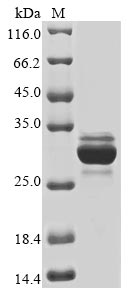
Greater than 85% as determined by SDS-PAGE.
Target Names
N/A
Uniprot NO.
Research Area
Microbiology
Species
Myrmecia pilosula (Jack jumper ant) (Australian jumper ant)
Source
Baculovirus
Expression Region
1-23aa
Target Protein Sequence
LIGLVSKGTCVLVKTVCKKVLKQ
Note: The complete sequence may include tag sequence, target protein sequence, linker sequence and extra sequence that is translated with the protein sequence for the purpose(s) of secretion, stability, solubility, etc.
If the exact amino acid sequence of this recombinant protein is critical to your application, please explicitly request the full and complete sequence of this protein before ordering.
Mol. Weight
30.8 kDa
Protein Length
Full Length
Tag Info
N-terminal GST-tagged and C-terminal 6xHis-tagged
The tag type will be determined during production process. If you have specified tag type, please tell us and we will develop the specified tag preferentially.
Form
Liquid or Lyophilized powder
Note: We will preferentially ship the format that we have in stock, however, if you have any special requirement for the format, please remark your requirement when placing the order, we will prepare according to your demand.
Buffer
If the delivery form is liquid, the default storage buffer is Tris/PBS-based buffer, 5%-50% glycerol. If the delivery form is lyophilized powder, the buffer before lyophilization is Tris/PBS-based buffer, 6% Trehalose.
Reconstitution
We recommend that this vial be briefly centrifuged prior to opening to bring the contents to the bottom. Please reconstitute protein in deionized sterile water to a concentration of 0.1-1.0 mg/mL.We recommend to add 5-50% of glycerol (final concentration) and aliquot for long-term storage at -20°C/-80°C. Our default final concentration of glycerol is 50%. Customers could use it as reference.
Storage
The shelf life is related to many factors, storage state, buffer ingredients, storage temperature and the stability of the protein itself. Generally, the shelf life of liquid form is 6 months at -20°C/-80°C. The shelf life of lyophilized form is 12 months at -20°C/-80°C.
Shelf Life
The shelf life is related to many factors, storage state, buffer ingredients, storage temperature and the stability of the protein itself.
Generally, the shelf life of liquid form is 6 months at -20°C/-80°C. The shelf life of lyophilized form is 12 months at -20°C/-80°C.
Lead Time
3-7 business days
Note: All of our proteins are default shipped with normal blue ice packs, if you request to ship with dry ice, please communicate with us in advance and extra fees will be charged.
Notes
Repeated freezing and thawing is not recommended. Store working aliquots at 4°C for up to one week.
Troubleshooting and FAQs
Datasheet & COA
Please contact us to get it.
Images
  • (Tris-Glycine gel) Discontinuous SDS-PAGE (reduced) with 5% enrichment gel and 15% separation gel.
Description

Recombinant Myrmecia pilosula M-myrmeciitoxin-Mp2b is expressed using a baculovirus system and contains the full-length sequence from amino acids 1 to 23. This protein carries both N-terminal GST tags and C-terminal 6xHis tags, which help with purification and detection processes. The preparation comes with purity greater than 85%, as determined by SDS-PAGE, and is designated for research use only.

M-myrmeciitoxin-Mp2b appears to be a key component in venom from the Myrmecia pilosula species—better known as the Australian jumper ant. Scientists study this protein primarily for its role in venom toxicity, since it seems to affect ion channels and may provide clues about how insect venom mechanisms work. Research into its structure and function could offer valuable insights into the biological activity of venom components and their possible uses in biotechnology.

Potential Applications

Note: The applications listed below are based on what we know about this protein's biological functions, published research, and experience from experts in the field. However, we haven't fully tested all of these applications ourselves yet. We'd recommend running some preliminary tests first to make sure they work for your specific research goals.

Myrmecia pilosula M-myrmeciitoxin-Mp2b is a small venom peptide that requires precise folding, potential disulfide bond formation, and specific tertiary structure for its functional activity, such as ion channel modulation or neurotoxicity. The baculovirus expression system provides a eukaryotic environment that supports disulfide bond formation and proper folding. However, the dual N-terminal GST-tag (∼26 kDa) and C-terminal 6xHis-tag are massively larger than the peptide itself (23 aa, ∼2.5 kDa), creating severe steric interference that will completely disrupt the peptide's functional conformation and bioactive domains. The probability of correct folding with functional bioactivity is essentially zero due to the overwhelming dominance of the tags.

This dual-tagged venom peptide expressed in baculovirus is unsuitable for any functional or structural studies due to the severe steric interference from the large tags relative to the tiny peptide size. The GST tag (26 kDa) is over 10 times larger than the peptide (2.5 kDa), dominating all properties. Antibody development has severe limitations. Antibody development will primarily generate responses against the large foreign GST tag rather than the small peptide. Antibodies may not recognize the native, tag-free toxin in its physiological context, reducing their utility for venom research. For reliable M-myrmeciitoxin-Mp2b research, use synthetic peptides or tag-free recombinant proteins produced in systems that preserve native conformation and disulfide bonding.

Customer Reviews and Q&A

 Customer Reviews

Target Background

Function(From Uniprot)
Heterodimer protein that may serve both defensive (pain-inducing) and predatory (insecticidal) roles. Has membrane-disrupting activity and shows induction of non-specific calcium influx into cells,. Shows broad-spectrum activity against a diverse range of bacteria, and cell lines, as well as hemolytic activity (EC(50)=2.18 uM). In vivo, shows moderate insecticidal activity against D.melanogaster and potent anthelmintic activity against the veterinary nematode H.contortus. In addition, intraplantar injection into mice induces nocifensive behavior and mechanical allodynia.
Subcellular Location
Secreted.
Protein Families
Pilosulin family
Tissue Specificity
Expressed by the venom gland.
icon of phone
Call us
301-363-4651 (Available 9 a.m. to 5 p.m. CST from Monday to Friday)

icon of address
Address
No. 269, Shendun 5th Road, Donghu Hi-Tech Development Area, Hubei Province, 430206, P.R.China
icon of social media
Join us with

Subscribe newsletter

Leave a message

* To protect against spam, please pass the CAPTCHA test below.
CAPTCHA verification
© 2007-2025 CUSABIO TECHNOLOGY LLC All rights reserved. 鄂ICP备15011166号-1
Select 0 Products