Recombinant Mouse Vitronectin (Vtn)

In Stock
Code: CSB-EP025944MO
Size:
20ug
20ug100ug1mg(1mg*1 or 500ug*2)
US$306
Quantity:
Express system: E.coli
Species: Mus musculus (Mouse)
Tag Info: N-terminal 10xHis-tagged and C-terminal Myc-tagged
For inquiries on large quantities or another requirements
Send an Inquiry
Start an on-line Chat
Online ordering is currently available for U.S. customers only. For orders outside the U.S., please kindly submit an inquiry or start a chat with us.

Product Details

Purity
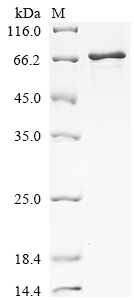
Greater than 85% as determined by SDS-PAGE.
Target Names
Vtn
Uniprot NO.
Research Area
Others
Species
Mus musculus (Mouse)
Source
E.coli
Expression Region
20-478aa
Target Protein Sequence
DQESCKGRCTQGFMASKKCQCDELCTYYQSCCADYMEQCKPQVTRGDVFTMPEDDYWSYDYVEEPKNNTNTGVQPENTSPPGDLNPRTDGTLKPTAFLDPEEQPSTPAPKVEQQEEILRPDTTDQGTPEFPEEELCSGKPFDAFTDLKNGSLFAFRGQYCYELDETAVRPGYPKLIQDVWGIEGPIDAAFTRINCQGKTYLFKGSQYWRFEDGVLDPGYPRNISEGFSGIPDNVDAAFALPAHRYSGRERVYFFKGKQYWEYEFQQQPSQEECEGSSLSAVFEHFALLQRDSWENIFELLFWGRSSDGAREPQFISRNWHGVPGKVDAAMAGRIYVTGSLSHSAQAKKQKSKRRSRKRYRSRRGRGHRRSQSSNSRRSSRSIWFSLFSSEESGLGTYNNYDYDMDWLVPATCEPIQSVYFFSGDKYYRVNLRTRRVDSVNPPYPRSIAQYWLGCPTSEK
Note: The complete sequence may include tag sequence, target protein sequence, linker sequence and extra sequence that is translated with the protein sequence for the purpose(s) of secretion, stability, solubility, etc.
If the exact amino acid sequence of this recombinant protein is critical to your application, please explicitly request the full and complete sequence of this protein before ordering.
Mol. Weight
60.2 kDa
Protein Length
Full Length of Mature Protein
Tag Info
N-terminal 10xHis-tagged and C-terminal Myc-tagged
The tag type will be determined during production process. If you have specified tag type, please tell us and we will develop the specified tag preferentially.
Form
Liquid or Lyophilized powder
Note: We will preferentially ship the format that we have in stock, however, if you have any special requirement for the format, please remark your requirement when placing the order, we will prepare according to your demand.
Buffer
If the delivery form is liquid, the default storage buffer is Tris/PBS-based buffer, 5%-50% glycerol. If the delivery form is lyophilized powder, the buffer before lyophilization is Tris/PBS-based buffer, 6% Trehalose.
Reconstitution
We recommend that this vial be briefly centrifuged prior to opening to bring the contents to the bottom. Please reconstitute protein in deionized sterile water to a concentration of 0.1-1.0 mg/mL.We recommend to add 5-50% of glycerol (final concentration) and aliquot for long-term storage at -20℃/-80℃. Our default final concentration of glycerol is 50%. Customers could use it as reference.
Storage
The shelf life is related to many factors, storage state, buffer ingredients, storage temperature and the stability of the protein itself. Generally, the shelf life of liquid form is 6 months at -20°C/-80°C. The shelf life of lyophilized form is 12 months at -20°C/-80°C.
Shelf Life
The shelf life is related to many factors, storage state, buffer ingredients, storage temperature and the stability of the protein itself.
Generally, the shelf life of liquid form is 6 months at -20°C/-80°C. The shelf life of lyophilized form is 12 months at -20°C/-80°C.
Lead Time
3-7 business days
Note: All of our proteins are default shipped with normal blue ice packs, if you request to ship with dry ice, please communicate with us in advance and extra fees will be charged.
Notes
Repeated freezing and thawing is not recommended. Store working aliquots at 4°C for up to one week.
Troubleshooting and FAQs
Datasheet & COA
Please contact us to get it.
Images
  • (Tris-Glycine gel) Discontinuous SDS-PAGE (reduced) with 5% enrichment gel and 15% separation gel.

Customer Reviews and Q&A

 Customer Reviews

Target Background

Function(From Uniprot)
Vitronectin is a cell adhesion and spreading factor found in serum and tissues. Vitronectin interact with glycosaminoglycans and proteoglycans. Is recognized by certain members of the integrin family and serves as a cell-to-substrate adhesion molecule. Inhibitor of the membrane-damaging effect of the terminal cytolytic complement pathway.
Gene References into Functions
  1. The effects of genetic alterations in PAI-1 expression, pharmacologic PAI-1 inhibition and recombinant PAI-1 on smooth muscle cell vitronectin (VN) expression were studied, and vascular VN expression in wild-type and PAI-1-deficient mice was assessed. PMID:29028290
  2. this study demonstrates in a mouse infection model that Vn reduces complement-mediated killing of Yersinia enterocolitica O:9 E40 and, thus, improves bacterial survival PMID:27798934
  3. the TGF-beta-PAI-1-vitronectin-integrin axis may represent a critical convergence of factors in determining the alveolar epithelial cell apoptotic response during lung injury. PMID:27106291
  4. In vtn knockout mice, neuronal differentiation in the cerebellum was suppressed compared with wild-type mice. PMID:26640242
  5. PAI-1, through its interaction with Vn, exerts multiple deleterious mechanisms to induce AKI. PMID:25799354
  6. These data suggest that adhesion to vitronectin allows for the uncoupling of fibronectin fibril formation from downstream signaling events by reducing alpha5beta1 integrin activation and fibronectin fibril extension. PMID:24509439
  7. Report role of vitronectin in the regulation of angiogenesis induced by VEGF. PMID:24603119
  8. Vitronectin inhibits efferocytosis through interactions with apoptotic cells as well as with macrophages. PMID:23345331
  9. VN plays a previously unrecognized role in regulating endothelial permeability via conformational- and integrin-dependent effects on VE-cadherin trafficking. PMID:22606350
  10. ability of vitronectin to enhance neutrophil viability was dependent on activation of phosphatidylinositol 3-kinase and extracellular signal-regulated kinase 1/2 kinases, but not on the p38 kinase PMID:22281987
  11. These results demonstrate that vitronectin exerts a deleterious role independently from complement, by directing PAI-dependent fibrinolysis in the glomerular compartment. PMID:21764994
  12. the vitronectin-binding capacity of PAI-1 was the primary determinant required for its ability to exacerbate lung scarring induced by intratracheal bleomycin administration PMID:21734232
  13. Suggest that despite significant interstitial Vtn deposition in the ureteral obstruction model of chronic kidney disease, its fibrogenic role is either nonessential or redundant. PMID:21270094
  14. Plasminogen activator inhibitor-1 and vitronectin expression level and stoichiometry regulate vascular smooth muscle cell migration through physiological collagen matrices PMID:20492459
  15. Endogenous vitronectin promotes neointima formation in carotid arteries. PMID:12067901
  16. regulation of cell spreading on vitronectin by ERK1 association with alphaVbeta3 integrin PMID:12393886
  17. In a carotid artery ligation model, vitronectin (VN) knockout mice generate a larger intima than wild-type as a result of more extensive smooth muscle cell (SMC)proliferation, demonstrating that VN inhibits thrombin-mediated SMC proliferation. PMID:12482822
  18. vitronectin can selectively regulate inactivating potassium current in embryonic hippocampal neurons PMID:12562917
  19. competition with plasminogen activator inhibitor type-1 for alphavbeta3 binding inhibits insulin signaling PMID:12603314
  20. in contrast to released platelet granule Vn which enhances platelet aggregation, plasma Vn inhibits platelet aggregation PMID:15733060
  21. There is an increase of vitronectin and integrin alphav in the retina and the optic nerve after optic nerve injury. Induction of Vitronectin and integrin alphav may have an important role in the regeneration of adult mammalian retinal ganglion cells. PMID:16479252
  22. PrP(C) plays an important role in axonal growth, and this function may be rescued in PrP(C)-knockout animals by integrin compensatory mechanisms. PMID:17504807
  23. a novel vitronectin-dependent mechanism contributing to the development of acute lung injury. PMID:17982099
  24. VN is a key determinant of the antiproliferative effect of PAI-1 overexpression. PMID:19574558

Show More

Hide All

Subcellular Location
Secreted, extracellular space.
Tissue Specificity
Plasma.
Database Links

UNIGENE: Mm.3667

KEGG: mmu:22370

STRING: 10090.ENSMUSP00000017488

icon of phone
Call us
301-363-4651 (Available 9 a.m. to 5 p.m. CST from Monday to Friday)
icon of address
Address
No. 269, Shendun 5th Road, Donghu Hi-Tech Development Area, Hubei Province, 430206, P.R.China
icon of social media
Join us with

Subscribe newsletter

Leave a message

* To protect against spam, please pass the CAPTCHA test below.
CAPTCHA verification
© 2007-2025 CUSABIO TECHNOLOGY LLC All rights reserved. 鄂ICP备15011166号-1
Select 0 Products