Purity
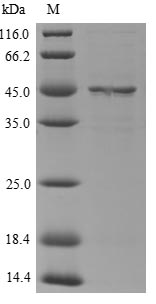
Greater than 85% as determined by SDS-PAGE.
Alternative Names
Serpina3n; Spi2; Serine protease inhibitor A3N; Serpin A3N
Species
Mus musculus (Mouse)
Expression Region
21-418aa
Target Protein Sequence
FPDGTLGMDAAVQEDHDNGTQLDSLTLASINTDFAFSLYKELVLKNPDKNIVFSPLSISAALAVMSLGAKGNTLEEILEGLKFNLTETSEADIHQGFGHLLQRLNQPKDQVQISTGSALFIEKRQQILTEFQEKAKTLYQAEAFTADFQQPRQAKKLINDYVRKQTQGMIKELVSDLDKRTLMVLVNYIYFKAKWKVPFDPLDTFKSEFYAGKRRPVIVPMMSMEDLTTPYFRDEELSCTVVELKYTGNASALFILPDQGRMQQVEASLQPETLRKWKNSLKPRMIDELHLPKFSISTDYSLEDVLSKLGIREVFSTQADLSAITGTKDLRVSQVVHKAVLDVAETGTEAAAATGVKFVPMSAKLYPLTVYFNRPFLIMIFDTETEIAPFIAKIANPK
Note: The complete
sequence may include tag sequence, target protein sequence, linker sequence and extra sequence that is
translated with the protein sequence for the purpose(s) of secretion, stability, solubility, etc.
If the exact amino acid sequence of this recombinant protein is critical to your application,
please explicitly request the full and complete sequence of this protein before ordering.
Protein Length
Full Length of Mature Protein
Tag Info
N-terminal 10xHis-tagged
The tag type will be determined during production process. If you have specified tag type, please tell us and we will develop the specified tag preferentially.
Reconstitution
We recommend that this vial be briefly centrifuged prior to opening to bring the contents to the bottom. Please reconstitute protein in deionized sterile water to a concentration of 0.1-1.0 mg/mL.We recommend to add 5-50% of glycerol (final concentration) and aliquot for long-term storage at -20°C/-80°C. Our default final concentration of glycerol is 50%. Customers could use it as reference.
Storage Condition
The shelf life is related to many factors, storage state, buffer ingredients, storage temperature and the stability of the protein itself.
Generally, the shelf life of liquid form is 6 months at -20°C/-80°C. The shelf life of lyophilized form is 12 months at -20°C/-80°C.
Shelf Life
The shelf life is related to many factors, storage state, buffer ingredients, storage temperature and the stability of the protein itself.
Generally, the shelf life of liquid form is 6 months at -20°C/-80°C. The shelf life of lyophilized form is 12 months at -20°C/-80°C.
Lead Time
3-7 business days
Note: All of our proteins are default shipped with normal blue ice packs, if you request to ship with dry ice, please communicate with us in advance and extra fees will be charged.
Notes
Repeated freezing and thawing is not recommended. Store working aliquots at 4°C for up to one week.
Datasheet & COA
Please contact us to get it.
Images
-
(Tris-Glycine gel) Discontinuous SDS-PAGE (reduced) with 5% enrichment gel and 15% separation gel.
Description
The expression vector recombined with the recombinant DNA was transfected into the yeast cells for expression. The recombinant DNA resulted from the fusion of the gene coding for the 21-418aa of the mouse Serpina3n protein and the N-terminal 10xHis tag gene. The product was purified and isolated to get the recombinant mouse Serpina3n protein with N-terminal 10xHis tag. This recombinant Serpina3n protein's purity reaches up to 85%. Under SDS-PAGE condition, this recombinant Serpina3n protein showed a band with a molecular weight of about 45 kDa on the gel.
Serpina3n is a serine protease inhibitor and belongs serpin family which is the largest protease inhibitor family. Serpina3n is a recently identified novel serine protease inhibitor, α1-antichymotrypsin–like protein, from EB22, a murine chondrocytic cell line. This protein is expressed at high levels in brain, heart, liver, lung, spleen, testis and thymus, and at low levels in bone marrow, kidney and skeletal muscle. The function of this protein is still unknown. A study has reported that mice lacking SerpinA3N developed more neuropathic mechanical allodynia than wild-type (WT) mice, and exogenous delivery of SerpinA3N attenuated mechanical allodynia in WT mice. Additionally, another study found Serpina3n as the most female osteoblast–dominant gene. This study demonstrated that Serpina3n exerts a suppression of the osteoblast phenotypes such as Col1a1 expression and ALP activity in differentiated osteoblasts, which might partly explain sex differences of the osteoblast phenotypes in mice.