Recombinant Mouse [Pyruvate dehydrogenase (acetyl-transferring)] kinase isozyme 1, mitochondrial (Pdk1)

In Stock
Code: CSB-BP807321MO
Size:
20ug
20ug100ug1mg(1mg*1 or 500ug*2)
US$528
Quantity:
Express system: Baculovirus
Species: Mus musculus (Mouse)
Tag Info: N-terminal 10xHis-tagged
For inquiries on large quantities or another requirements
Send an Inquiry
Start an on-line Chat
Online ordering is currently available for U.S. customers only. For orders outside the U.S., please kindly submit an inquiry or start a chat with us.

Product Details

Abbreviation
Pdk1
Purity
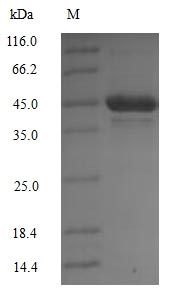
Greater than 85% as determined by SDS-PAGE.
Target Names
Pdk1
Uniprot NO.
Research Area
Signal Transduction
Species
Mus musculus (Mouse)
Source
Baculovirus
Expression Region
27-434aa
Target Protein Sequence
ASASASGSGPASELGVPGQVDFYARFSPSPLSMKQFLDFGSVNACEKTSFMFLRQELPVRLANIMKEISLLPDNLLRTPSVQLVQSWYIQSLQELLDFKDKSAEDAKTIYEFTDTVIRIRNRHNDVIPTMAQGVTEYKESFGVDPVTSQNVQYFLDRFYMSRISIRMLLNQHSLLFGGKGSPSHRKHIGSINPNCDVVEVIKDGYENARRLCDLYYVNSPELELEELNAKSPGQTIQVVYVPSHLYHMVFELFKNAMRATMEHHADKGVYPPIQVHVTLGEEDLTVKMSDRGGGVPLRKIDRLFNYMYSTAPRPRVETSRAVPLAGFGYGLPISRLYAQYFQGDLKLYSLEGYGTDAVIYIKALSTESVERLPVYNKAAWKHYKANHEADDWCVPSREPKDMTTFRSS
Note: The complete sequence may include tag sequence, target protein sequence, linker sequence and extra sequence that is translated with the protein sequence for the purpose(s) of secretion, stability, solubility, etc.
If the exact amino acid sequence of this recombinant protein is critical to your application, please explicitly request the full and complete sequence of this protein before ordering.
Mol. Weight
48.7kDa
Protein Length
Full Length of Mature Protein
Tag Info
N-terminal 10xHis-tagged
The tag type will be determined during production process. If you have specified tag type, please tell us and we will develop the specified tag preferentially.
Reconstitution
We recommend that this vial be briefly centrifuged prior to opening to bring the contents to the bottom. Please reconstitute protein in deionized sterile water to a concentration of 0.1-1.0 mg/mL.We recommend to add 5-50% of glycerol (final concentration) and aliquot for long-term storage at -20°C/-80°C. Our default final concentration of glycerol is 50%. Customers could use it as reference.
Storage
The shelf life is related to many factors, storage state, buffer ingredients, storage temperature and the stability of the protein itself. Generally, the shelf life of liquid form is 6 months at -20°C/-80°C. The shelf life of lyophilized form is 12 months at -20°C/-80°C.
Shelf Life
The shelf life is related to many factors, storage state, buffer ingredients, storage temperature and the stability of the protein itself.
Generally, the shelf life of liquid form is 6 months at -20°C/-80°C. The shelf life of lyophilized form is 12 months at -20°C/-80°C.
Lead Time
3-7 business days
Note: All of our proteins are default shipped with normal blue ice packs, if you request to ship with dry ice, please communicate with us in advance and extra fees will be charged.
Notes
Repeated freezing and thawing is not recommended. Store working aliquots at 4°C for up to one week.
Troubleshooting and FAQs
Datasheet & COA
Please contact us to get it.
Images
  • (Tris-Glycine gel) Discontinuous SDS-PAGE (reduced) with 5% enrichment gel and 15% separation gel.

Description

The expression region of this recombinant Mouse Pdk1 covers amino acids 27-434. The theoretical molecular weight of the Pdk1 protein is 48.7 kDa. This Pdk1 recombinant protein is manufactured in baculovirus. The N-terminal 10xHis tag was fused into the coding gene segment of Pdk1, making it easier to detect and purify the Pdk1 recombinant protein in the later stages of expression and purification.

Pyruvate dehydrogenase kinase isoform 1 (Pdk1) is a highly studied protein, with a primary focus on metabolic regulation and the field of tumor biology. As a critical regulator of the tricarboxylic acid cycle, Pdk1 influences cellular energy metabolism by inhibiting decarboxylase activity through phosphorylation. One of its most crucial research directions is its role in tumor metabolism regulation. Pdk1 is found to be overexpressed in various cancers, closely linked to tumor growth and metabolic reprogramming. Additionally, Pdk1 is implicated in multiple research areas, including cardiovascular diseases, as its regulation of metabolic pathways and signaling networks positions it as a potential drug target for the treatment and prevention of related diseases.


Customer Reviews and Q&A

 Customer Reviews

Target Background

Function(From Uniprot)
Kinase that plays a key role in regulation of glucose and fatty acid metabolism and homeostasis via phosphorylation of the pyruvate dehydrogenase subunits PDHA1 and PDHA2. This inhibits pyruvate dehydrogenase activity, and thereby regulates metabolite flux through the tricarboxylic acid cycle, down-regulates aerobic respiration and inhibits the formation of acetyl-coenzyme A from pyruvate. Plays an important role in cellular responses to hypoxia and is important for cell proliferation under hypoxia. Protects cells against apoptosis in response to hypoxia and oxidative stress.
Gene References into Functions
  1. In Agrp Pdk1-/- female mice stature and femur length were shorter. Bone mineral density in the femur decreased, and bone formation was delayed. PMID:28462077
  2. HIF-1alpha-PDK1-mediated metabolic changes occur in mild hypoxia, where mitochondrial cytochrome c oxidase activity is unimpaired, suggesting a mode of glycolytic reprogramming. PMID:27189088
  3. The results demonstrate a novel role of PDK1 in AgRP neurons to counteract the high salt diet-induced hypertension by preventing hyperactivation of paraventricular nucleus nesfatin-1 neurons. PMID:29705701
  4. Here, the authors show that loss of Fxn in the nervous system in mice also activates an iron/sphingolipid/PDK1/Mef2 pathway, indicating that the mechanism is evolutionarily conserved. PMID:27901468
  5. PDK1 has broad effects in hematopoiesis and is a critical factor for engraftment of both hematopoietic stem cells and multipotent progenitors upon transplantation to recipient mice. PMID:28182733
  6. PTEN is required for stabilization of planar cell packing in the neural plate and for the formation of stable apical-basal microtubule arrays, while PDPK1 is required for stabilization of apical junctions during epithelial morphogenesis. PMID:26809587
  7. results thus reveal an essential role for the PDK1-Akt pathway in the regulation of a key step of neuronal migration. PMID:27170189
  8. PDK1 plays a pivotal role in regulating cardiac function and tumor metastasis by interfering with microenvironment. PMID:25601552
  9. These findings reveal that there are divergent roles of PDKs during oocyte maturation and indicate a new mechanism controlling meiotic structure. PMID:25991547
  10. Our data suggest that two arms of the glucose metabolism synergistically regulate the differential activation of macrophages. Our findings also highlight the central role of PDK1 in this event via controlling glycolysis and glucose oxidation. PMID:25964487
  11. PDHK1 is expressed in Th17 cells, but not Th1 cells, and at low levels in Tregs, and inhibition or knockdown of PDHK1 selectively suppressed Th17 cells and increased Tregs. PMID:25437876
  12. The tyrosine phosphorylation enhances PDHK1 kinase activity by promoting ATP and PDC binding. PMID:22195962
  13. Pdk1 enzyme is critical in conserving mitochondrial function by diverting metabolic intermediates to glycolysis PMID:20160671

Show More

Hide All

Subcellular Location
Mitochondrion matrix.
Protein Families
PDK/BCKDK protein kinase family
Database Links
icon of phone
Call us
301-363-4651 (Available 9 a.m. to 5 p.m. CST from Monday to Friday)
icon of address
Address
No. 269, Shendun 5th Road, Donghu Hi-Tech Development Area, Hubei Province, 430206, P.R.China
icon of social media
Join us with

Subscribe newsletter

Leave a message

* To protect against spam, please pass the CAPTCHA test below.
CAPTCHA verification
© 2007-2025 CUSABIO TECHNOLOGY LLC All rights reserved. 鄂ICP备15011166号-1
Select 0 Products