Recombinant Mouse Otoferlin (Otof), partial

Code: CSB-EP017272MO
Size:
20ug
20ug100ug1mg(1mg*1 or 500ug*2)
US$388
Quantity:
Express system: E.coli
Species: Mus musculus (Mouse)
Tag Info: N-terminal 10xHis-tagged and C-terminal Myc-tagged
For inquiries on large quantities or another requirements
Send an Inquiry
Start an on-line Chat
Online ordering is currently available for U.S. customers only. For orders outside the U.S., please kindly submit an inquiry or start a chat with us.

Product Details

Purity
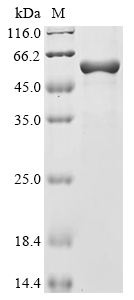
Greater than 85% as determined by SDS-PAGE.
Target Names
Otof
Uniprot NO.
Research Area
Neuroscience
Species
Mus musculus (Mouse)
Source
E.coli
Expression Region
1461-1868aa
Target Protein Sequence
KVPLPEDVSREAGYDPTYGMFQGIPSNDPINVLVRIYVVRATDLHPADINGKADPYIAIKLGKTDIRDKENYISKQLNPVFGKSFDIEASFPMESMLTVAVYDWDLVGTDDLIGETKIDLENRFYSKHRATCGIAQTYSIHGYNIWRDPMKPSQILTRLCKEGKVDGPHFGPHGRVRVANRVFTGPSEIEDENGQRKPTDEHVALSALRHWEDIPRVGCRLVPEHVETRPLLNPDKPGIEQGRLELWVDMFPMDMPAPGTPLDISPRKPKKYELRVIVWNTDEVVLEDDDFFTGEKSSDIFVRGWLKGQQEDKQDTDVHYHSLTGEGNFNWRYLFPFDYLAAEEKIVMSKKESMFSWDETEYKIPARLTLQIWDADHFSADDFLGAIELDLNRFPRGAKTAKQCTMEM
Note: The complete sequence may include tag sequence, target protein sequence, linker sequence and extra sequence that is translated with the protein sequence for the purpose(s) of secretion, stability, solubility, etc.
If the exact amino acid sequence of this recombinant protein is critical to your application, please explicitly request the full and complete sequence of this protein before ordering.
Mol. Weight
54.2 kDa
Protein Length
Partial
Tag Info
N-terminal 10xHis-tagged and C-terminal Myc-tagged
The tag type will be determined during production process. If you have specified tag type, please tell us and we will develop the specified tag preferentially.
Form
Liquid or Lyophilized powder
Note: We will preferentially ship the format that we have in stock, however, if you have any special requirement for the format, please remark your requirement when placing the order, we will prepare according to your demand.
Buffer
If the delivery form is liquid, the default storage buffer is Tris/PBS-based buffer, 5%-50% glycerol. If the delivery form is lyophilized powder, the buffer before lyophilization is Tris/PBS-based buffer, 6% Trehalose.
Reconstitution
We recommend that this vial be briefly centrifuged prior to opening to bring the contents to the bottom. Please reconstitute protein in deionized sterile water to a concentration of 0.1-1.0 mg/mL.We recommend to add 5-50% of glycerol (final concentration) and aliquot for long-term storage at -20℃/-80℃. Our default final concentration of glycerol is 50%. Customers could use it as reference.
Storage
The shelf life is related to many factors, storage state, buffer ingredients, storage temperature and the stability of the protein itself. Generally, the shelf life of liquid form is 6 months at -20°C/-80°C. The shelf life of lyophilized form is 12 months at -20°C/-80°C.
Shelf Life
The shelf life is related to many factors, storage state, buffer ingredients, storage temperature and the stability of the protein itself.
Generally, the shelf life of liquid form is 6 months at -20°C/-80°C. The shelf life of lyophilized form is 12 months at -20°C/-80°C.
Lead Time
Delivery time may differ from different purchasing way or location, please kindly consult your local distributors for specific delivery time.
Note: All of our proteins are default shipped with normal blue ice packs, if you request to ship with dry ice, please communicate with us in advance and extra fees will be charged.
Notes
Repeated freezing and thawing is not recommended. Store working aliquots at 4°C for up to one week.
Troubleshooting and FAQs
Datasheet & COA
Please contact us to get it.
Images
  • (Tris-Glycine gel) Discontinuous SDS-PAGE (reduced) with 5% enrichment gel and 15% separation gel.

Customer Reviews and Q&A

 Customer Reviews

Target Background

Function(From Uniprot)
Key calcium ion sensor involved in the Ca(2+)-triggered synaptic vesicle-plasma membrane fusion and in the control of neurotransmitter release at these output synapses. Interacts in a calcium-dependent manner to the presynaptic SNARE proteins at ribbon synapses of cochlear inner hair cells (IHCs) to trigger exocytosis of neurotransmitter. Also essential to synaptic exocytosis in immature outer hair cells (OHCs). May also play a role within the recycling of endosomes.
Gene References into Functions
  1. Otoferlin thus functions as a Ca(2+) sensor, setting the rates of primed vesicle fusion with the presynaptic plasma membrane and synaptic vesicle pool replenishment in the inner hair cell active zone. PMID:29111973
  2. Furthermore, this F-actin mesh network attached to the synaptic ribbons directly influences the efficiency of otoferlin-dependent exocytosis and its sensitivity to intracellular hydrostatic pressure. PMID:26568308
  3. Mice that carry a mutation in a calcium binding domain of Otoferlin, the putative calcium sensor at hair cell synapses, have normal distortion product otoacoustic emissions (DPOAEs), but auditory brain stem responses (ABRs) are absent. PMID:25253474
  4. a direct role for otoferlin in exocytosis and modulation of calcium-dependent membrane fusion PMID:24478316
  5. The analysis of otoferlin knockout mice gave the 1st insights into its function in inner hair cell calcium-dependent exocytosis & type-i vestibular hair cells. Review. PMID:22959777
  6. Co-localization studies revealed an overlap of Ergic2 and Otoferlin signals in IHCs and neurons of cerebral cortical layer I making Ergic2 the promising binding candidate PMID:22613993
  7. Otoferlin deletion does not affect transmitter release at hippocampal synapses. PMID:21451027
  8. Otoferlin is a calcium sensor that can directly regulate soluble N-ethyl-maleimide sensitive fusion protein attachment protein receptor-mediated membrane fusion reactions. PMID:20921140
  9. Otoferlin underlies highly efficient calcium ion-dependent membrane fusion, a process likely essential to increase the probability and synchrony of vesicle fusion events at the mature inner hair cell ribbon synapse. PMID:20926654
  10. Deficient vesicle replenishment underlies the hearing impairment of Otof(Pga/Pga) mice. Otoferlin may confer the high capacity for vesicle re-supply to the inner hair cell synapse. PMID:20562868
  11. Otoferlin is essential for a late step of synaptic vesicle exocytosis and may act as the major Ca(2+) sensor triggering membrane fusion at the auditory inner hair cell ribbon synapse. PMID:17055430
  12. Missense mutation of Otof underlies deafness phenotype of ENU-induced deaf5 mutation. PMID:17967520
  13. Otoferlin, the putative major calcium sensor at inner hair cell ribbon synapses, is also essential to synaptic exocytosis in immature outer hair cells. PMID:18287496
  14. Otoferlin-Rab8b interaction links otoferlin to the basolateral endocytic and secretory trafficking. PMID:18772196
  15. Direct interaction of otoferlin with syntaxin 1A, SNAP-25, and the L-type voltage-gated calcium channel Cav1.3. PMID:19004828
  16. Otoferlin and myosin VI mutant showed a reduced basolateral synaptic surface area and altered topography of the inner hair cell. PMID:19417007
  17. Otoferlin is essential for a high-affinity Ca(2+) sensor function that allows efficient and linear encoding of low-intensity stimuli at the vestibular hair cell synapse. PMID:19710301

Show More

Hide All

Subcellular Location
Cytoplasmic vesicle, secretory vesicle, synaptic vesicle membrane; Single-pass type II membrane protein. Basolateral cell membrane; Single-pass type II membrane protein. Endoplasmic reticulum membrane; Single-pass type II membrane protein. Golgi apparatus membrane; Single-pass type II membrane protein. Cell junction, synapse, presynaptic cell membrane; Single-pass type II membrane protein. Cell membrane; Single-pass type II membrane protein. Note=Detected at basolateral cell membrane with synaptic vesicles surrounding the ribbon and at the presynaptic plasma membrane in the inner hair cells (IHCs) at postnatal day 30 (P30). Colocalizes with GPR25 and RAB8B in inner hair cells.
Protein Families
Ferlin family
Tissue Specificity
Isoform 1 is expressed in cochlea and brain. Expressed in the cochlear and vestibular hair cells. Expressed in both inner and outer hair cells (IHCs and OHCs) and cochlear ganglions neurons at postnatal day 2 (P2) and 6 (P6). Expressed only in IHCs at pos
Database Links
icon of phone
Call us
301-363-4651 (Available 9 a.m. to 5 p.m. CST from Monday to Friday)
icon of address
Address
No. 269, Shendun 5th Road, Donghu Hi-Tech Development Area, Hubei Province, 430206, P.R.China
icon of social media
Join us with

Subscribe newsletter

Leave a message

* To protect against spam, please pass the CAPTCHA test below.
CAPTCHA verification
© 2007-2025 CUSABIO TECHNOLOGY LLC All rights reserved. 鄂ICP备15011166号-1
Select 0 Products