Recombinant Mouse Myosin regulatory light chain 2, ventricular/cardiac muscle isoform (Myl2)

Code: CSB-EP015309MO
Size:
20ug
20ug100ug1mg
US$256
Quantity:
Express system: E.coli
Species: Mus musculus (Mouse)
Tag Info: C-terminal 6xHis-tagged
For inquiries on large quantities or another requirements
Send an Inquiry
Start an on-line Chat
Online ordering is currently available for U.S. customers only. For orders outside the U.S., please kindly submit an inquiry or start a chat with us.

Product Details

Purity
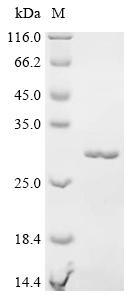
Greater than 90% as determined by SDS-PAGE.
Target Names
Myl2
Uniprot NO.
Research Area
Signal Transduction
Species
Mus musculus (Mouse)
Source
E.coli
Expression Region
2-166aa
Target Protein Sequence
APKKAKKRIEGGSSNVFSMFEQTQIQEFKEAFTIMDQNRDGFIDKNDLRDTFAALGRVNVKNEEIDEMIKEAPGPINFTVFLTMFGEKLKGADPEETILNAFKVFDPEGKGSLKADYVREMLTTQAERFSKEEIDQMFAAFPPDVTGNLDYKNLVHIITHGEEKD
Note: The complete sequence may include tag sequence, target protein sequence, linker sequence and extra sequence that is translated with the protein sequence for the purpose(s) of secretion, stability, solubility, etc.
If the exact amino acid sequence of this recombinant protein is critical to your application, please explicitly request the full and complete sequence of this protein before ordering.
Mol. Weight
25.6 kDa
Protein Length
Full Length of Mature Protein
Tag Info
C-terminal 6xHis-tagged
The tag type will be determined during production process. If you have specified tag type, please tell us and we will develop the specified tag preferentially.
Form
Liquid or Lyophilized powder
Note: We will preferentially ship the format that we have in stock, however, if you have any special requirement for the format, please remark your requirement when placing the order, we will prepare according to your demand.
Buffer
If the delivery form is liquid, the default storage buffer is Tris/PBS-based buffer, 5%-50% glycerol. If the delivery form is lyophilized powder, the buffer before lyophilization is Tris/PBS-based buffer, 6% Trehalose.
Reconstitution
We recommend that this vial be briefly centrifuged prior to opening to bring the contents to the bottom. Please reconstitute protein in deionized sterile water to a concentration of 0.1-1.0 mg/mL.We recommend to add 5-50% of glycerol (final concentration) and aliquot for long-term storage at -20℃/-80℃. Our default final concentration of glycerol is 50%. Customers could use it as reference.
Storage
The shelf life is related to many factors, storage state, buffer ingredients, storage temperature and the stability of the protein itself. Generally, the shelf life of liquid form is 6 months at -20°C/-80°C. The shelf life of lyophilized form is 12 months at -20°C/-80°C.
Shelf Life
The shelf life is related to many factors, storage state, buffer ingredients, storage temperature and the stability of the protein itself.
Generally, the shelf life of liquid form is 6 months at -20°C/-80°C. The shelf life of lyophilized form is 12 months at -20°C/-80°C.
Lead Time
Delivery time may differ from different purchasing way or location, please kindly consult your local distributors for specific delivery time.
Note: All of our proteins are default shipped with normal blue ice packs, if you request to ship with dry ice, please communicate with us in advance and extra fees will be charged.
Troubleshooting and FAQs
Datasheet & COA
Please contact us to get it.
Images
  • (Tris-Glycine gel) Discontinuous SDS-PAGE (reduced) with 5% enrichment gel and 15% separation gel.

Customer Reviews and Q&A

 Customer Reviews

Target Background

Function(From Uniprot)
Contractile protein that plays a role in heart development and function. Following phosphorylation, plays a role in cross-bridge cycling kinetics and cardiac muscle contraction by increasing myosin lever arm stiffness and promoting myosin head diffusion; as a consequence of the increase in maximum contraction force and calcium sensitivity of contraction force. These events altogether slow down myosin kinetics and prolong duty cycle resulting in accumulated myosins being cooperatively recruited to actin binding sites to sustain thin filament activation as a means to fine-tune myofilament calcium sensitivity to force. During cardiogenesis plays an early role in cardiac contractility by promoting cardiac myofibril assembly.
Gene References into Functions
  1. transgenic mouse models of hypertrophic cardiomyopathy may be caused by mutations in myosin regulatory light chain PMID:26906074
  2. MLC2 phosphorylation regulates actin-based cytokinesis in mouse oocytes, and this regulation may be mediated via a RhoA-MLC2-actin pathway. PMID:26701676
  3. Treatment of mice with an AT1R biased ligand, acting via beta-arrestin signalling, is able to induce an increase in cardiac contractility associated with an increase in ventricular myosin light chain-2 phosphorylation PMID:26045475
  4. Hypertrophic cardiomyopathy associated Lys104Glu mutation in the myosin regulatory light chain causes diastolic disturbance in mice. PMID:24992035
  5. Data indicate that NRG-1beta up-regulated the gene expressions of Nkx2.5, GATA4, alpha-actin, MLC-2v, and ANF in a time-dependent regulation of ErbB/ERK1/2 pathways. PMID:23606057
  6. High resolution characterization of myosin IIC protein tailpiece and its effect on filament assembly PMID:23426373
  7. Accelerated cMLCK protein turnover by the ubiquitin-proteasome system underlies the transition from compensated hypertrophy to decompensated heart failure as a result of reduced phosphorylation of MLC2v. PMID:23095280
  8. MLC2 isoforms play a role in tumorigenesis. PMID:22425609
  9. Mlc2 phosphorylation regulates actin-myosin interactions in striated muscle contraction. It is important for feedback control of calcium-dependent thin-filament activation. Dephosphorylation can play a critical role in heart failure. PMID:22426213
  10. Pak1-knockout hearts have reduced recovery of myocardial performance after global I/R injury concomitant with changes in troponin-T and MLC2 phosphorylation and protein association. PMID:22037191
  11. Oxidative stress related to asphyxia induces nitration of cardiac MLC2 protein and thus increases its degradation. This and a large decrease in MLC2 phosphorylation contribute to the development of systolic dysfunction. PMID:20386496
  12. cDNA microarray and 2-D protein electrophoresis studies revealed characteristic changes in AF tissue: the reprogramming of myosin regulatory light chain isoform composition, with a significant increase of its ventricular isoform (MLC-2V). PMID:15028053
  13. The capability of noninvasive imaging of the MLC2v-Fluc in the heart will encourage applications that aim at monitoring and tracking the marker gene expression over time in cells undergoing cardiac differentiation. PMID:15350583
  14. RLC phosphorylation increases force and the rate of cross-bridge recruitment in murine myocardium, which would increase power generation in vivo and thereby enhance systolic function. PMID:16908724

Show More

Hide All

Subcellular Location
Cytoplasm, myofibril, sarcomere, A band.
Tissue Specificity
Abundantly expressed in both cardiac and slow skeletal muscle. In the adult heart, the phosphorylated form is highly expressed in epicardium and weakly in endocardium.
Database Links

UNIGENE: Mm.1529

KEGG: mmu:17906

STRING: 10090.ENSMUSP00000014080

icon of phone
Call us
301-363-4651 (Available 9 a.m. to 5 p.m. CST from Monday to Friday)
icon of address
Address
No. 269, Shendun 5th Road, Donghu Hi-Tech Development Area, Hubei Province, 430206, P.R.China
icon of social media
Join us with

Subscribe newsletter

Leave a message

* To protect against spam, please pass the CAPTCHA test below.
CAPTCHA verification
© 2007-2025 CUSABIO TECHNOLOGY LLC All rights reserved. 鄂ICP备15011166号-1
Select 0 Products