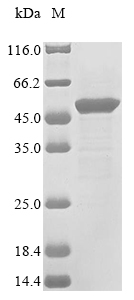
ADAGRDFSDIESKFALRTPEDTAEDTCHLIPGLADSVSNCHFNHSSKTFVVIHGWTVTGMYESWVPKLVAALYKREPDSNVIVVDWLYRAQQHYPVSAGYTKLVGNDVARFINWMEEEFNYPLDNVHLLGYSLGAHAAGVAGSLTNKKVNRITGLDPAGPNFEYAEAPSRLSPDDADFVDVLHTFTRGSPGRSIGIQKPVGHVDIYPNGGTFQPGCNIGEAIRVIAERGLGDVDQLVKCSHERSIHLFIDSLLNEENPSKAYRCNSKEAFEKGLCLSCRKNRCNNLGYEINKVRAKRSSKMYLKTRSQMPYKVFHYQVKIHFSGTEDGKQHNQAFEISLYGTVAESENIPFTLPEVSTNKTYSFLIYTEVDIGELLMMKLKWISDSYFSWPDWWSSPSFVIERIRVKAGETQKKVIFCAREKVSHLQKGKDSAVFVKCHDKSLKKSG
Note: The complete
sequence may include tag sequence, target protein sequence, linker sequence and extra sequence that is
translated with the protein sequence for the purpose(s) of secretion, stability, solubility, etc.
If the exact amino acid sequence of this recombinant protein is critical to your application,
please explicitly request the full and complete sequence of this protein before ordering.
Mol. Weight
50.3 kDa
Protein Length
Full Length of Mature Protein
Tag Info
Tag-Free
The tag type will be determined during production process. If you have specified tag type, please tell us and we will develop the specified tag preferentially.
Buffer
Tris-based buffer,50% glycerol
Storage
The shelf life is related to many factors, storage state, buffer ingredients, storage temperature and the stability of the protein itself.
Generally, the shelf life of liquid form is 6 months at -20°C/-80°C. The shelf life of lyophilized form is 12 months at -20°C/-80°C.
Shelf Life
The shelf life is related to many factors, storage state, buffer ingredients, storage temperature and the stability of the protein itself.
Generally, the shelf life of liquid form is 6 months at -20°C/-80°C. The shelf life of lyophilized form is 12 months at -20°C/-80°C.
Lead Time
3-7 business days
Note: All of our proteins are default shipped with normal blue ice packs, if you request to ship with dry ice, please communicate with us in advance and extra fees will be charged.
Notes
Repeated freezing and thawing is not recommended. Store working aliquots at 4°C for up to one week.
Key enzyme in triglyceride metabolism. Catalyzes the hydrolysis of triglycerides from circulating chylomicrons and very low density lipoproteins (VLDL), and thereby plays an important role in lipid clearance from the blood stream, lipid utilization and storage. Although it has both phospholipase and triglyceride lipase activities it is primarily a triglyceride lipase with low but detectable phospholipase activity. Mediates margination of triglyceride-rich lipoprotein particles in capillaries. Recruited to its site of action on vascular endothelium by binding to GPIHBP1 and cell surface heparan sulfate proteoglycans.
Gene References into Functions
LPL-mediated release of essential fatty acid DHA regulates hematopoietic stem progenitor cell expansion and definitive hematopoiesisPMID:29615667
the negatively charged IDR of GPIHBP1 traverses a vast space, facilitating capture of LPL by capillary endothelial cells and simultaneously contributing to GPIHBP1's ability to preserve LPL structure and activity.PMID:29899144
LPL in the hypothalamus is an important regulator of body weight and glucose homeostasisPMID:28456865
These results identify LPL as an important regulator of fatty acid transport to skeletal compartments and demonstrate an intricate functional link between systemic and skeletal fatty acid and glucose metabolism.PMID:28608812
mutation of a conserved cysteine in GPIHBP1 abolishes the ability of GPIHBP1 to bind LPLPMID:28476858
The data suggests that ANGPTL3 is part of the machinery causing dyslipidemia majorily via LPL inhibition in mastitis mice.PMID:29104012
Using in vitro ketosis model by glucose starvation, studied inhibition of ketosis by momilactone B. Found momilactone B could regulate the angiopoietin-like-3 (ANGPTL3)-lipoprotein lipase (LPL)pathway, and suppressed the expression of HMGCS2 through the increased expression of STAT5b.PMID:27874312
physiological changes in adipose tissue ANGPTL4 expression during fasting and cold resulted in inverse changes in the amount of mature-glycosylated LPL in wild-type mice, but not Angptl4(-/-) mice. We conclude that ANGPTL4 promotes loss of intracellular LPL by stimulating LPL degradation after LPL processing in the endoplasmic reticulum (ER).PMID:27034464
LPL moved quickly from heparan sulfate proteoglycans (HSPGs) on adipocytes to GPIHBP1-coated beads, thereby depleting LPL stores on the surface of adipocytes. We conclude that HSPG-bound LPL in the interstitial spaces of tissues is mobile, allowing the LPL to move to GPIHBP1 on endothelial cellsPMID:27811232
our study reveals that hepatic LPL is involved in the regulation of plasma LPL activity and lipid homeostasis.PMID:27234787
The induction of LPL activity by fasting in core transgenic mice activated PPARalpha downstream target genes that are involved in fatty acid beta-oxidation.PMID:27665576
This study shows that TNF-alpha, by a Foxo1 dependent pathway, increases the transcription of ANGPTL4 which is secreted by the cells and causes inactivation of LPL.PMID:28215713
Our findings suggest that neuronal LPL is involved in the regulation of body weight and composition in response to either the change in quantity (HF feeding) or quality (n-3 PUFA-enriched) of dietary fatPMID:27282869
An LPL structural model suggests that the LPL S447X truncation exposes residues implicated in LPL binding to lipoprotein binding uptake receptors, such as GPIHBP1.PMID:27984852
feeding induces lipasin, activating the lipasin-Angptl3 pathway, which inhibits LPL in cardiac and skeletal muscles to direct circulating TAG to WAT for storagePMID:26687026
MiR-590 agomir down-regulates LPL mRNA and protein expression in a mouse model of atherosclerosis.PMID:26397958
Deficiency of Lipoprotein Lipase in Neurons Decreases AMPA Receptor Phosphorylation and Leads to Neurobehavioral Abnormalities in MicePMID:26263173
Systemic LPL deletion results in impaired glucose tolerance, whole-body and tissue-specific insulin resistance, which is associated with tissue lipid deposition in various insulin target tissuesPMID:25635326
Results indicated that aggregation of alpha-syn and reduction of UCHL1 expression in LPL-deficient mice may affect synaptic function.PMID:25595992
the amount of LPL expressed in muscle and heart governed both the binding of chylomicron particles and the assimilation of chylomicron lipids in the tissue.PMID:25589507
Maternal overnutrition induces LPL expression in trophoblasts by reducing the inhibitory effect of SIRT1 on PPARgamma.PMID:25948680
Lipoprotein lipase is an important modulator of lipid uptake and storage in hypothalamic neurons.PMID:26265042
Results suggest that impaired synaptic vesicle recycling results from deficient docosahexaenoic acid and arachidonic acid and contributes to the presynaptic dysfunction and plasticity impairment in LPL-deficient neuronsPMID:25194787
Adipocyte-specific Sel1L-deficient (AKO) mice are resistant to diet-induced obesity. Sel1L stabilizes and prevents LPL dimers from aggregation in the endoplasmic reticulum.PMID:25066055
This study showed that phloridzin improved plasma lipoprotein lipase activity via a decrease of ANGPTL4 mRNA expression and an increase of AMP-activated protein kinase phosphorylation.PMID:24932810
TRL margination depends on LPL bound to GPIHBP1.PMID:24726386
LpL hydrolysis of circulating lipoproteins is required for the accumulation of lipids in the heart of fasting mice.PMID:24493834
The expression levels of miR-27a and miR-29a inversely correlate with the mRNA levels of lipoprotein lipase and its key transcriptional regulator peroxisome proliferator-activated receptor gamma during 3T3-L1 adipocyte differentiation.PMID:24457907
Leu452His mutation in lipoprotein lipase gene transfer associated with hypertriglyceridemia in mice in vivo.PMID:24086538
PPARgamma1 was intimately involved in LPL gene expression in skeletal muscle and the AMPK-PPARgamma1 pathway may play a role in exercise-induced LPL expression.PMID:24644240
Activated cyclin-dependent kinase 5 promotes microglial phagocytosis of fibrillar beta-amyloid by up-regulating lipoprotein lipase expression.PMID:23816988
inactivation of LPL by Angptl4 appears to occur after both proteins have traveled along the secretory pathway and arrived at the cell surface.PMID:24220340
The present study showed that miR-467b protects apoE(-/-) mice from atherosclerosis by reducing lipid accumulation and inflammatory cytokine secretion via downregulation of LPL expression.PMID:24309104
Lipoprotein lipase activity decreases in adipose tissue during fasting.PMID:23176178
Macrophage LpL plays an important role in the development of atherosclerosis but not adiposity.PMID:23378601
LpL has a role as the "gatekeeper" for tissue lipid distribution and its deficiency more profoundly affects brown than white fat biologyPMID:23542081
Neither a high fat diet nor fasting/re-feeding markedly altered the distribution pattern of LPL or GPIHBP1 in mouse pancreas.PMID:23186339
Findings indicate that miR-467b may regulate lipid accumulation and proinflammatory cytokine secretion in oxLDL-stimulated macrophages by targeting the LPL gene.PMID:22963823
ABCG1 controls LPL activity and promotes lipid accumulation in human macrophages in the presence of triglyceride-rich lipoproteins.PMID:22772754
variation in Lmf1 expression is a posttranslational determinant of LPL activity.PMID:22345169
lipoprotein retention in Bruch's membrane is mediated by lipoprotein lipasePMID:21801873
Hematopoietic cell-derived LPL could efficiently ameliorate severe hypertriglyceridemia and hypo-alpha-cholesterolemia at the compensation of increased triglyceride content of liverPMID:21980507
These results suggest that downregulation of miR-467b is involved in the development of hepatic steatosis by modulating the expression of its target, LPL.PMID:21986524
Uptake of dietary retinoids at the maternal-fetal barrier: in vivo evidence for the role of lipoprotein lipase and alternative pathways.PMID:21795711
LPL gene expression appears to be under dietary control: supplementation with cyanidin-3-O-beta-glucoside appears to up-regulate LPL in plasma and skeletal muscle but down-regulate LPL in visceral adipose tissue in the KK-Ay mouse model of diabetesPMID:21360538
the cleavage of ANGPTL4 by these PCs modulates its inhibitory effect on LPL activity.PMID:21398697
LPL is a novel Abeta-binding protein promoting cellular uptake and subsequent degradation of Abeta.PMID:21177248
Data show that apoC-II and LPL mRNAs correlate temporally and geographically with surfactant lipid synthesis in preparation for birth and suggest that fatty acid recruitment from the circulation by apoC-II-activated LPL is modulated by apoC-II secretion.PMID:21059267
PPAR-alpha response is generated by unbound fatty acids released locally by lipase activity and not by circulating plasma fatty acids.PMID:20421589
Results show that cotransfection of LPL with wild-type Lmf1 restores its ability to support normal lipase maturation.PMID:19471043
Detected in white and brown adipose tissue and heart muscle, especially at the lumenal surface of capillaries. Detected on capillary endothelium in the lactating mammary gland. Detected in blood plasma (at protein level). Expressed in liver, epididymal fa