Recombinant Mouse L-dopachrome tautomerase (Dct), partial

In Stock
Code: CSB-EP006562MO1b3
Size:
20μg
20μg100μg1mg(1mg*1 or 500ug*2)
US$388
Quantity:
Express system: E.coli
Species: Mus musculus (Mouse)
Tag Info: N-terminal 10xHis-SUMO-tagged and C-terminal Myc-tagged
For inquiries on large quantities or another requirements
Send an Inquiry
Start an on-line Chat
Online ordering is currently available for U.S. customers only. For orders outside the U.S., please kindly submit an inquiry or start a chat with us.

Product Details

Purity
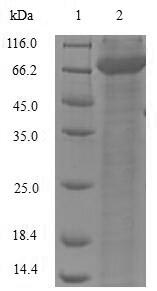
Greater than 90% as determined by SDS-PAGE.
Target Names
Dct
Uniprot NO.
Research Area
others
Alternative Names
DOPAchrome conversion factor1 Publication DOPAchrome isomerase1 Publication DOPAchrome oxidoreductase1 Publication L-dopachrome Delta-isomerase SLATY locus protein Tyrosinase-related protein 2
Species
Mus musculus (Mouse)
Source
E.coli
Expression Region
24-472aa
Target Protein Sequence
QFPRVCMTLDGVLNKECCPPLGPEATNICGFLEGRGQCAEVQTDTRPWSGPYILRNQDDREQWPRKFFNRTCKCTGNFAGYNCGGCKFGWTGPDCNRKKPAILRRNIHSLTAQEREQFLGALDLAKKSIHPDYVITTQHWLGLLGPNGTQPQIANCSVYDFFVWLHYYSVRDTLLGPGRPYKAIDFSHQGPAFVTWHRYHLLWLERELQRLTGNESFALPYWNFATGKNECDVCTDELLGAARQDDPTLISRNSRFSTWEIVCDSLDDYNRRVTLCNGTYEGLLRRNKVGRNNEKLPTLKNVQDCLSLQKFDSPPFFQNSTFSFRNALEGFDKADGTLDSQVMNLHNLAHSFLNGTNALPHSAANDPVFVVLHSFTDAIFDEWLKRNNPSTDAWPQELAPIGHNRMYNMVPFFPPVTNEELFLTAEQLGYNYAVDLSEEEAPVWSTTLS
Note: The complete sequence may include tag sequence, target protein sequence, linker sequence and extra sequence that is translated with the protein sequence for the purpose(s) of secretion, stability, solubility, etc.
If the exact amino acid sequence of this recombinant protein is critical to your application, please explicitly request the full and complete sequence of this protein before ordering.
Mol. Weight
71.2kDa
Protein Length
Partial
Tag Info
N-terminal 10xHis-SUMO-tagged and C-terminal Myc-tagged
The tag type will be determined during production process. If you have specified tag type, please tell us and we will develop the specified tag preferentially.
Reconstitution
We recommend that this vial be briefly centrifuged prior to opening to bring the contents to the bottom. Please reconstitute protein in deionized sterile water to a concentration of 0.1-1.0 mg/mL.We recommend to add 5-50% of glycerol (final concentration) and aliquot for long-term storage at -20°C/-80°C. Our default final concentration of glycerol is 50%. Customers could use it as reference.
Storage
The shelf life is related to many factors, storage state, buffer ingredients, storage temperature and the stability of the protein itself. Generally, the shelf life of liquid form is 6 months at -20°C/-80°C. The shelf life of lyophilized form is 12 months at -20°C/-80°C.
Shelf Life
The shelf life is related to many factors, storage state, buffer ingredients, storage temperature and the stability of the protein itself.
Generally, the shelf life of liquid form is 6 months at -20°C/-80°C. The shelf life of lyophilized form is 12 months at -20°C/-80°C.
Lead Time
3-7 business days
Note: All of our proteins are default shipped with normal blue ice packs, if you request to ship with dry ice, please communicate with us in advance and extra fees will be charged.
Notes
Repeated freezing and thawing is not recommended. Store working aliquots at 4°C for up to one week.
Troubleshooting and FAQs
Datasheet & COA
Please contact us to get it.
Images
  • (Tris-Glycine gel) Discontinuous SDS-PAGE (reduced) with 5% enrichment gel and 15% separation gel.


Customer Reviews and Q&A

 Customer Reviews

Target Background

Function(From Uniprot)
Catalyzes the conversion of L-dopachrome into 5,6-dihydroxyindole-2-carboxylic acid (DHICA).
Gene References into Functions
  1. soyasaponin Ag inhibited TRP2 expression in a dosedependent manner. Therefore, the depigmenting effect of soyasaponin Ag may be due to the inhibition of tyrosinase expression or the enhancement of tyrosinase degradation. PMID:28713957
  2. the slaty mutant melanocytes seem to be more sensitive to ultraviolet rays and oxidative stress than black melanocytes. PMID:26451690
  3. A novel murine model of vitiligo is established by sequential prime/boost immunizations into the hind footpad and tail dermis with tyrosinase-related protein 2 (TRP2)-180 (SVYDFFVWL) peptide. PMID:23711243
  4. study indicates that tumor antigen (TRP2) expressed in MCMV induces a strong and long-lasting anti-melanoma effect through an antibody-dependent mechanism PMID:23811402
  5. Vaccine formulations with synthetic long peptides for treating B16F10 skin melanoma fails to elicit strong CD8 T cell responses to self-differentiation antigens TRP-2 and gp100. PMID:23203930
  6. level of gene targeting was not improved by the DSB induction, indicating a limited capacity of I-SceI to mediate homologous recombination at the Dct locus PMID:22761925
  7. Recombinant dopachrome tautomerase was expressed and purified, without its carboxy-terminal transmembrane region. Analysis of dopachrome tautomerase tryptic peptides by MALDI-TOF/TOF determined N-glycosylation as a primary post-translational modification. PMID:20386969
  8. Dopachrome tautomerase inactivation elevates the level of ROS, increases the numbers of sunburn cells and apoptotic cells, and decreases the amount of eumelanin in the epidermis upon exposure to chronic UVA radiation PMID:20123016
  9. the TRP-2 polypeptide folds in the endoplasmic reticulum (ER) in the presence of calnexin, until it reaches a dithiothreitol-resistant conformation enabling its ER exit to the Golgi PMID:12719423
  10. Results describe the generation of a knockout of the dopachrome tautomerase gene in mice with effects restricted to pigment production and coat color. PMID:15060160
  11. We found that ionophore monensin (Mon) and the quaternary amine chloroquine (CQ) discriminate between the traffic routes of TRP-2 and TRP-1 PMID:15707965
  12. The enzymatic activity of Dct may play a role in determining whether the eumelanin or pheomelanin pathway is preferred for pigment biosynthesis. PMID:15960609
  13. These results suggest that the slaty mutation affects both eumelanin and pheomelanin synthesis in developmental stage-specific and skin site-specific manners. PMID:16584806
  14. Slaty mutation blocks the melanosome maturation at stage III and affects the melanosome morphology (elliptical or spherical) in a developmental stage-specific manner. PMID:17516460
  15. Eumelanin and pheomelanin may accumulate with difficulty in slaty-mutated melanocytes and be easily released from them during skin development. L-Tyr may stimulate this release. PMID:17551240
  16. These results suggest that the slaty mutation inhibits the development of elliptical stage IV melanosomes and that L-Tyr restores the development of elliptical stage IV melanosomes PMID:17867832
  17. Cytotoxicity toward targets loaded with a K(b)-restricted tyrosinase-related protein 2-derived peptide correlated with depigmentation in a mouse model of autoimmune vitiligo. PMID:18337834
  18. mice lacking DCT displayed normal cardiac development but an increased susceptibility to atrial arrhythmias PMID:19855129

Show More

Hide All

Subcellular Location
Melanosome membrane; Single-pass type I membrane protein. Melanosome.
Protein Families
Tyrosinase family
Tissue Specificity
Melanocytes and retinal pigmented epithelium (at protein level).
Database Links
icon of phone
Call us
301-363-4651 (Available 9 a.m. to 5 p.m. CST from Monday to Friday)
icon of address
Address
No. 269, Shendun 5th Road, Donghu Hi-Tech Development Area, Hubei Province, 430206, P.R.China
icon of social media
Join us with

Subscribe newsletter

Leave a message

* To protect against spam, please pass the CAPTCHA test below.
CAPTCHA verification
© 2007-2025 CUSABIO TECHNOLOGY LLC All rights reserved. 鄂ICP备15011166号-1
Select 0 Products