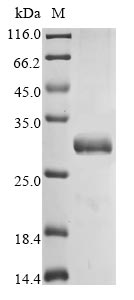
If the delivery form is liquid, the default storage buffer is Tris/PBS-based buffer, 5%-50% glycerol.
If the delivery form is lyophilized powder, the buffer before lyophilization is Tris/PBS-based buffer, 6% Trehalose.
Reconstitution
We recommend that this vial be briefly centrifuged prior to opening to bring the contents to the bottom. Please reconstitute protein in deionized sterile water to a concentration of 0.1-1.0 mg/mL.We recommend to add 5-50% of glycerol (final concentration) and aliquot for long-term storage at -20°C/-80°C. Our default final concentration of glycerol is 50%. Customers could use it as reference.
Storage
The shelf life is related to many factors, storage state, buffer ingredients, storage temperature and the stability of the protein itself.
Generally, the shelf life of liquid form is 6 months at -20°C/-80°C. The shelf life of lyophilized form is 12 months at -20°C/-80°C.
Shelf Life
The shelf life is related to many factors, storage state, buffer ingredients, storage temperature and the stability of the protein itself.
Generally, the shelf life of liquid form is 6 months at -20°C/-80°C. The shelf life of lyophilized form is 12 months at -20°C/-80°C.
Lead Time
3-7 business days
Notes
Repeated freezing and thawing is not recommended. Store working aliquots at 4°C for up to one week.
Receptor for erythropoietin. Mediates erythropoietin-induced erythroblast proliferation and differentiation. Upon EPO stimulation, EPOR dimerizes triggering the JAK2/STAT5 signaling cascade. In some cell types, can also activate STAT1 and STAT3. May also activate the LYN tyrosine kinase.
Gene References into Functions
these results have revealed that phosphorylation of Tyr-343, Tyr-460, and Tyr-464 in EpoR underlies JAK2 V617F mutant-induced tumorigenesis.PMID:27998978
A solution NMR study of the mouse erythropoietin receptor (mEpoR) comprising the transmembrane domain and the juxtamembrane regions reconstituted in dodecylphosphocholine (DPC) micelles.PMID:26316120
loss of function results in defective macrophage clearance of apoptotic cells in vivoPMID:26872696
These data indicate that EpoR signaling is associated with cardiac remodeling following chronic iron deficiency.PMID:25715089
We propose that the CID-dependent dimerization system combined with the EpoR intracellular domain and the Gata1 gene regulatory region generates a novel peroral strategy for the treatment of anemia.PMID:25790231
transmembrane domain and the juxtamembrane region of the erythropoietin receptor in micellesPMID:25418301
EpoR and its activity are downstream effectors of Klotho enabling it to function as a cytoprotective protein against oxidative injury.PMID:23636173
Expression of EPOR in rod photoreceptors, Muller cells, and amacrine, horizontal, and ganglion cells of the peripheral retina is not required for the maturation, function, and survival of these cells in aging tissue.PMID:24644405
Data from knockout mice suggest that adipose tissue-specific disruption of EPO receptor does not alter adipose tissue expansion, adipocyte morphology, insulin resistance, inflammation, or angiogenesis.PMID:23885016
the EPO-EPOR system may play a role in glucose metabolism within adipocytes.PMID:23313788
EPOR regulates transcriptome for primary progenitors, including Tnfr-sf13c as a novel mediator of EPO-dependent erythroblast formation.PMID:22808010
expression of EPOR decreased with the development of renal cortexPMID:22844537
enhanced activation of signaling pathways downstream of the EPO-receptor, indicate that SH2B1 is a negative regulator of EPO signaling.PMID:22669948
EPO/EPOR signaling from astrocyte to oligodendrocyte progenitor cells (OPC) prevents OPC damage under hypoxic/reoxygenation conditions.PMID:21833990
Postmortem neural precursor cells differentiate mostly in self-renewable neurons, show activation, and express both erythropoietin (EPO) and its receptor (EPO-R).PMID:21324364
expressed in both non-wounded and wounded skin tissue as well as in fibroblasts and keratinocytesPMID:21894148
Gata4 or Sp1 may limit the accessibility of the EpoR for binding of erythropoiesis-stimulating agents.PMID:21029371
Mice with transgenic expression of a constitutively active erythropoietin receptor isoform in pyramidal neurons of cortex and hippocampus exhibit enhancement of spatial learning, cognitive flexibility, social memory, and attentional capacities.PMID:21527022
The Epo/EpoR complex plays a critical role in the adhesion and migration of rat fibroblasts, and its functional inactivation is associated with PLC-gammal-dependent reduction of cell-matrix adhesion and this also affects cell migration.PMID:21360263
These data provide evidence of a role for nitric oxide in erythropoietin activity in brain and suggest links between NO production, EpoR expression, and Epo signaling in neuroprotection.PMID:20806411
The phosphorylation of EpoR at Y479 is required for oncogenic signaling of JAK2 V617F mutant and that targeted disruption of this pathway has therapeutic utility.PMID:21255641
ubiquitination of the EpoR critically controls both receptor down-regulation and downstream signaling.PMID:21183685
Darbepoetin stimulates multiple cardioprotective mechanisms in infarcted myocardium to improve cardiac function independent of erythropoietin receptor-common beta-chain heteroreceptor.PMID:20649603
regional specific up-regulation of EPOR at an early stage after MPTP stimulus may represent a pro-survival mechanism against neurotoxin injury in Parkinsonian modelPMID:19537929
rapid ligand depletion & replenishment of cell surface receptor are characteristic of EpoR; Epo-EpoR complexes & EpoR activation integrated over time correspond linearly to ligand input; relation depends on EpoR turnoverPMID:20488988
the presence of EpoR is required to activate oncogenic signaling via the JAK2 mutant and STAT5, its interacting ability is a target for the treatment of these hematopoietic diseases.PMID:20028972
N-terminal domain of Janus kinase 2 is required for Golgi processing and cell surface expression of erythropoietin receptorPMID:11779507
Epo receptor cytoplasmic domain conformation is essential for the initiation of signal transductionPMID:11997394
developmental defect of PrlR(-/-) mammary epithelium is rescued by an exogenously expressed chimeric receptor (prl-EpoR) containing the PrlR extracellular domain joined to the EpoR transmembrane and intracellular domainsPMID:12381781
demonstration of an essential role for Src pathway in regulating growth, proliferation, and cooperation with Epo-Receptor downstream from KitPMID:12486028
C-hexosylation of the WSAWS motif did not play a role in the correct intracellular transport of sEPORPMID:12859190
the function of JAK2-coupled but phosphotyrosine-null Epo form appears to be attenuated in several contexts and to be assisted in vivo by compensatory mechanisms.PMID:12869513
the Epo receptor Tyr-343 Stat5 pathway has a role in proliferative co-signaling with kitPMID:12909618
EpoR can be activated to different extents by homodimeric gp55 proteins, depending on the conformation of the gp55 protein dimer in the TM regionPMID:12930840
erythropoietin receptor transmembrane segments self-interaction depends on a membrane-spanning leucine zipperPMID:14602718
Data suggest that the activity of the erythropoietin receptor is determined by the helical periodicity or orientation of the transmembrane and cytosolic domains.PMID:14636581
results elucidate a previously unrecognized hematopoietic cell survival pathway elicited by the EPOR, that requires Stat5 and is serum independent.PMID:14662339
a functional EPO-R may be necessary and sufficient for TPO to exert its mitogenic effects on erythroid cells.PMID:15102474
Knockout mice exhibit normal erythrocyte maturation, so receptor is not resquired for erythropoiesisPMID:15456912
the TM-JM junction of EpoR forms an N-terminal helix cap required for functionPMID:15657048
Friend virus activates both sf-STK and the EPOR to cause deregulated erythroid proliferation and differentiation.PMID:16174761
In knockout mice, epoietein induced reticulocyte and erythroblast maturation were attenuated.PMID:16332976
analysis of gene expression induced by erythropoietin receptor structural variantsPMID:16380376
model of the active and inactive conformations of the Epo receptorPMID:16414957
The classical EPOR is essential for EPO action during embryonic neurogenes & is important for adult neurogenesis and for migration of regenerating neurons during post-injury recovery.PMID:16436614
Stress erythropoiesis during anemia is rescued to wild type levels upon the selective restoration of an EpoR-phosphotyrosine-Stat5-binding site signaling axis.PMID:16511603
The vascular EpoR system plays an important role in angiogenesis in response to hindlimb ischemia through upregulation of the vascular endothelial growth factor/VEGF receptor system.PMID:17293480
In mice expressing an EpoR allele, compromised erythropoietin-induced podocalyxin expression correlated with enucleated red cells in bone marrow.PMID:17403918
Hypoxic downregulation of sEpoR is required for adequate ventilatory acclimatization to hypoxia.PMID:17584830
Show
More
Hide
All
Subcellular Location
[Isoform EPOR-F]: Cell membrane; Single-pass type I membrane protein.; [Isoform EPOR-S]: Secreted.
Protein Families
Type I cytokine receptor family, Type 1 subfamily
Tissue Specificity
Expressed in relatively mature erythroid progenitor cells and in EPO-responsive erythroleukemia cells.