Recombinant Mouse Caspase-12 (Casp12), partial

Code: CSB-EP004545MO
Size:
20ug
20ug100ug1mg(1mg*1 or 500ug*2)
US$388
Quantity:
Express system: E.coli
Species: Mus musculus (Mouse)
Tag Info: N-terminal 6xHis-B2M-tagged
For inquiries on large quantities or another requirements
Send an Inquiry
Start an on-line Chat
Online ordering is currently available for U.S. customers only. For orders outside the U.S., please kindly submit an inquiry or start a chat with us.

Product Details

Purity
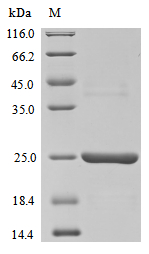
Greater than 90% as determined by SDS-PAGE.
Target Names
Casp12
Uniprot NO.
Research Area
Cancer
Species
Mus musculus (Mouse)
Source
E.coli
Expression Region
1-92aa
Target Protein Sequence
MAARRTHERDPIYKIKGLAKDMLDGVFDDLVEKNVLNGDELLKIGESASFILNKAENLVENFLEKTDMAGKIFAGHIANSQEQLSLQFSNDE
Note: The complete sequence may include tag sequence, target protein sequence, linker sequence and extra sequence that is translated with the protein sequence for the purpose(s) of secretion, stability, solubility, etc.
If the exact amino acid sequence of this recombinant protein is critical to your application, please explicitly request the full and complete sequence of this protein before ordering.
Mol. Weight
24.3 kDa
Protein Length
Partial
Tag Info
N-terminal 6xHis-B2M-tagged
The tag type will be determined during production process. If you have specified tag type, please tell us and we will develop the specified tag preferentially.
Form
Liquid or Lyophilized powder
Note: We will preferentially ship the format that we have in stock, however, if you have any special requirement for the format, please remark your requirement when placing the order, we will prepare according to your demand.
Buffer
If the delivery form is liquid, the default storage buffer is Tris/PBS-based buffer, 5%-50% glycerol. If the delivery form is lyophilized powder, the buffer before lyophilization is Tris/PBS-based buffer, 6% Trehalose.
Reconstitution
We recommend that this vial be briefly centrifuged prior to opening to bring the contents to the bottom. Please reconstitute protein in deionized sterile water to a concentration of 0.1-1.0 mg/mL.We recommend to add 5-50% of glycerol (final concentration) and aliquot for long-term storage at -20°C/-80°C. Our default final concentration of glycerol is 50%. Customers could use it as reference.
Storage
The shelf life is related to many factors, storage state, buffer ingredients, storage temperature and the stability of the protein itself. Generally, the shelf life of liquid form is 6 months at -20°C/-80°C. The shelf life of lyophilized form is 12 months at -20°C/-80°C.
Shelf Life
The shelf life is related to many factors, storage state, buffer ingredients, storage temperature and the stability of the protein itself.
Generally, the shelf life of liquid form is 6 months at -20°C/-80°C. The shelf life of lyophilized form is 12 months at -20°C/-80°C.
Lead Time
Delivery time may differ from different purchasing way or location, please kindly consult your local distributors for specific delivery time.
Note: All of our proteins are default shipped with normal blue ice packs, if you request to ship with dry ice, please communicate with us in advance and extra fees will be charged.
Notes
Repeated freezing and thawing is not recommended. Store working aliquots at 4°C for up to one week.
Troubleshooting and FAQs
Datasheet & COA
Please contact us to get it.
Images
  • (Tris-Glycine gel) Discontinuous SDS-PAGE (reduced) with 5% enrichment gel and 15% separation gel.

Customer Reviews and Q&A

 Customer Reviews

Target Background

Function(From Uniprot)
Involved in the activation cascade of caspases responsible for apoptosis execution.
Gene References into Functions
  1. mice ablated for caspase-12 develop spontaneous obesity and insulin resistance. PMID:26582949
  2. Caspase-12 plays a pivotal role in CCl4-induced hepatic apoptosis through the activation of the downstream effector caspase-3 directly and/or indirectly via caspase-9 activation. PMID:25561786
  3. We validated caspase-12 as a therapeutic target, ablation of which significantly protects T17M photoreceptors from deterioration. PMID:26207309
  4. Findings an increase in multiple unfolded protein response pathways in muscles of the dystrophin-deficient mdx mouse, the model for Duchenne muscular dystrophy. PMID:24879640
  5. Tauroursodeoxycholic acid intervention down-regulated GRP78 and CHOP expression and Caspase 12 activation. PMID:22212133
  6. Findings indicate that although caspase-12 deficiency results in enhanced pro-inflammatory and immunoregulatory cytokine levels in sera during P. yoelii 17XL infection, these responses are not essential for protection against lethal malaria infection. PMID:21086719
  7. caspase-12 competed with NEMO for association with IkappaB kinase-alpha/beta, effectively preventing the formation of the IkappaB kinase complex and inhibiting downstream transcriptional activation by NF-kappaB. PMID:20876354
  8. Caspase-12 was required for an effective antiviral immune response, especially for the production of type I interferons through the regulation of TRIM25-mediated ubiquitination of RIG-I. . PMID:20818395
  9. Matrix metalloproteinase-3 is increased and participates in neuronal apoptotic signaling downstream of caspase-12 during endoplasmic reticulum stress PMID:20368330
  10. Reactive oxygen species promote caspase-12 expression and tubular apoptosis in diabetic nephropathy. PMID:20299359
  11. enhanced repair response of Casp12(-/-) mice rendered them more susceptible to colorectal cancer induced by azoxymethane (AOM)+ dextran sulfate sodium. PMID:20226691
  12. role of caspase-12-dependent pathway in apoptosis induction by manganese(II) PMID:11964391
  13. caspase-12 was activated by poly(Q)(72) aggregates via a pathway independent of caspase-8 and caspase-3 activation, and caspase-12 activation was closely associated with poly(Q) aggregate-mediated cell death PMID:12045204
  14. procaspase-9 is a substrate of caspase-12 and ER stress triggers a specific cascade involving caspase-12, -9, and -3 in a cytochrome c-independent manner. PMID:12097332
  15. Caspase-12 seems to be involved in neuronal death induced by ischemia/reperfusion. PMID:12699784
  16. Pathways involving this enzyme are involved in a neurodegenerative disease in vivo, and thus offer novel potential targets for the treatment of prion disorders. PMID:14532116
  17. caspase-12 expression in caspase-12 is regulated by NF-E2 and participates in the development of fully functional signaling pathways linking some G-protein-coupled receptors to alphaIIbbeta3 activation. PMID:15059849
  18. both caspases and calpains are involved in 661W photoreceptor apoptosis PMID:15210718
  19. The results indicate that oxidative and ER induced stress causing caspase-12 activation are involved in neuronal death and disease progression in ALS. PMID:15313203
  20. cloning of promoter PMID:15701691
  21. caspase-12 and caspase-4 are not required for the induction of ER stress-induced apoptosis and that caspase-4-like activity is not always associated with an initiating event. PMID:15975932
  22. Ribozyme 138 prepared in vitro can site specific cleave mouse caspase-12 mRNA with an excellent efficiency. PMID:15996037
  23. Data show that overexpression of X-linked Inhibitor of Apoptosis Protein (XIAP)inhibits caspase-12 cleavage and reduces calpain activity in amyotrophic lateral sclerosis mice. PMID:16566922
  24. provides compelling genetic evidence for calpain's role in caspase-12 activation at the endoplasmic reticulum (ER), and reveals a novel role for the ubiquitous calpains in ER-stress induced apoptosis and JNK activation PMID:16597616
  25. In mice, caspase-12 deficiency confers resistance to sepsis and its presence exerts a dominant-negative suppressive effect on caspase-1, resulting in enhanced vulnerability to bacterial infection and septic mortality PMID:16625199
  26. apoptosis-inducing factor plays the major role in this apoptotic event, whereas caspase-12 has a reinforcing effect PMID:17088543
  27. Data show that caspase-12 can compensate for lack of caspase-2 and caspase-3 in female germ cells. PMID:17245644
  28. In hippocampal neuroblasts, Ca(++) mobilization from ER and caspase-12 activation are components of the molecular pathway that leads to apoptosis triggered by serum deprivation and may constitute an amplifying loop of the mitochondrial pathway. PMID:17399692
  29. Nod activation and resulting antimicrobial peptide production constitute an early innate defense mechanism, and caspase-12 inhibits this mucosal antimicrobial response. PMID:18329614
  30. caspase-12 is not necessary for mediating the neurotoxic effects of prion protein misfolding. PMID:19164919

Show More

Hide All

Protein Families
Peptidase C14A family
Tissue Specificity
Mainly expressed in skeletal muscle and lung.
Database Links
icon of phone
Call us
301-363-4651 (Available 9 a.m. to 5 p.m. CST from Monday to Friday)
icon of address
Address
No. 269, Shendun 5th Road, Donghu Hi-Tech Development Area, Hubei Province, 430206, P.R.China
icon of social media
Join us with

Subscribe newsletter

Leave a message

* To protect against spam, please pass the CAPTCHA test below.
CAPTCHA verification
© 2007-2025 CUSABIO TECHNOLOGY LLC All rights reserved. 鄂ICP备15011166号-1
Select 0 Products