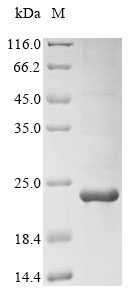
The shelf life is related to many factors, storage state, buffer ingredients, storage temperature and the stability of the protein itself.
Generally, the shelf life of liquid form is 6 months at -20°C/-80°C. The shelf life of lyophilized form is 12 months at -20°C/-80°C.
Shelf Life
The shelf life is related to many factors, storage state, buffer ingredients, storage temperature and the stability of the protein itself.
Generally, the shelf life of liquid form is 6 months at -20°C/-80°C. The shelf life of lyophilized form is 12 months at -20°C/-80°C.
Lead Time
3-7 business days
Notes
Repeated freezing and thawing is not recommended. Store working aliquots at 4°C for up to one week.
Receptor for the C-X-C chemokine CXCL9, CXCL10 and CXCL11 and mediates the proliferation, survival and angiogenic activity of mesangial cells through a heterotrimeric G-protein signaling pathway. Probably promotes cell chemotaxis response. Binds to CCL21.
Gene References into Functions
The data illustrate the paradoxical pro-tumor role for CXCR3 in lung immunobiology wherein the CXCR3 axis drives both the anti-tumor effector cell chemoattraction and pro-tumor infiltration of the lungs and suggests a potential therapeutic target for lung-tropic metastasizing cancers.PMID:28358049
the data suggest that CXCR3 and the integrin alpha4 mediate T cell recruitment to uninfected salivary glands but that redundant mechanisms mediate T cell recruitment after Murine Cytomegalovirus infection.PMID:29288198
The data of this study suggested that spinal CXCR3 mediates chronic itch and alloknesis, and targeting CXCR3 may provide effective treatment for chronic pruritus.PMID:28401489
Study provided the evidence that CXCL10/CXCR3 signaling in periaqueductal gray is involved in the development of morphine analgesic tolerance via neuron-microglia interaction.PMID:28755808
The results demonstrate that the recruitment of peripheral immune cells into the CNS, induction of neuroinflammation, and consecutive weight loss during herpes encephalitis is modulated by CXCR3 signaling.PMID:28116674
results show an important role for CXCR3 and CXCL10 in the tissue distribution of preimmune memory phenotype CD8 T- cellsPMID:29187588
Our data suggests that the altered gene profiles induced by CXCR3 deficiency promotes autoimmune cholangitis through pathogenic CD8(+) T cells.PMID:28129932
Data suggest that the CXCL9-CXCR3 axis plays a pivotal role in the liver-specific distribution of TRAIL+ NK cells in mice.PMID:29088306
study thus shows that lung mucosal-resident memory T cells are not generated following systemic TB immunization and that local inflammation is required for systemically activated T cells to home to lung mucosa, which is mediated by interaction between CXCR3 upregulated in these cells and its ligands IP-10 and MIGPMID:28827285
Antigen targeting to DEC-205 on dendritic cells leads to an IL-10-dependent downregulation of CXCR3 expression on differentiated antigen-specific Th1 cells in vivo. This downregulation interferes with the migration of Th1 cells into the gut and protects mice against severe acute and relapsing intestinal inflammation.PMID:26732675
this study shows that neutrophils and NK cells act as important disease-promoting immune cells in experimental osteoarthritis and their functional interaction is promoted by the CXCL10/CXCR3 axisPMID:28108560
These results demonstrate a critical role for both BLT1 and CXCR3 in cytotoxic T lymphocyte (CTL) migration to tumors and thus may be targeted to enhance efficacy of CTL-based immunotherapies.PMID:27465528
Our studies suggest that CXCR3 is a key contributor to the pathogenesis of Alopecia areata by mediating the infiltration of autoreactive CD8+NKG2D+ T cells into the skinPMID:27412416
Cxcr3 is up-regulated by DNA demethylation and interaction with C/EBPalpha which contributes to neuropathic pain.PMID:28100749
These findings demonstrate that the CXCL10/CXCR3 chemokine pathway is critical in shaping CD8(+) T cell immunity, locally within latently infected tissues, which protects against recurrent herpesvirus infection and disease.PMID:28468883
this study shows that although T cell-specific expression of CXCR3 promotes the accumulation of CXCR3-expressing T cells during Leishmania donovani infection, this does not enhance resistance to visceral leishmaniasis; hepatic granuloma formation is impaired in CXCR3 transgenic micePMID:27614845
up-regulated in sepsis-induced acute lung injuryPMID:27565063
beta4GalT1 can regulate N-glycans of CXCR3 in RA. N-glycans of CXCR3 affects CXCL10/CXCR3 ligand-binding which enhancing fibroblast-like synoviocytes invasion.PMID:28215986
this study shows that diosgenin-mediated anti-allergic effects are associated with increased number of Foxp3+ Treg cells expressing CXCR3PMID:27886644
Circulating levels of chemokines that activate CXCR3 are elevated in non-obese diabetic (NOD) mice, consistent with clinical findings in human diabetes.PMID:27325565
CXCR3 interacts with IL-10 secreted by CD8+CD122+ regulatory T cells in a mouse model of Acute Lung Injury and promotes interferon-gamma and CXCL10 release.PMID:26475448
This study demonstrates a previously unrecognized role of CXCR3 signaling in glial cells in negatively regulating Th17 cell expansion during experimental autoimmune encephalomyelitisPMID:27068264
CXCR3 was also linked to steatosis through inducing hepatic lipogenic genesPMID:26394162
findings demonstrate that targeting CXCR3 is effective in both tumor and host compartments, and suggest that CXCR3 inhibition is likely to avoid adverse effects on host cellsPMID:26485767
Activation of the CXCL10/CXCR3 pathway has an important role in retinal inflammation and neuronal injury after high intraocular pressure-induced ischemia.PMID:26448323
STAT3 in CD8+ T Cells Inhibits Their Tumor Accumulation by Downregulating CXCR3/CXCL10 AxisPMID:26025380
CXCR3-mediated trafficking of regulatory T cells could represent a mechanism of homeostatic immunoregulation during diabetogeneesis.PMID:25946021
These studies identify CXCR3-mediated trafficking at the tumour vascular interface as a critical checkpoint to effective T-cell-based cancer immunotherapy.PMID:26109379
activated T cells display a subtle distance-dependent chemotaxis toward clusters of infected cells and this is mediated by CXCR3 and its ligands.PMID:26525288
results suggest that CXCR3 plays an important role in recruiting proinflammatory cells to the colon during colitis and that CXCR3 may be a therapeutic target to reduce the influx of proinflammatory cells in the inflamed colon.PMID:24992040
MOG(1-125) immunization resulted in an increased incidence of severe experimental autoimmune encephalomyelitis and was accompanied by an increased percentage of CXCR3-expressing CD4+ T cells producing IFNgamma in the CNS.PMID:24552747
Data indicate that dipeptidylpeptidase 4 (DPP4) diminishes chemokine CXCL10 expression and limits CXC Chemokine Receptor 3 (CXCR3)-mediated antitumor immunity.PMID:26075911
Maternal CD8+ T cells with fetal specificity upregulated expression of the chemokine receptor CXCR3 and were essential for L. monocytogenes-induced fetal resorption in prenatal L. monocytogenes infection. CXCR3 knockout or blockade prevented this.PMID:25751061
The anti-fibrotic effects of CXCL10 in the healing infarct and in isolated cardiac fibroblasts are CXCR3-independent and may be mediated through proteoglycan signallingPMID:24891401
CXCR3-dependent recruitment of cells to inflamed areas was critical for development of the CD8-positive, CD103-negative T lymphocyte population and pathogen clearance.PMID:25706747
CXCR3 enables local CD8(+) T cell migration for the destruction of virus-infected keratinocytes.PMID:25769612
CXCR3 signaling mediates development of Alzheimer disease-like pathology in APP/PS1 mice.PMID:25500888
The CXCR3 chemokine system is critically involved in the intrinsic glial activation during cuprizone-induced demyelination, which significantly modulates the distribution of glial cells and the local cytokine milieu.PMID:24930935
plays a role in insulin resistance and obesity-induced visceral adipose inflammationPMID:24124129
this is the first report that demonstrates a role for CXCR3 in macrophage polarization and subsequent breast tumor outcomesPMID:24679047
In our mouse model, fatal progression of AIH is mediated by IL-18-dependent differentiation of T cells into Th1 cells and effector T cells, respectively, and that CXCR3-CXCL9 axis-dependent migration of those T cells is crucial for fatal progression.PMID:24700550
CXCR3 contributes to T-cell accumulation in periepididymal adipose of obese mice.PMID:24812325
CCR4 and CXCR3 play different roles in the migration of T cells to inflammation in skin, arthritic joints, and lymph nodes.PMID:24700244
CXCR3 is critical to the skin-selective effector T-cell recruitment underlying autoreactive GVHDPMID:24390137
Data indicate that NOD2 is required for CXCR3-dependent small intestinal (SI) CD8(+) T cell migration during T cell activation.PMID:24591373
results establish a central role for CXCR3 in coordinating innate and adaptive immunity, ensuring generation of Th1 effectors and their trafficking to the frontline of infection to program microbial killing by inflammatory monocytes.PMID:24130498
blockade or genetic deficiency of either CXCR3 or of its primary ligand has no impact on clinical experimental autoimmune encephalomyelitis induced by the adoptive transfer of highly polarized Th1 effector cells.PMID:23873018
The data show that CCL21 and CXCR3 have dichotomous functions in traumatic and autoimmune encephalomyelitis-evoked neuropathic pain suggestingPMID:23643685
Expression of the chemokine receptor CXCR3 was critical for memory CD8(+) T cells to populate the airways during the steady state. IL-12 signaling shortly after immunization limited CXCR3 expression on memory CD8(+) T cells.PMID:24238342
early differentiated CD138(high)MHCII(+) rather than terminally differentiated CD138(high)MHCII(low) plasma cells may be involved in the renal inflammatory injury in lupus, due to CXCR3 expression and IgG secretion.PMID:23520491