Recombinant Mouse Alpha-2-macroglobulin receptor-associated protein (Lrpap1), partial

In Stock
Code: CSB-BP013104MO1e4
Size:
20ug
20ug100ug1mg(1mg*1 or 500ug*2)
US$528
Quantity:
Express system: Baculovirus
Species: Mus musculus (Mouse)
Tag Info: N-terminal GFP-tagged and C-terminal 6xHis-tagged
For inquiries on large quantities or another requirements
Send an Inquiry
Start an on-line Chat
Online ordering is currently available for U.S. customers only. For orders outside the U.S., please kindly submit an inquiry or start a chat with us.

Product Details

Purity
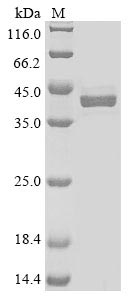
Greater than 85% as determined by SDS-PAGE.
Target Names
Lrpap1
Uniprot NO.
Research Area
Cardiovascular
Species
Mus musculus (Mouse)
Source
Baculovirus
Expression Region
248-360aa
Target Protein Sequence
GYGSTTEFEEPRVIDLWDLAQSANFTEKELESFREELKHFEAKIEKHNHYQKQLEISHQKLKHVESIGDPEHISRNKEKYVLLEEKTKELGYKVKKHLQDLSSRVSRARHNEL
Note: The complete sequence may include tag sequence, target protein sequence, linker sequence and extra sequence that is translated with the protein sequence for the purpose(s) of secretion, stability, solubility, etc.
If the exact amino acid sequence of this recombinant protein is critical to your application, please explicitly request the full and complete sequence of this protein before ordering.
Mol. Weight
42.3 kDa
Protein Length
Partial
Tag Info
N-terminal GFP-tagged and C-terminal 6xHis-tagged
The tag type will be determined during production process. If you have specified tag type, please tell us and we will develop the specified tag preferentially.
Form
Liquid or Lyophilized powder
Note: We will preferentially ship the format that we have in stock, however, if you have any special requirement for the format, please remark your requirement when placing the order, we will prepare according to your demand.
Buffer
If the delivery form is liquid, the default storage buffer is Tris/PBS-based buffer, 5%-50% glycerol. If the delivery form is lyophilized powder, the buffer before lyophilization is Tris/PBS-based buffer, 6% Trehalose.
Reconstitution
We recommend that this vial be briefly centrifuged prior to opening to bring the contents to the bottom. Please reconstitute protein in deionized sterile water to a concentration of 0.1-1.0 mg/mL.We recommend to add 5-50% of glycerol (final concentration) and aliquot for long-term storage at -20°C/-80°C. Our default final concentration of glycerol is 50%. Customers could use it as reference.
Storage
The shelf life is related to many factors, storage state, buffer ingredients, storage temperature and the stability of the protein itself. Generally, the shelf life of liquid form is 6 months at -20°C/-80°C. The shelf life of lyophilized form is 12 months at -20°C/-80°C.
Shelf Life
The shelf life is related to many factors, storage state, buffer ingredients, storage temperature and the stability of the protein itself.
Generally, the shelf life of liquid form is 6 months at -20°C/-80°C. The shelf life of lyophilized form is 12 months at -20°C/-80°C.
Lead Time
3-7 business days
Note: All of our proteins are default shipped with normal blue ice packs, if you request to ship with dry ice, please communicate with us in advance and extra fees will be charged.
Notes
Repeated freezing and thawing is not recommended. Store working aliquots at 4°C for up to one week.
Troubleshooting and FAQs
Datasheet & COA
Please contact us to get it.
Images
  • (Tris-Glycine gel) Discontinuous SDS-PAGE (reduced) with 5% enrichment gel and 15% separation gel.
Description

Recombinant Mouse Alpha-2-macroglobulin receptor-associated protein (Lrpap1) gets produced using a baculovirus expression system and spans amino acids 248 to 360. The partially expressed protein carries a GFP tag at the N-terminus plus a 6xHis tag at the C-terminus, which helps with both purification and detection. SDS-PAGE analysis confirms the protein reaches greater than 85% purity, making it appropriate for various research applications.

Alpha-2-macroglobulin receptor-associated protein, or Lrpap1, appears to play a critical role in regulating lipoprotein metabolism and endocytosis. It works as a molecular chaperone, helping with proper folding and trafficking of low-density lipoprotein receptor-related proteins. Researchers often turn to Lrpap1 when studying receptor-mediated cellular processes since it may provide insights into lipid metabolism and related disorders.

Potential Applications

Note: The applications listed below are based on what we know about this protein's biological functions, published research, and experience from experts in the field. However, we haven't fully tested all of these applications ourselves yet. We'd recommend running some preliminary tests first to make sure they work for your specific research goals.

Mouse Lrpap1 is a eukaryotic chaperone protein that requires precise folding, proper tertiary structure, and specific domain organization for its functional activity in low-density lipoprotein receptor-related protein (LRP) binding and trafficking. The baculovirus expression system provides a eukaryotic environment that supports proper folding and potential post-translational modifications. However, the partial fragment (248-360aa) represents only a portion of the full-length protein and may lack critical functional domains. The large N-terminal GFP tag (∼27 kDa) is significantly larger than the protein fragment itself (113 aa, ∼12 kDa) and will cause severe steric interference with the protein's functional domains and binding interfaces. The probability of correct folding with functional bioactivity is extremely low.

1. Antibody Development and Validation

This application has severe limitations. While antibodies can be generated, the immune response will primarily target the large foreign GFP tag rather than the small Lrpap1 fragment. Antibodies may not recognize the native, full-length Lrpap1 protein in its physiological context.

2. Structural and Biochemical Characterization Studies

Basic biophysical analysis can be performed, but will not reflect native Lrpap1 structure. The GFP tag will dominate all physical properties, and results will describe an artificial construct rather than the physiological protein. Studies cannot provide meaningful insights into native Lrpap1 biochemistry.

Final Recommendation & Action Plan

This GFP-tagged Lrpap1 fragment expressed in baculovirus is unsuitable for functional studies due to the severe steric interference from the massive GFP tag (27 kDa) relative to the small protein fragment (12 kDa). The GFP tag is more than twice the size of the Lrpap1 fragment itself, dominating all structural and functional properties. Applications 1 and 2 have severe limitations and will not provide insights into native Lrpap1 biology. For reliable Lrpap1 research, use full-length or larger domain constructs with minimal tags expressed in mammalian systems that support proper folding and preserve native functional interfaces.

Customer Reviews and Q&A

 Customer Reviews

Target Background

Function(From Uniprot)
Molecular chaperone for LDL receptor-related proteins that may regulate their ligand binding activity along the secretory pathway.
Gene References into Functions
  1. RAP deficiency attenuated atherosclerosis without influencing abdominal aortic aneurysms in hypercholesterolemic mice infused with angiotensin II. PMID:22153700
  2. Findings reveal that RAP is a novel Abeta-binding protein that promotes cellular internalization of Abeta. PMID:19826010
  3. In RAP-deficient mice megalin expression was strongly reduced and restricted to a subapical localization and NaP(i)-IIa protein distribution and abundance in the kidney was not altered. PMID:12748857
  4. the His-sRAP-induced acceleration of megalin-mediated endocytosis causes phosphaturia via altered subcellular distribution of NaPi-II [39-kD receptor-associated protein (RAP)] PMID:15976002
  5. Results suggest that receptor-associated protein is required for the establishment of thyroglobulin reservoirs, but its absence does not affect hormone secretion. PMID:16306127
  6. RAP is expressed by thyrocytes in a TSH-dependent manner, both in cultured thyroid cells and in vivo PMID:17123336
  7. Disruption of the RAP gene determines not only thyroid abnormalities, but also a severe defect of megalin expression and function in the kidney. PMID:18296906
  8. Receptor-associated protein (RAP) plays a central role in modulating Abeta deposition in APP/PS1 transgenic mice PMID:18776935

Show More

Hide All

Subcellular Location
Rough endoplasmic reticulum lumen. Endoplasmic reticulum-Golgi intermediate compartment lumen. Golgi apparatus, cis-Golgi network. Golgi apparatus lumen. Endosome lumen. Cell surface.
Protein Families
Alpha-2-MRAP family
Tissue Specificity
Highly expressed in PYS-2 parietal endoderm cells and in the kidney. The RNA level increased about 10-fold during differentiation of F9 embryonal carcinoma cells to parietal endoderm cells.
Database Links
icon of phone
Call us
301-363-4651 (Available 9 a.m. to 5 p.m. CST from Monday to Friday)

icon of address
Address
No. 269, Shendun 5th Road, Donghu Hi-Tech Development Area, Hubei Province, 430206, P.R.China
icon of social media
Join us with

Subscribe newsletter

Leave a message

* To protect against spam, please pass the CAPTCHA test below.
CAPTCHA verification
© 2007-2025 CUSABIO TECHNOLOGY LLC All rights reserved. 鄂ICP备15011166号-1
Select 0 Products