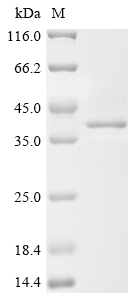
If the delivery form is liquid, the default storage buffer is Tris/PBS-based buffer, 5%-50% glycerol.If the delivery form is lyophilized powder, the buffer before lyophilization is Tris/PBS-based buffer, 6% Trehalose.
Reconstitution
We recommend that this vial be briefly centrifuged prior to opening to bring the contents to the bottom. Please reconstitute protein in deionized sterile water to a concentration of 0.1-1.0 mg/mL.We recommend to add 5-50% of glycerol (final concentration) and aliquot for long-term storage at -20°C/-80°C. Our default final concentration of glycerol is 50%. Customers could use it as reference.
Storage
The shelf life is related to many factors, storage state, buffer ingredients, storage temperature and the stability of the protein itself. Generally, the shelf life of liquid form is 6 months at -20°C/-80°C. The shelf life of lyophilized form is 12 months at -20°C/-80°C.
Shelf Life
The shelf life is related to many factors, storage state, buffer ingredients, storage temperature and the stability of the protein itself.
Generally, the shelf life of liquid form is 6 months at -20°C/-80°C. The shelf life of lyophilized form is 12 months at -20°C/-80°C.
Lead Time
25-35 business days
Notes
Repeated freezing and thawing is not recommended. Store working aliquots at 4°C for up to one week.
Single-stranded DNA-specific cytidine deaminase. Involved in somatic hypermutation (SHM), gene conversion, and class-switch recombination (CSR) in B-lymphocytes by deaminating C to U during transcription of Ig-variable (V) and Ig-switch (S) region DNA. Required for several crucial steps of B-cell terminal differentiation necessary for efficient antibody responses. May also play a role in the epigenetic regulation of gene expression by participating in DNA demethylation.
Gene References into Functions
AID has a role in transcription elongation for mutagenesis in B cellsPMID:29593215
MMSET promotes AICDA-mediated DNA breaks at the donor switch region during immunoglobulin class switch recombination.PMID:29158395
Results indicate activation-induced cytidine deaminase (AICDA) as a driver of epigenetic heterogeneity in B-cell lymphomas with potential significance for other tumors with aberrant expression of cytidine deaminases.PMID:29335468
findings suggest that activation of Tnf-Aicda axis and co-inhibitory signals to T cells in coordination with Th1-type immunity has critical roles in the immune response against Hepatitis B virus infectionPMID:28063995
the role of phosphorylation on AID serine38 in AID activity at the Immunoglobulin switch region and off-target Myc gene, is reported.PMID:29122947
Class switching correlates with replication origin activation in immunoglobulin genes;R loops contribute to the specification of origins of replication; Origin activation is independent of AID and DNA breaksPMID:27974207
The reduced expression of activation-induced cytidine deaminase (AID).PMID:28407558
this study shows that enforced expression of Sox2 in splenic B cells severely inhibits AID expression and IgH class switch recombinationPMID:28188246
Aid loss in mice leads to expansion of myeloid cells and reduced erythroid progenitors resulting in anemia, with dysregulated expression of Cebpa and Gata1, myeloid/erythroid lineage-specific transcription factorsPMID:28077417
UNG deficiency reduces B cell clonal expansion in the germinal center in mice and blocks the proliferation of tumor B cells expressing AID.PMID:27697833
Efficient chemoprotection of CDD and MDR1 transduced hematopoietic 32D as well as primary lin(-) cells was proven in the context of Ara-C and anthracycline applicationPMID:26651614
this study indicate that inflammation-induced AID expression promotes skin cancer development independently of UV damage and suggest AID as a potential target for skin cancer therapeutics.PMID:26974156
Molecular mechanism of Aid interaction with RNA-binding proteins, dimer formation and it's role in DNA-cleavage and recombinationPMID:26929374
DNA methylation dynamics of germinal center B cells are mediated by AID.PMID:26365193
Demonstrate the importance of AID in generating an appropriate B1a cell response to pathogenic bacteria.PMID:26456931
AID-induced mutations are prone to generate double-strand breaksPMID:26263206
Unlike deletion of the AID C terminus, 3 of the substitution mutants reduce DNA double-strand breaks (DSBs) detected within the Sm region in splenic B cells undergoing class switch recombination .PMID:26267846
Study demonstrates that intronic switch RNA acts in trans to target AID to S region DNA. AID binds directly to switch RNA through G-quadruplexes formed by the RNA molecules.PMID:25957684
The effect of insertion of transcribed intronic S regions in a locus (Igkappa)strongly recruiting AICDA on class switch recombination is reported.PMID:26146363
Study finds AID targets somatic hypermutation (SHM) hotspots within V exon and S region passengers at similar frequencies and that the normal SHM process frequently generates deletions, indicating that SHM and class-switch recombination employ the same mechanism.PMID:26582132
Splice variants of activation induced deaminase (AID) do not affect the efficiency of class switch recombination in murine CH12F3 cellsPMID:25803053
genetic deficiency in spontaneously autoimmune B6.Nba2 mice impairs production of anti-nuclear antibodies, a hallmark of systemic lupus erythematosusPMID:25634361
AID deficiency inhibits DSA-mediated aortic vasculopathy after aorta transplantation in mice.PMID:25769064
HSP90 inhibitors indirectly target AID in vivoPMID:25912253
class switch recombination is programmed to occur in a productive deletional orientation and does so via an unprecedented mechanism that involves in cis Igh organizational features in combination with frequent S-region DSBs initiated by AIDPMID:26308889
Observed an activity-dependent induction of BDNF exon IV mRNA expression, which correlated with reduced DNA methylation within the BDNF P4 promoter. Knockdown of AID disrupted these effects and inhibited BDNF exon IV mRNA expression.PMID:25041363
These data suggest that Aid does not have crucial functions in DNA demethylation during induced pluripotent stem cell generation.PMID:24718089
B cell Rab7 mediates induction of activation-induced cytidine deaminase expression and class-switching in T-dependent and T-independent antibody responses.PMID:25740947
results elucidate the molecular basis of AID cytoplasmic retention, define its functional relevance and distinguish it from other mechanisms regulating AID.PMID:25824822
miR-155 controls the outcome of the the germinal center reaction by modulating its initiation (Aicda) and termination (Socs1/p53 response).PMID:25645925
AID target genes are enriched in chromatin modifications associated with active enhancers (such as H3K27Ac) and marks of active transcription (such as H3K36me3) in both fibroblasts and B cellsPMID:25512519
Chronic lung injury by constitutive expression of activation-induced cytidine deaminase leads to focal mucous cell metaplasia and cancer.PMID:25659078
our results suggest a stringent and sophisticated control of Aicda by a novel IL-10/miR-155PMID:25381386
Study reports that the majority of detectable AID off-target activity in a variety of mouse and human lymphoid or nonlymphoid cell types occurs within focal regions of overlapping sense/antisense transcription within intragenic super enhancers.PMID:25483776
AID activity and its relationship to chromosome folding and the B cell regulome was studied; find that AID-mediated lesions occur predominantly within B cell super-enhancers and regulatory clusters; further show that the structural and transcriptional features of these domains help explain AID tumorigenic activity in the B cell compartment of mice and humans.PMID:25483777
AICDA does not appear to be required for tumor development in the two virus-induced tumor mouse models.PMID:24569264
IkappaB-zeta regulates TLR-mediated CSR by inducing AIDPMID:25124037
RNA exosome regulation of ncRNA recruits AID to single-strand DNA-forming sites of antisense and divergent transcription in the B-cell genome, thereby creating a link between ncRNA transcription and overall maintenance of B-cell genomic integrityPMID:25119026
Results indicate a role for apurinic/apyrimidinic endonuclease (APE) 2 (Apex2) in the protection of germinal center (GC) cells from activation-induced cytidine deaminase (AID)-independent damage.PMID:24935922
To have dominant negative (DN) function, AID lacking the C terminus (DeltaAID) must have deaminase activity, suggesting that its ability to induce double-strand breaks is important for the DN function.PMID:24973444
Activation-induced deaminase-coupled DNA demethylation is not crucial for the generation of induced pluripotent stem cells.PMID:24083501
GANP regulates the choice of DNA repair pathway by DNA-PKcs interaction in AID-dependent IgV region diversification.PMID:24808370
findings suggest that S regions are preferred targets for AID and, aided by polypyrimidine tract binding protein-2, act as "sinks" to sequester AID activity from other genomic regions.PMID:24879790
A domain of AID is required to link the DNA damage step with the subsequent repair during CSR as well as for chromosomal translocations, a collateral effect of class switch recombination.PMID:24591601
Hypoxia within spheres together with loss of Zeb1 repression synergize to cause superinduction of Hif1a, which in turn leads to induction of the DNA demethylase Aid/Aicda, demethylation of the Oct4 promoter/enhancer and multipotency.PMID:23554223
Murine Aicda(-/-) GC B cells accumulate as centrocytes and inefficiently generate plasma cells.PMID:24244021
Fate mapping and AID reporter mice were used to determine if AID expression in the mouse extends beyond lymphocytes.PMID:23861962
GANP-mediated chromatin modification promotes transcription complex recruitment and positioning at immunoglobulin variable loci to favour AID targeting.PMID:23652018
Precise regulation of the Aicda promoter appears to depend on a coordinated balance of activities between enhancer and silencer elements.PMID:23613851
studies identified a late step of reprogramming associated with methylation status, and implicated a secondary set of pluripotency network components; AID regulates this late step, removing epigenetic memory to stabilize the pluripotent statePMID:23803762
Show
More
Hide
All
Subcellular Location
Nucleus. Cytoplasm.
Protein Families
Cytidine and deoxycytidylate deaminase family
Tissue Specificity
Expressed in germinal center B-cells (at protein level).