Recombinant Macaca fascicularis albumin (ALB)

CSB-YP001561MOV
Size:
20ug
20ug100ug1mg(1mg*1 or 500ug*2)
US$436
Quantity:
Express system: Yeast
Species: Macaca fascicularis (Crab-eating macaque) (Cynomolgus monkey)
Tag Info: N-terminal 6xHis-tagged
For inquiries on large quantities or another requirements
Send an Inquiry
Start an on-line Chat
Orders can only be placed from within the U.S.

Product Details

Purity
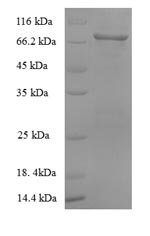
Greater than 90% as determined by SDS-PAGE.
Target Names
ALB
Uniprot NO.
Research Area
Cardiovascular
Species
Macaca fascicularis (Crab-eating macaque) (Cynomolgus monkey)
Source
Yeast
Expression Region
25-608aa
Target Protein Sequence
DTHKSEVAHRFKDLGEEHFKGLVLVAFSQYLQQCPFEEHVKLVNEVTEFAKTCVADESAENCDKSLHTLFGDKLCTVATLRETYGEMADCCAKQEPERNECFLQHKDDNPNLPPLVRPEVDVMCTAFHDNEATFLKKYLYEVARRHPYFYAPELLFFAARYKAAFAECCQAADKAACLLPKLDELRDEGKASSAKQRLKCASLQKFGDRAFKAWAVARLSQKFPKAEFAEVSKLVTDLTKVHTECCHGDLLECADDRADLAKYMCENQDSISSKLKECCDKPLLEKSHCLAEVENDEMPADLPSLAADYVESKDVCKNYAEAKDVFLGMFLYEYARRHPDYSVMLLLRLAKAYEATLEKCCAAADPHECYAKVFDEFQPLVEEPQNLVKQNCELFEQLGEYKFQNALLVRYTKKVPQVSTPTLVEVSRNLGKVGAKCCKLPEAKRMPCAEDYLSVVLNRLCVLHEKTPVSEKVTKCCTESLVNRRPCFSALELDEAYVPKAFNAETFTFHADMCTLSEKEKQVKKQTALVELVKHKPKATKEQLKGVMDNFAAFVEKCCKADDKEACFAEEGPKFVAASQAALA
Mol. Weight
68.0kDa
Protein Length
Full Length of Mature Protein
Tag Info
N-terminal 6xHis-tagged
Buffer
Tris-based buffer,50% glycerol
Storage
The shelf life is related to many factors, storage state, buffer ingredients, storage temperature and the stability of the protein itself. Generally, the shelf life of liquid form is 6 months at -20°C/-80°C. The shelf life of lyophilized form is 12 months at -20°C/-80°C.
Shelf Life
The shelf life is related to many factors, storage state, buffer ingredients, storage temperature and the stability of the protein itself.
Generally, the shelf life of liquid form is 6 months at -20°C/-80°C. The shelf life of lyophilized form is 12 months at -20°C/-80°C.
Lead Time
3-7 business days
Notes
Repeated freezing and thawing is not recommended. Store working aliquots at 4°C for up to one week.
Troubleshooting and FAQs
Datasheet & COA
Please contact us to get it.
Images
  • (Tris-Glycine gel) Discontinuous SDS-PAGE (reduced) with 5% enrichment gel and 15% separation gel.
Description

Customer Reviews and Q&A

 Customer Reviews
 Q&A
Q:

First, it must be expressed in Yeast and a His tag.
Second, they need endotoxin removal and a guarantee of less than 0.5 EU/mL.
Finally, we would like to know what purification and QC methods would be used to test and verify all parameters.

A:
Thanks for your inquiry
1. This is a protein we successfully developed before. The current protein is with N-terminal 6xHis-tagged and expressed in yeast system which can satisfy your requirement.
2. We could perform Endotoxin Removal free of charge and guarantee endotoxin level <1.0 EU/ug of the protein by the LAL method.
This endotoxin removal is semi-quantitative, we can guarantee that the endotoxin level is less than 1.0 EU/ug, but we cannot determine a specific value.
Endotoxin (LPS) is mainly present in Gram-negative bacteria, which is the main constituent of the outer membrane of the cell wall, so it is mainly targeted for E. coli recombinant expression system.
Theoretically, there should exist no endotoxin in other recombinant expression systems.
However, laboratory reagents (including deionized water) and instruments may be affected by some endotoxin. The endotoxin content produced by this reason should be not too high in itself,
and it may be able to meet the needs of the customer, but we cannot guarantee it.
3. This protein has a his tag. The separation and purification of our protein is performed by Ni column affinity chromatography. The size of the band is detected by SDS-PAGE.
1) During the production process, we will perform sequencing in the cloning stage to ensure that the sequence is 100% correct (we can also provide sequencing reports if necessary).
2) After protein expression, SDS-PAGE is used to detect the band size, which is in line with the theoretical value.
3) We have a comprehensive purity of 90% or more by SDS-PAGE Coomassie blue staining and Bandscan software analysis.
4) You can perform SDS-PAGE test, and if available, mass spectrometry.

Target Background

Function
Binds water, Ca(2+), Na(+), K(+), fatty acids, hormones, bilirubin and drugs. Its main function is the regulation of the colloidal osmotic pressure of blood. Major zinc transporter in plasma, typically binds about 80% of all plasma zinc. Major calcium and magnesium transporter in plasma, binds approximately 45% of circulating calcium and magnesium in plasma. Potentially has more than two calcium-binding sites and might additionally bind calcium in a non-specific manner. The shared binding site between zinc and calcium at residue Asp-273 suggests a crosstalk between zinc and calcium transport in the blood. The rank order of affinity is zinc > calcium > magnesium. Binds to the bacterial siderophore enterobactin and inhibits enterobactin-mediated iron uptake of E.coli from ferric transferrin, and may thereby limit the utilization of iron and growth of enteric bacteria such as E.coli. Does not prevent iron uptake by the bacterial siderophore aerobactin.
Subcellular Location
Secreted.
Protein Families
ALB/AFP/VDB family
Tissue Specificity
Plasma.
Database Links

UNIGENE: Mfa.4123

KEGG: mcf:102130757

icon of phone
Call us
301-363-4651 (Available 9 a.m. to 5 p.m. CST from Monday to Friday)

icon of address
Address
7505 Fannin St., Ste 610, Room 7 (CUBIO Innovation Center), Houston, TX 77054, USA
icon of social media
Join us with

Subscribe newsletter

Leave a message

* To protect against spam, please pass the CAPTCHA test below.
CAPTCHA verification
© 2007-2025 CUSABIO TECHNOLOGY LLC All rights reserved. 鄂ICP备15011166号-1
Select 0 Products