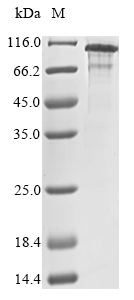
MALSRGLPRELAEAVAGGRVLVVGAGGIGCELLKNLVLTGFSHIDLIDLDTIDVSNLNRQFLFQKKHVGRSKAQVAKESVLQFYPKANIVAYHDSIMNPDYNVEFFRQFILVMNALDNRAARNHVNRMCLAADVPLIESGTAGYLGQVTTIKKGVTECYECHPKPTQRTFPGCTIRNTPSEPIHCIVWAKYLFNQLFGEEDADQEVSPDRADPEAAWEPTEAEARARASNEDGDIKRISTKEWAKSTGYDPVKLFTKLFKDDIRYLLTMDKLWRKRKPPVPLDWAEVQSQGEETNASDQQNEPQLGLKDQQVLDVKSYARLFSKSIETLRVHLAEKGDGAELIWDKDDPSAMDFVTSAANLRMHIFSMNMKSRFDIKSMAGNIIPAIATTNAVIAGLIVLEGLKILSGKIDQCRTIFLNKQPNPRKKLLVPCALDPPNPNCYVCASKPEVTVRLNVHKVTVLTLQDKIVKEKFAMVAPDVQIEDGKGTILISSEEGETEANNHKKLSEFGIRNGSRLQADDFLQDYTLLINILHSEDLGKDVEFEVVGDAPEKVGPKQAEDAAKSITNGSDDGAQPSTSTAQEQDDVLIVDSDEEDSSNNADVSEEERSRKRKLDEKENLSAKRSRIEQKEELDDVIALD
Note: The complete
sequence may include tag sequence, target protein sequence, linker sequence and extra sequence that is
translated with the protein sequence for the purpose(s) of secretion, stability, solubility, etc.
If the exact amino acid sequence of this recombinant protein is critical to your application,
please explicitly request the full and complete sequence of this protein before ordering.
Mol. Weight
84.2 kDa
Protein Length
Full Length
Tag Info
N-terminal 6xHis-SUMO-tagged
The tag type will be determined during production process. If you have specified tag type, please tell us and we will develop the specified tag preferentially.
Buffer
Tris-based buffer,50% glycerol
Storage Condition
The shelf life is related to many factors, storage state, buffer ingredients, storage temperature and the stability of the protein itself. Generally, the shelf life of liquid form is 6 months at -20°C/-80°C. The shelf life of lyophilized form is 12 months at -20°C/-80°C.
Shelf Life
The shelf life is related to many factors, storage state, buffer ingredients, storage temperature and the stability of the protein itself.
Generally, the shelf life of liquid form is 6 months at -20°C/-80°C. The shelf life of lyophilized form is 12 months at -20°C/-80°C.
Notes
Repeated freezing and thawing is not recommended. Store working aliquots at 4°C for up to one week.
The heterodimer acts as an E1 ligase for SUMO1, SUMO2, SUMO3, and probably SUMO4. It mediates ATP-dependent activation of SUMO proteins followed by formation of a thioester bond between a SUMO protein and a conserved active site cysteine residue on UBA2/SAE2.
Gene References into Functions
Calcium/calpain-induced cleavage of the SAE2 leads to sumoylation inhibition reslting in bacillary dysentery.PMID:29231810
We propose that disturbance of the SUMOylation pathway, mediated by pathogenic variants in UBA2, is a novel mechanism for aplasia cutis congenita and other phenotypic abnormalities.PMID:28110515
Here, we show that hHR23A utilizes both the UBA2 and XPCB domains to form a stable complex with Vpr, linking Vpr directly to cellular DNA repair pathways and their probable exploitation by the virus.PMID:24318982
This study has identified the mechanism used to localize SAE to the nucleus.PMID:23095757
Data indicate the role of anti-SUMO activating enzyme SAE1 and SAE2 antibody as marker of dermatomyositis.PMID:22884621
Data show that the SAE2 subunit of the small ubiquitin-like modifier (SUMO) E1 is autoSUMOylated at residue Lys-236, and SUMOylation was catalyzed by Ubc9 at several additional Lys residues surrounding the catalytic Cys-173 of SAE2.PMID:22403398
loss of SAE1/2 activity drives synthetic lethality with Myc; inactivation of SAE2 leads to mitotic catastrophe and cell death upon Myc hyperactivation; findings in Myc-high breast cancers suggest low tumor SAE1 and SAE2 correlates metastasis-free survivalPMID:22157079
The mammalian E1 subunits can be imported separately, identify nuclear localization signals (NLSs) in Aos1 and in Uba2, and demonstrate that their import is mediated by importin alpha/beta in vitro and in intact cells.PMID:21209321
structures of heterodimeric Sae1/Sae2-Mg.ATP and Sae1/Sae2-SUMO-1-Mg.ATP complexesPMID:15660128
UBA2 stabilizes APOBEC3G by preventing ubiquitin chain elongation and proteasome-mediated proteolysis.PMID:18680593
Show
More
Hide
All
Subcellular Location
Cytoplasm. Nucleus. Note=Shuttles between the cytoplasm and the nucleus, sumoylation is required either for nuclear translocation or nuclear retention.