Recombinant Human Ribonuclease 7 (RNASE7)

Code: CSB-MP872431HU
Size:
20ug
20ug100ug1mg(1mg*1 or 500ug*2)
US$660
Quantity:
Express system: Mammalian cell
Species: Homo sapiens (Human)
Tag Info: C-terminal hFc-tagged
For inquiries on large quantities or another requirements
Send an Inquiry
Start an on-line Chat
Online ordering is currently available for U.S. customers only. For orders outside the U.S., please kindly submit an inquiry or start a chat with us.

Product Details

Purity
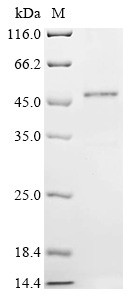
Greater than 85% as determined by SDS-PAGE.
Target Names
RNASE7
Uniprot NO.
Research Area
Epigenetics and Nuclear Signaling
Species
Homo sapiens (Human)
Source
Mammalian cell
Expression Region
29-156aa
Target Protein Sequence
KPKGMTSSQWFKIQHMQPSPQACNSAMKNINKHTKRCKDLNTFLHEPFSSVAATCQTPKIACKNGDKNCHQSHGAVSLTMCKLTSGKHPNCRYKEKRQNKSYVVACKPPQKKDSQQFHLVPVHLDRVL
Note: The complete sequence may include tag sequence, target protein sequence, linker sequence and extra sequence that is translated with the protein sequence for the purpose(s) of secretion, stability, solubility, etc.
If the exact amino acid sequence of this recombinant protein is critical to your application, please explicitly request the full and complete sequence of this protein before ordering.
Mol. Weight
43.4 kDa
Protein Length
Full Length
Tag Info
C-terminal hFc-tagged
The tag type will be determined during production process. If you have specified tag type, please tell us and we will develop the specified tag preferentially.
Form
Liquid or Lyophilized powder
Note: We will preferentially ship the format that we have in stock, however, if you have any special requirement for the format, please remark your requirement when placing the order, we will prepare according to your demand.
Buffer
If the delivery form is liquid, the default storage buffer is Tris/PBS-based buffer, 5%-50% glycerol. If the delivery form is lyophilized powder, the buffer before lyophilization is Tris/PBS-based buffer, 6% Trehalose.
Reconstitution
We recommend that this vial be briefly centrifuged prior to opening to bring the contents to the bottom. Please reconstitute protein in deionized sterile water to a concentration of 0.1-1.0 mg/mL.We recommend to add 5-50% of glycerol (final concentration) and aliquot for long-term storage at -20℃/-80℃. Our default final concentration of glycerol is 50%. Customers could use it as reference.
Storage Condition
The shelf life is related to many factors, storage state, buffer ingredients, storage temperature and the stability of the protein itself. Generally, the shelf life of liquid form is 6 months at -20°C/-80°C. The shelf life of lyophilized form is 12 months at -20°C/-80°C.
Shelf Life
The shelf life is related to many factors, storage state, buffer ingredients, storage temperature and the stability of the protein itself.
Generally, the shelf life of liquid form is 6 months at -20°C/-80°C. The shelf life of lyophilized form is 12 months at -20°C/-80°C.
Lead Time
Delivery time may differ from different purchasing way or location, please kindly consult your local distributors for specific delivery time.
Note: All of our proteins are default shipped with normal blue ice packs, if you request to ship with dry ice, please communicate with us in advance and extra fees will be charged.
Notes
Repeated freezing and thawing is not recommended. Store working aliquots at 4°C for up to one week.
Troubleshooting and FAQs
Datasheet & COA
Please contact us to get it.
Images
  • (Tris-Glycine gel) Discontinuous SDS-PAGE (reduced) with 5% enrichment gel and 15% separation gel.

Customer Reviews and Q&A

 Customer Reviews

Target Background

Function(From Uniprot)
Exhibits a potent RNase activity. Has broad-spectrum antimicrobial activity against many pathogenic microorganisms and remarkably potent activity (lethal dose of 90% < 30 nM) against a vancomycin resistant Enterococcus faecium. Causes loss of bacterial membrane integrity. Probably contributes to urinary tract sterility. Bactericidal activity is independent of RNase activity.
Gene References into Functions
  1. These data suggest that the induction of RNase 7 in response to Mycobacterium tuberculosis could have a role in anti-mycobacterial immunity. PMID:29346642
  2. RNase 7 has immunomodulatory functions on TH2 cells and decreases the production of TH2 cytokines in the skin. PMID:28378334
  3. Our results indicate that RNase 7 is an important factor released by keratinocytes to control the growth of P. aeruginosa on the skin surface. PMID:27513608
  4. Insulin and PI3K/AKT signaling are essential for RNase 7 expression and increased infection risks in diabetic patients may be secondary to suppressed RNase 7 production. PMID:27401534
  5. This article provides an overview about the role of RNase 7 in cutaneous defense with focus on the molecular mechanism of the antimicrobial activity of RNase 7, the regulation of RNase 7 expression, and the role of RNase 7 in skin diseases. [review] PMID:27089327
  6. RNH1 bound to RNase 7 and suppressed its antimicrobial activity by blocking its ability to bind the cell wall of uropathogenic bacteria. PMID:24107847
  7. RNase 7 is an antimicrobial protein that plays an important role in the innate immune defense system of human epithelia. PMID:12244054
  8. Suggest that RNase 7 may function as antimicrobial peptide with a role in the differentiation and development of the primitive epidermis. PMID:23545750
  9. the influence of STAT3 on the IL-17A/IFN-gamma -mediated RNase 7 induction PMID:23555696
  10. RNase 7 expression is increased in the urinary tract with infection and has antibacterial activity against uropathogens at micromolar concentrations. PMID:23302724
  11. a complex relationship between tear induction of miR-762, its modulation of innate defense genes, and P. aeruginosa internalization PMID:23469087
  12. RNASE7 prevents staphylococcal skin infections PMID:20668470
  13. proteases contribute indirectly to the defense function of the stratum corneum by releasing the RNase inhibitor mediated inhibition of RNase 5 and RNase 7. PMID:19262607
  14. Using phospholipid vesicles as membrane models, RNase 3 triggers first the vesicle aggregation, while RNase 7 induces leakage well before the aggregation step. PMID:19366593
  15. data indicate that RNase 7 contributes to the E. faecium-killing activity of skin extracts and suggest an important role for RNase 7 in the protection of human skin against E. faecium colonization PMID:19641608
  16. These findings suggest that antimicrobial peptides found at high baseline levels in healthy skin, such as RNase 7, confer protection against Staphylococcus aureus infection of the skin. PMID:19919305

Show More

Hide All

Subcellular Location
Secreted.
Protein Families
Pancreatic ribonuclease family
Tissue Specificity
Expressed in collecting ducts in kidney, and in apical uroepithelium in bladder (at protein level). Expressed in various epithelial tissues including skin, respiratory tract, genito-urinary tract and, at a low level, in the gut. Expressed in liver, kidney
Database Links

HGNC: 19278

UNIGENE: Hs.525206

KEGG: hsa:84659

STRING: 9606.ENSP00000298690

OMIM: 612484

icon of phone
Call us
301-363-4651 (Available 9 a.m. to 5 p.m. CST from Monday to Friday)
icon of address
Address
No. 269, Shendun 5th Road, Donghu Hi-Tech Development Area, Hubei Province, 430206, P.R.China
icon of social media
Join us with

Subscribe newsletter

Leave a message

* To protect against spam, please pass the CAPTCHA test below.
CAPTCHA verification
© 2007-2025 CUSABIO TECHNOLOGY LLC All rights reserved. 鄂ICP备15011166号-1
Select 0 Products