RLPADVSPINYSLCLKPDLLDFTFEGKLEAAAQVRQATNQIVMNCADIDIITASYAPEGDEEIHATGFNYQNEDEKVTLSFPSTLQTGTGTLKIDFVGELNDKMKGFYRSKYTTPSGEVRYAAVTQFEATDARRAFPCWDEPAIKATFDISLVVPKDRVALSNMNVIDRKPYPDDENLVEVKFARTPVMSTYLVAFVVGEYDFVETRSKDGVCVRVYTPVGKAEQGKFALEVAAKTLPFYKDYFNVPYPLPKIDLIAIADFAAGAMENWGLVTYRETALLIDPKNSCSSSRQWVALVVGHELAHQWFGNLVTMEWWTHLWLNEGFASWIEYLCVDHCFPEYDIWTQFVSADYTRAQELDALDNSHPIEVSVGHPSEVDEIFDAISYSKGASVIRMLHDYIGDKDFKKGMNMYLTKFQQKNAATEDLWESLENASGKPIAAVMNTWTKQMGFP
Note: The complete
sequence may include tag sequence, target protein sequence, linker sequence and extra sequence that is
translated with the protein sequence for the purpose(s) of secretion, stability, solubility, etc.
If the exact amino acid sequence of this recombinant protein is critical to your application,
please explicitly request the full and complete sequence of this protein before ordering.
Mol. Weight
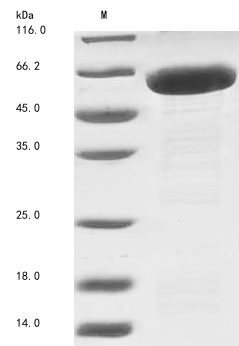
57.0 kDa
Protein Length
Partial
Tag Info
N-terminal 6xHis-tagged
The tag type will be determined during production process. If you have specified tag type, please tell us and we will develop the specified tag preferentially.
Buffer
Tris-based buffer,50% glycerol
Storage Condition
The shelf life is related to many factors, storage state, buffer ingredients, storage temperature and the stability of the protein itself.
Generally, the shelf life of liquid form is 6 months at -20°C/-80°C. The shelf life of lyophilized form is 12 months at -20°C/-80°C.
Shelf Life
The shelf life is related to many factors, storage state, buffer ingredients, storage temperature and the stability of the protein itself.
Generally, the shelf life of liquid form is 6 months at -20°C/-80°C. The shelf life of lyophilized form is 12 months at -20°C/-80°C.
Notes
Repeated freezing and thawing is not recommended. Store working aliquots at 4°C for up to one week.
Aminopeptidase with broad substrate specificity for several peptides. Involved in proteolytic events essential for cell growth and viability. May act as regulator of neuropeptide activity. Plays a role in the antigen-processing pathway for MHC class I molecules. Involved in the N-terminal trimming of cytotoxic T-cell epitope precursors. Digests the poly-Q peptides found in many cellular proteins. Digests tau from normal brain more efficiently than tau from Alzheimer disease brain.
Gene References into Functions
cytosolic peptidases(puromycin-sensitive aminopeptidase (PSA), aminopeptidase B (APB) and pyroglutamyl-peptidase I (PGI) ) may be involved in colorectal carcinogenesisPMID:26078706
Studies indicate the critical role of M1 aminopeptidases ERAP1, ERAP2 and NPEPPS in immune-mediated diseases.PMID:25142031
MiR-614 inhibited cell invasion and proliferationa targeting PSA in lung cancer cells, PGCL3PMID:25342037
Elevation of NPEPPS activity blocks accumulation of hyperphosphorylated TAU protein and slows down the progression of Alzheimer's disease.PMID:21320871
findings show that by promoting autophagic protein clearance, PSA helps protect against accumulation of aggregation-prone proteins and proteotoxicityPMID:20829225
attenuated proteolysis of FTDP-17 mutant tau may be explained by increased phosphorylation levels, resulting in resistance to proteolysis.PMID:20377816
ApPS Y394F exhibited a 3.3-fold lower affinity for RB-3014, a transition state inhibitor, indicating that Tyr394 is involved in transition state stabilizationPMID:14706550
PSA gene was downregulated in PC-3 cells that were treated with CoCl(2). PSA is involved in the proliferation, migration, and invasion of PC-3 cells, which are important determinants of metastasis, via a mechanism that involves MMP-9 modulation.PMID:19494703
Show
More
Hide
All
Subcellular Location
Cytoplasm, cytosol. Nucleus.
Protein Families
Peptidase M1 family
Tissue Specificity
Detected in liver, epithelium of renal tubules, epithelium of small and large intestine, gastric epithelial cells, and alveoli of the lung (at protein level).